Case Studies: Raising the Bar

By now, most test engineers have recognized both HALT, or Highly Accelerated Life Testing, and HASS, or Highly Accelerated Stress Screening, as the quickest, most effective new standards for design verification and testing (DVT) and production screenings. However, the impact of these new testing methods is now starting to reach into the boardroom to awaken C-level executives to the fact that HALT and HASS also translate into highly accelerated income.
Accelerated testing aids profitability across a wide range of industries. Every manufacturer whose product contains a microprocessor, circuit card or electromechanical assembly can benefit from accelerated test methods.
“You can use accelerated testing for testing components, subassemblies, or finished products, so we use it at all three levels,” says Brian Dahl, environmental test engineer at Agilent Technologies Inc. (Palo Alto, CA). Agilent is a test and measurement company that provides core electronic and bioanalytical measurement tools to advance the electronics, communications, life science research, environmental and petrochemical industries.
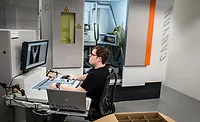
“HALT has become a culture here,” continues Dahl. “We started using it as soon as we selected system components like disk drives, power supplies and motherboards. We use the equipment from QualMark to test at every stage, from prototyping to production, to make sure the end product is robust and meets or exceeds our customer’s expectations. I chose the QualMark HALT chambers because the equipment really impressed me.”
QualMark Corp. (Denver) designs, markets and manufactures accelerated testing systems, and adds value to the sale of accelerated testing equipment by counseling manufacturers on how to successfully set up and run HALT and HASS. QualMark has installed more than 700 of its proprietary testing systems in 30 countries for many major corporations.
HALT and HASS techniques shortcut and avoid the problems of slower traditional testing methods that only test to minimum specifications. HALT and HASS quickly expose any weak links in a product by testing well beyond minimum specs so that any reliability problems can be fixed before they become expensive field issues.
“Accelerated testing always shortens product development cycles because it allows for earlier detection of reliability problems: weak components, timing relationships, things like that,” notes Brian Flanagan, hardware qualification manager for McData (Broomfield, CO), a company that has two decades’ experience providing storage networking products for the enterprise.
“We recently used the QualMark equipment to do hardware qualification testing for McData’s new 4Gb/s blade enhancement to the Intrepid 10,000 platform, a 256 port director that has 10Gb/s capabilities,” continues Flanagan. “Without HALT testing, this likely would have taken six to nine months. Using the QualMark chambers, it only took us eight weeks.”

Improving Reliability
Accelerated testing proves effective at screening-out failures that may have gone undetected during traditional burn-in testing processes; it does this by going beyond normal testing to verify the integrity of mechanical interconnects and component tolerance compatibility. A product that passes ensures manufacturing-process quality and workmanship integrity. This results in increased out-of-box quality and field reliability, which yields decreased field service and warranty costs.“When I started this job, power supplies were the highest failing items in our division, but thanks to accelerated testing it’s almost a nonissue now,” says Dahl. “In one particular case, HALT helped us go back to a vendor to show them where their product failed. The vendor redesigned the power supply, which subsequently passed the accelerated stress screenings. We awarded the business to that supplier. We have since fielded over a thousand of those power supplies. Guess how many have failed? Zero.”
In the case of mission critical applications, accelerated testing becomes essential because having extremely high product reliability represents the only way of doing business.
Reducing Warranty Claims
Accelerated testing even helps solve problems in products released before HALT and HASS techniques have been adopted by a manufacturer. In such instances, recall and repair expenses can be significantly reduced or even eliminated.Although conducting accelerated testing falls squarely within the domain of engineering, the benefits ultimately reach into the books of the CFO.
“Any time you can catch a potential reliability issue early on in a production qualification cycle, that’s got huge connotations in terms of cost savings, or cost avoidance if it prevents finding that same type of failure over time in the field,” observes McData’s Flanagan.
Bringing products to market faster while improving reliability provides those manufacturers who employ HALT, HASS and Highly Accelerated Stress Audit techniques with a competitive edge over those companies that favor slower testing procedures.
QualMark
(303) 876-0700
www.qualmark.com
Benefits
Looking for a reprint of this article?
From high-res PDFs to custom plaques, order your copy today!