Quality Magazine logo
search
cart
facebook twitter linkedin youtube
  • Sign In
  • Create Account
  • Sign Out
  • My Account
Quality Magazine logo
  • NEWS
  • PRODUCTS
    • FEATURED PRODUCTS
    • SUBMIT YOUR PRODUCT
  • CHANNELS
    • AUTOMATION
    • MANAGEMENT
    • MEASUREMENT
    • NDT
    • QUALITY 101
    • SOFTWARE
    • TEST & INSPECTION
    • VISION & SENSORS
  • MARKETS
    • AEROSPACE
    • AUTOMOTIVE
    • ENERGY
    • GREEN MANUFACTURING
    • MEDICAL
  • MEDIA
    • A WORD ON QUALITY PUZZLE
    • EBOOK
    • PODCASTS
    • VIDEOS
    • WEBINARS
  • EVENTS
    • EVENT CALENDAR
    • IMTS
  • DIRECTORIES
    • BUYERS GUIDE >
      • Supplier Insights
    • NDT SOURCEBOOK
    • VISION & SENSORS
    • TAKE A TOUR
  • INFOCENTERS
    • Digital Quality Management Systems
    • NEXT GENERATION SPC & QUALITY ANALYTICS
  • AWARDS
    • ROOKIE OF THE YEAR
    • PLANT OF THE YEAR
    • PROFESSIONAL OF THE YEAR
  • MORE
    • Expert Columns
    • NEWSLETTERS
    • QUALITY STORE
    • INDUSTRY LINKS
    • SPONSOR INSIGHTS
  • EMAG
    • eMAGAZINE
    • ARCHIVES
    • CONTACT
    • ADVERTISE
  • SIGN UP!

GR&R for Destructive Measurement Systems
By William D. Kappele, John Raffaldi
May 1, 2010


A gage performance curve will help communicate the results of the study. Source: JMP, a Div. of SAS

Gage repeatability and reproducibility (GR&R) studies provide information on measurement system performance by analyzing measurement error from various sources. A statistical evaluation of the variability in a measurement system is an important aspect of product quality because if not performed, it can lead to poor quality product being shipped to customers and reduce profitability by causing good parts to be rejected.

The sources of measurement variability are broken into three categories: part-to-part; repeatability or equipment; and reproducibility or appraiser.

Repeatability is the variability due to the gage itself, the closeness of the agreement between the results of successive measurements of the same characteristic carried out under the same conditions of measurement.

Reproducibility is the variability due to different operators using the gage differently, the closeness of the agreement between the results of measurements of the same characteristic carried out under changed conditions of measurement.

Repeatability and reproducibility together are called gage repeatability and reproducibility or simply GR&R.

Typical gage R&R studies rely on the assumption that a part can be measured without changing the characteristics of that part. If the part is changed by the measurement in a manner not allowing measurement of the same characteristic, the system is called a destructive measurement system.

Most software packages provide simplified analysis and data entry for GR&R studies. Source: JMP, a Div. of SAS

Assessing repeatability

In a typical GR&R study, repeatability is determined by repeating measurements on the same part several times. This is not possible with a destructive test. Extra precautions are required to perform a gage R&R study for a destructive measurement system. There also will be extra uncertainty in the study results.

With a destructive measurement system there are two choices for assessing repeatability:

Find a nondestructive test that correlates with the results of the destructive test and use it instead.

Collect parts that are so similar in the property to be measured that it can be assumed they have identical measurements.

The first choice here is the better one, if it is possible. Let’s look at an example.

Printed circuit boards are used in a wide variety of electronic devices. They have copper traces plated onto them to act as conductors. Holes drilled through the board for component installation often have a copper plate through the board to create an electrical contact from one side of the board to the other.

In a destructive test, the thickness of this plating in the hole can be measured by cutting a piece from the board, being careful to slice through the middle of a hole. The copper thickness can them be measured directly. Unfortunately, this leaves the board unusable.

Fortunately for printed circuit board manufacturers, a digital meter can be used to measure the copper thickness in the hole. A small probe is inserted into the hole and the copper thickness dimension is displayed. This measurement system is nondestructive-the board is not affected by the measurement and can still be sold to a customer.

While this is a better option than a destructive test, some extra precautions are necessary. First, compare the readings from the meter with the cross sections of circuit boards to make sure they agree. You may need to determine the best technique for using the meter to obtain agreement, and may even need to create a calibration curve to correlate the meter readings with actual measured thicknesses. It is extremely important to check and make sure the methods agree and not assume that they will correlate and result in the same measurement.

After is has been determined that the nondestructive test will be an acceptable substitute, a typical GR&R study can be performed using the nondestructive measurement system.

Searching for a substitute

Sometimes it is not possible to find a nondestructive substitute measurement system. In these cases find parts that are so uniform in the property to be measured so it can be assumed they are the same part. Let’s look at an example.

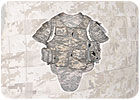
Suppose the penetration on bullet-proof vests needs to be measured. The only way to do this is to shoot at it and see if the bullet penetrates the vest. Whether or not it does, the vest is irreparably damaged. This is a destructive measurement system for which there is no nondestructive substitute.

Following typical GR&R guidelines, test 10 vests that are representative of the production capabilities and have three operators make the measurements. Now comes the nontraditional part of a GR&R study, each operator cannot measure each part twice because every measurement destroys the part.

In a typical study, each part (vest) would be measured six times, twice by each of three operators. Because the part can only be measured once, six identical vests for each “part” to be measured are needed. These vests will need to be made from the same roll of material, using material that is as close on the roll as possible to avoid within lot variation in the material.

Perhaps by looking at other testing data for the material, it can be verified that the variation in the material meets the requirements. Additionally, the vests will need to be sewn together as identically as possible, including stitch placement and spacing. This will require care above and beyond normal production procedures. The more careful the preparation, the more accurate the results will be.

A gage R&R study can now be performed on the vest measurement system in the normal way with this exception-each time a part is called for, use one of the six identical vests representing that part. Analyze the data in the usual way as if it were a nondestructive study.

Whether or not a suitable substitute measurement system is found, one will have greater uncertainty in the results. If using a nondestructive substitute, there will be some additional uncertainty in the correlation with the original method. A statistician can help account for this extra uncertainty.

If you must proceed with the original measurement system, you will not be able to separate the repeatability from the variation in the “identical” parts-the six vests, in this case. Not even a statistician can help here. Repeatability will always be overestimated. If sufficient care was used in preparing the “identical” parts, the overestimate will likely be low and not important.

GR&R studies help judge whether a measurement system is trustworthy, even with a destructive measurement system. Consequently, they help to increase profitability and product quality.

If you find yourself asking, “Do I really need a gage R&R study?” ask yourself, “Do I want high product quality and profitability?” The answer to both questions is the same. Q

Tech Tips

  • Gage repeatability and reproducibility studies provide information on measurement system performance by analyzing measurement error from various sources.

  • Typical gage R&R studies rely on the assumption that a part can be measured without changing the characteristics of that part.

  • If the part is changed by the measurement in a manner not allowing measurement of the same characteristic, the system is called a destructive measurement system.
  • Share This Story

    Looking for a reprint of this article?
    From high-res PDFs to custom plaques, order your copy today!

    William D. Kappele is president of MathOptions Inc. (Bellingham, WA).
    John Raffaldi is a test engineer at Micro Encoder Inc. (Kirkland, WA)

    Recommended Content

    JOIN TODAY
    to unlock your recommendations.

    Already have an account? Sign In

    • 2024 Quality Rookie of the Year Justin Wise 1440x750px banner with "Quality Rookie of the Year" logo inset

      Meet the 2024 Quality Rookie of the Year: Justin Wise

      Justin Wise is an exceptional individual who has been...
      Aerospace
      By: Michelle Bangert
    • Man with umbrella and coat stands outside while it rains at night looking at a building.

      Nondestructive Testing: Is there an ethics problem?

      I was a whistleblower who exposed fraudulent activities...
      NDT
      By: Dale Norwood
    • Unraveling Deflategate: Football stadium with closeup of football on field

      Unraveling the Tom Brady Deflategate

      The Deflategate scandal erupted following the 2014 AFC...
      Measurement
      By: Greg Cenker and Henry Zumbrun
    Manage My Account
    • eMagazine Subscriptions
    • Newsletters
    • Online Registration
    • Subscription Customer Service
    • Manage My Preferences

    More Videos

    Sponsored Content

    Sponsored Content is a special paid section where industry companies provide high quality, objective, non-commercial content around topics of interest to the Quality audience. All Sponsored Content is supplied by the advertising company and any opinions expressed in this article are those of the author and not necessarily reflect the views of Quality or its parent company, BNP Media. Interested in participating in our Sponsored Content section? Contact your local rep!

    close
    • Key Takeaways for Quality Leaders
      Sponsored byComplianceQuest

      Key Takeaways for Quality Leaders from the 2026 Gartner Magic Quadrant™ for QMS

    • This image shows a person seated next to a Bobcat T66 compact track loader.
      Sponsored byPolyWorks by InnovMetric

      Supercharging Digital Gauging at Bobcat North America

    • Dorsey Calibration Lab photo by Tom LaBarbera Picture this Studios
      Sponsored byDorsey Metrology International

      Ensuring Product Quality in a Competitive Manufacturing Landscape

    Popular Stories

    This image shows a person seated next to a Bobcat T66 compact track loader.

    Supercharging Digital Gauging at Bobcat North America

    Dorsey Calibration Lab photo by Tom LaBarbera Picture this Studios

    Ensuring Product Quality in a Competitive Manufacturing Landscape

    a professional in the aviation field performing maintenance, repair, and overhaul (MRO) work

    Manufacturing Retention: Strategies for Improving Company Culture, Engagement and Skill Development

    2026 Quality Professional of the Year!

    Events

    June 9, 2026

    Future-Proof your Quality Processes with Advanced 3D Optical CMM Technology

    Discover how to effortlessly capture complex data, leverage true multi-sensor automation, and ensure continuous operation without creating inspection delays.

    June 22, 2026

    Automate 2026

    Automate is North America's largest robotics and automation event — and the best place to take your ideas from insight to impact.
     
    Our show floor features the world’s leading automation solutions, from AI and robotics to motion control, vision systems, and more. Plus, our educational conference is second to none, led by the brightest minds in automation today.
     
    Ready to transform the way you work? Take the next step at Automate.
    View All Submit An Event

    Products

    Lean Manufacturing and Service Fundamentals, Applications, and Case Studies

    Lean Manufacturing and Service Fundamentals, Applications, and Case Studies

    See More Products
    Quality Podcast Channel Custom Content

    Related Articles

    • gage repeatability and reliability

      Gage Repeatability and Reliability: Ensuring Accurate Test Results for Measurement Systems

      See More
    • ASTM Offers Guide for Measurement Systems Analysis

      See More
    • API

      API, MLT Cooperate for 3D Measurement Systems in Finland, Norway

      See More

    Related Products

    See More Products
    • Mechanical and Non-Destructive Testing DVD

    • Measurement and Gaging DVD

    • Six Sigma for Sustainability

    See More Products

    Related Directories

    • Starrett-Bytewise Measurement Systems

      Starrett-Bytewise provides in line, continuous, dimensional profile measurement technology. Applications include tires, rubber extrusion, plastic extrusion, roll forming, pipe & tube, and wire & cable.
    ×

    Stay in the know with Quality’s comprehensive coverage of
    the manufacturing and metrology industries.

    Newsletters | Website | eMagazine

    JOIN TODAY!
    • RESOURCES
      • Advertise
      • Contact Us
      • Directories
      • Manufacturing Division
      • Store
      • Want More
    • SIGN UP TODAY
      • Create Account
      • eMagazine
      • Newsletters
      • Customer Service
      • Manage Preferences
    • SERVICES
      • Marketing Services
      • Market Research
      • Reprints
      • List Rental
      • Survey/Respondent Access
    • STAY CONNECTED
      • LinkedIn
      • Facebook
      • YouTube
      • X (Twitter)
    • PRIVACY
      • PRIVACY POLICY
      • TERMS & CONDITIONS
      • DO NOT SELL MY PERSONAL INFORMATION
      • PRIVACY REQUEST
      • ACCESSIBILITY

    Copyright ©2026. All Rights Reserved BNP Media, Inc. and BNP Media II, LLC.

    Design, CMS, Hosting & Web Development :: ePublishing