Brain Teasers: How Thin Can We Go?

Anyone who has faced a production problem with a need to solve it by using production data can relate to the notion of a brain teaser. The brain teasers presented here are based on real-world situations encountered by workers in manufacturing environments. The brain teasers have three parts: (1) the situation, (2) available data or other supporting information and (3) questions that various workers need answered for continual improvement. Recommended solutions follow in the next issue and on the Web at Quality Online (www.qualitymag.com).

Situation
Russell has recently assumed the job as manager of his company’s product engineering group. He works with the quality manager, Jake, to ensure that the specifications for all products can be achieved. One high-volume product is a blow-molded container that has multiple layers. The material for one of the layers is very costly and Russell’s boss has requested that the average thickness for this layer be reduced as much as possible. Specifications for the thickness of this layer are 0.2 millimeter ± 0.1 millimeter. Even a reduction of 0.02 millimeter on the average has the potential to reduce the materials costs for this product by as much as $10,000 per month (or $120,000 annually) at current production rates of 50,000 units each month. Russell asked Jake to provide recent thickness data for this layer to determine if the average thickness could be reduced without going out of specification on the low side.
Available data
Jake was unable to find data for the specific product, so he set up a data collection plan to measure the thickness of this critical layer on two containers (one from each cavity in the machine) every two hours. He decided not to collect more data at this point because the measurement is a destructive and time-consuming test. Two days of data are summarized in the table, “Layer Thickness Data.”Questions
1. What is the current behavior and capability of the thickness of the layer in question based on the data collected for November 5th and 6th?2. What is the potential for reducing the average thickness for this layer of the product?
3. If Russell recommends that production reduce the average thickness of this layer, what concerns must be addressed to ensure that the thickness meets the minimum specification?
Answers to January Brain Teaser
As the supplier quality manager, Carmen monitors critical characteristics of incoming components and materials. Her goal is to accept incoming materials based on data from the supplier, but first she wants to make certain that the measurement processes used by the supplier and her own company give data that agrees. Carmen and one supplier have agreed on a set of samples to use in the measurement study to evaluate the agreement.Q: Do both the supplier and Carmen’s company have predictable measurement techniques?
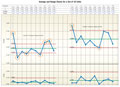
A: The data from both the supplier company and Carmen’s company consist of two measurements of each of 10 disks. Using the subgroups of size 2 for the data from Carmen’s company, the range chart shows a predictable amount of measurement variation. The data from the supplier company also shows a predictable amount of measurement variation. In both cases, the average chart shows points outside the control limits, which are based only on measurement process variation or repeatability. When the measurement process variation is small compared to the production process variation, many of the average values of the different units measured are expected to be outside these control limits. See the chart, “Average and Range Charts for a Set of 10 Units.”
Q: What is the standard deviation (repeatability) of each measurement process?
A: For Carmen’s company, the measurement process standard deviation is:
R = 0.03
- - = 0.0267
d2 1.128
while the standard deviation of the supplier’s measurement process is:
R = 0.058
- - = 0.0514
d2 1.128
Q: Do the two measurement processes give similar results on the thickness values?
A: No, they do not. Carmen’s company has a measurement process that has a standard deviation of 0.0267 while the supplier measurement process has a standard deviation of 0.0514, which is almost twice that of Carmen’s company. Also, the overall average value from Carmen’s company is 2.4840. The overall average value from the supplier is 2.6020 for the same 10 units. The difference in these averages is 0.118.
If the limits from the process behavior chart based on data from Carmen’s company were used with the data from the supplier company, every part average would be outside the upper control limit on the average chart and two of the ranges would be outside the upper control limit on the range chart. This is an indication that the supplier’s measurement technique is detectably different from the technique used by Carmen’s company on both average and variation.
Q: What actions do you recommend Carmen take based on the results of this measurement study?
A: Because there is a detectable difference in both the average result and the variation between the data collected using the supplier’s measurement process and the technique used by Carmen’s company, Carmen needs to determine the causes of these differences and re-run the study. Until both companies get similar answers on the set of test units, Carmen cannot afford to accept shipments from the supplier based on data collected by the supplier.
Looking for a reprint of this article?
From high-res PDFs to custom plaques, order your copy today!