Quality Magazine logo
search
cart
facebook twitter linkedin youtube
  • Sign In
  • Create Account
  • Sign Out
  • My Account
Quality Magazine logo
  • NEWS
  • PRODUCTS
    • FEATURED PRODUCTS
    • SUBMIT YOUR PRODUCT
  • CHANNELS
    • AUTOMATION
    • MANAGEMENT
    • MEASUREMENT
    • NDT
    • QUALITY 101
    • SOFTWARE
    • TEST & INSPECTION
    • VISION & SENSORS
  • MARKETS
    • AEROSPACE
    • AUTOMOTIVE
    • ENERGY
    • GREEN MANUFACTURING
    • MEDICAL
  • MEDIA
    • A WORD ON QUALITY PUZZLE
    • EBOOK
    • PODCASTS
    • VIDEOS
    • WEBINARS
  • EVENTS
    • EVENT CALENDAR
    • IMTS
  • DIRECTORIES
    • BUYERS GUIDE >
      • Supplier Insights
    • NDT SOURCEBOOK
    • VISION & SENSORS
    • TAKE A TOUR
  • INFOCENTERS
    • Digital Quality Management Systems
    • NEXT GENERATION SPC & QUALITY ANALYTICS
  • AWARDS
    • ROOKIE OF THE YEAR
    • PLANT OF THE YEAR
    • PROFESSIONAL OF THE YEAR
  • MORE
    • Expert Columns
    • NEWSLETTERS
    • QUALITY STORE
    • INDUSTRY LINKS
    • SPONSOR INSIGHTS
  • EMAG
    • eMAGAZINE
    • ARCHIVES
    • CONTACT
    • ADVERTISE
  • SIGN UP!

Brain Teasers: Drying Furniture Finishes

By Dr. Sophronia Ward
July 1, 2006
Anyone who has faced a production problem with a need to solve it by using production data can relate to the notion of a brain teaser. The brain teasers presented here are based on real-world situations encountered by workers in manufacturing environments. The brain teasers have three parts: (1) the situation, (2) available data or other supporting information and (3) questions that various workers need answered for continual improvement.

Situation

Anita works for a company that makes specialty furniture. Her expertise is in furniture finishes and this step is currently a bottleneck for the company. Anita's boss, Jennie, wants to determine if they can increase capacity in finishing by decreasing the amount of time it takes for the finished furniture to dry. Ideally, they hope to decrease the time to dry by as much as 50% from the three hours currently allowed. They both realize that it will take a fundamental change in the drying process to meet this challenge.

Currently all furniture dries in a separate room. There is a separate temperature control for the room, but the temperature is not constant throughout the room. After consulting one of the engineers at the company, Anita and Jennie decide to add equipment to control air flow and humidity in the drying room. They decided to conduct an experiment on drying time of the finishes using two temperatures, two air flow settings and two densities of furniture in the room while keeping the humidity of the air coming into the room constant. The design is summarized in the table, "Design Factors and Levels for Drying Experiment."


Design Factors and Levels for Drying Experiment


Available Data

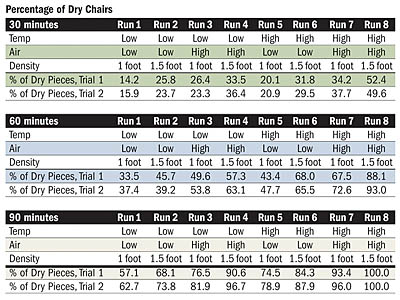
Two replications of the eight versions or runs of the experiment were conducted randomly over a week's time. Anita and Jennie were very careful to ensure that the levels of the factors were set correctly. To keep the amount of furniture in the room the same for each level, they used dining room chairs that are a high volume item. During each run, they made measurements on the percent of pieces that were completely dry at 30, 60 and 90 minutes. The data from these experiments are summarized in the table, "Percentage of Dry Chairs."


Questions

1. From these data, which factors are important in the drying time of

the furniture?

2. What combination of these factors yields the highest percentage of units dry for each time period?

3. Do these results provide useful information for Anita and Jennie to determine how to gain production capacity by drying the furniture faster?

4. Why is it important to study multiple factors in one experiment?


Answers to June Brain Teaser

Chad, an engineer for a company that makes precision components for aircraft manufacturers, prepares reports for customer meetings. To demonstrate product quality, Chad reports first pass yield for the specific customer's components. The first pass yield has consistently been above 95%. Now a new plant manager, Henry, has begun to ask Chad how first pass yield can be so good while customers continue to complain of late shipments. Chad has agreed to provide data to show how first pass yield is calculated.


Q: How could Chad use these data to calculate a first pass yield of 95% or better?

A: Based on the data Chad provided, the only way to get a number close to the 95% or better is to use the number of components returned divided by the number that were produced or the number shipped. Either of these measures in no way reveals first pass yield at the manufacturing process. However, there are companies that have used this approach because the real first pass yield was so poor.


Q: What should Chad have been reporting for first pass yield based on the data given?

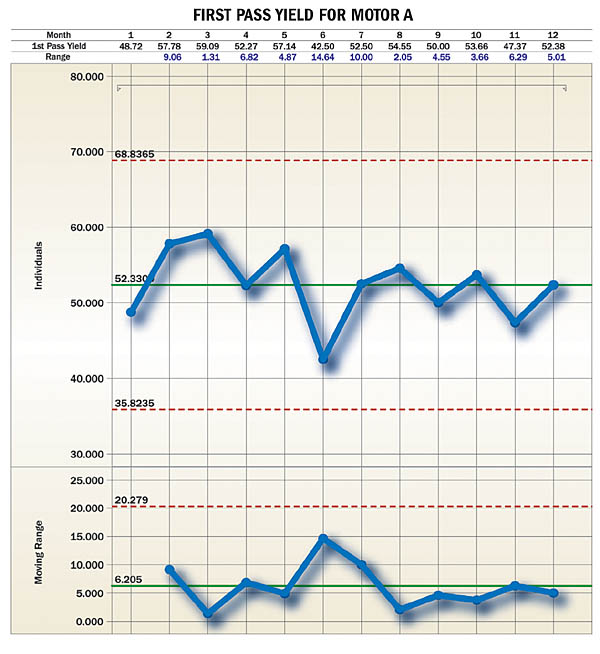
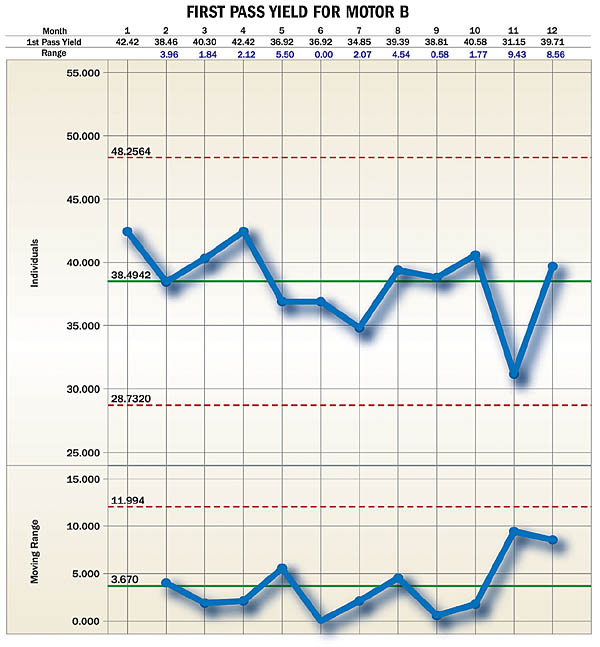
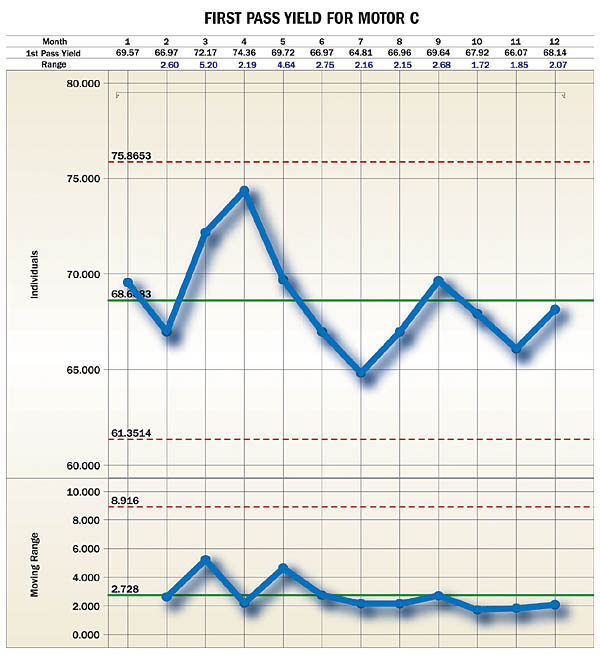
A: Using these data, the closest measure of first pass yield is the percent not reworked. The calculation is (number produced - number reworked) divided by number produced expressed as a percent. This assumes that all components that failed inspection were reworked and all components scrapped came from those reworked. An analysis of the percent not reworked for all three motors using individuals and moving range charts shows that all three motors are predictable. See the charts, "First Pass Yield for Motors A," First Pass Yield for Motor B," and "First Pass Yield for Motor C." Based on these analyses Chad should have been reporting first pass yield for Motor A at an average of 52.3% with limits of 37.235.8% and 67.568.8%. The results for Motor B gave an average of 38.5% rework with limits of 29.328.7% and 47.748.3%. For Motor C, the results gave an average of 68.6% rework with limits of 61.49% and 75.94%. Clearly these predictable processes are currently doing the best they can and require fundamental changes to improve the first pass yield. Also, the data need to be reviewed to determine if the assumptions made in calculating this first pass yield are correct.


Q: Is the number of units produced, reworked, shipped and returned for each motor predictable?

A: Individuals and moving range process behavior charts for the number of units produced, reworked, shipped and returned as well as the percentage of reworked, shipped and returned units for each motor show that almost all of the processes are predictable. Only the Percent Shipped for Motor A and the Number Produced for Motor B were unpredictable. Again, the predictable behavior of these processes is an indication that improvement depends on fundamental changes to the processes.


Q: Do these data provide a framework for Henry to understand the issue of late shipments?

A: Yes, the real first pass yield values indicate that a lot of time is spent doing rework and the percent shipped indicates that not all of the units produced are shipped. Taking time for rework and not shipping all of the components may well explain the complaints associated with failure to receive the components on time.


Dr. Sophronia Ward is a continual improvement specialist and Six Sigma Senior Master Black Belt and coach. Brain teasers are now incorporated in the new training programs, Six Sigma Training for Champions, Black Belts and Green Belts, offered by Dr. Ward and her associates at Pinnacle Partners Inc. For more information, call (865) 482-1362 or visit www.pinnaclepartnersinc.com.

Share This Story

Looking for a reprint of this article?
From high-res PDFs to custom plaques, order your copy today!

Qm0620 clmn ask the expert author sophronia ward 0620

Dr. Sophronia Ward, a PhD statistician and continual improvement specialist, has extensive experience in manufacturing, service and health CARE. [email protected], www.pinnaclepartnersinc.com, or (865) 310-2973.

Recommended Content

JOIN TODAY
to unlock your recommendations.

Already have an account? Sign In

  • 2024 Quality Rookie of the Year Justin Wise 1440x750px banner with "Quality Rookie of the Year" logo inset

    Meet the 2024 Quality Rookie of the Year: Justin Wise

    Justin Wise is an exceptional individual who has been...
    Aerospace
    By: Michelle Bangert
  • Man with umbrella and coat stands outside while it rains at night looking at a building.

    Nondestructive Testing: Is there an ethics problem?

    I was a whistleblower who exposed fraudulent activities...
    NDT
    By: Dale Norwood
  • Unraveling Deflategate: Football stadium with closeup of football on field

    Unraveling the Tom Brady Deflategate

    The Deflategate scandal erupted following the 2014 AFC...
    Measurement
    By: Greg Cenker and Henry Zumbrun
Manage My Account
  • eMagazine Subscriptions
  • Newsletters
  • Online Registration
  • Subscription Customer Service
  • Manage My Preferences

More Videos

Sponsored Content

Sponsored Content is a special paid section where industry companies provide high quality, objective, non-commercial content around topics of interest to the Quality audience. All Sponsored Content is supplied by the advertising company and any opinions expressed in this article are those of the author and not necessarily reflect the views of Quality or its parent company, BNP Media. Interested in participating in our Sponsored Content section? Contact your local rep!

close
  • Key Takeaways for Quality Leaders
    Sponsored byComplianceQuest

    Key Takeaways for Quality Leaders from the 2026 Gartner Magic Quadrant™ for QMS

  • This image shows a person seated next to a Bobcat T66 compact track loader.
    Sponsored byPolyWorks by InnovMetric

    Supercharging Digital Gauging at Bobcat North America

  • Dorsey Calibration Lab photo by Tom LaBarbera Picture this Studios
    Sponsored byDorsey Metrology International

    Ensuring Product Quality in a Competitive Manufacturing Landscape

Popular Stories

This image shows a person seated next to a Bobcat T66 compact track loader.

Supercharging Digital Gauging at Bobcat North America

Dorsey Calibration Lab photo by Tom LaBarbera Picture this Studios

Ensuring Product Quality in a Competitive Manufacturing Landscape

a professional in the aviation field performing maintenance, repair, and overhaul (MRO) work

Manufacturing Retention: Strategies for Improving Company Culture, Engagement and Skill Development

2026 Quality Professional of the Year!

Events

June 22, 2026

Automate 2026

Automate is North America's largest robotics and automation event — and the best place to take your ideas from insight to impact.
 
Our show floor features the world’s leading automation solutions, from AI and robotics to motion control, vision systems, and more. Plus, our educational conference is second to none, led by the brightest minds in automation today.
 
Ready to transform the way you work? Take the next step at Automate.
July 14, 2026

Quality Leaders Forum: Better Communication, Better Quality Data

The Quality Leaders Forum is a quarterly, editor-moderated fireside chat series hosted by Quality Magazine, featuring candid conversations with senior manufacturing and operations executives shaping enterprise-level quality.

View All Submit An Event

Products

Lean Manufacturing and Service Fundamentals, Applications, and Case Studies

Lean Manufacturing and Service Fundamentals, Applications, and Case Studies

See More Products
Quality Podcast Channel Custom Content

Related Articles

  • Brain Teasers: Can You Solve the Final Brain Teaser?

    See More
  • Brain Teasers: Collapsing Tents

    See More
  • Brain Teasers: Leaky Seals

    See More

Related Products

See More Products
  • Quality Brain Teasers: Real World Challenges to Build Your Manufacturing Skills (ebook)

See More Products

Related Directories

  • HEMCO Corp.

    HEMCO Corporation's modern manufacturing and distribution facilities combined with our many years of experience uniquely qualifies us to provide Laboratory Fume Hoods, Lab Furniture, Vented Enclosures, Modular Clean Labs and Emergency Showers. HEMCO offers UL-1805 classified Fume Hoods. HEMCO is a member of the Scientific Equipment and Furniture Association (SEFA). HEMCO looks forward to serving the life sciences, academic, pharmaceutical, chemical, aerospace, government, and research markets.
×

Stay in the know with Quality’s comprehensive coverage of
the manufacturing and metrology industries.

Newsletters | Website | eMagazine

JOIN TODAY!
  • RESOURCES
    • Advertise
    • Contact Us
    • Directories
    • Manufacturing Division
    • Store
    • Want More
  • SIGN UP TODAY
    • Create Account
    • eMagazine
    • Newsletters
    • Customer Service
    • Manage Preferences
  • SERVICES
    • Marketing Services
    • Market Research
    • Reprints
    • List Rental
    • Survey/Respondent Access
  • STAY CONNECTED
    • LinkedIn
    • Facebook
    • YouTube
    • X (Twitter)
  • PRIVACY
    • PRIVACY POLICY
    • TERMS & CONDITIONS
    • DO NOT SELL MY PERSONAL INFORMATION
    • PRIVACY REQUEST
    • ACCESSIBILITY

Copyright ©2026. All Rights Reserved BNP Media, Inc. and BNP Media II, LLC.

Design, CMS, Hosting & Web Development :: ePublishing