Quality Magazine logo
search
cart
facebook twitter linkedin youtube
  • Sign In
  • Create Account
  • Sign Out
  • My Account
Quality Magazine logo
  • NEWS
  • PRODUCTS
    • FEATURED PRODUCTS
    • SUBMIT YOUR PRODUCT
  • CHANNELS
    • AUTOMATION
    • MANAGEMENT
    • MEASUREMENT
    • NDT
    • QUALITY 101
    • SOFTWARE
    • TEST & INSPECTION
    • VISION & SENSORS
  • MARKETS
    • AEROSPACE
    • AUTOMOTIVE
    • ENERGY
    • GREEN MANUFACTURING
    • MEDICAL
  • MEDIA
    • A WORD ON QUALITY PUZZLE
    • EBOOK
    • PODCASTS
    • VIDEOS
    • WEBINARS
  • EVENTS
    • EVENT CALENDAR
    • IMTS
  • DIRECTORIES
    • BUYERS GUIDE >
      • Supplier Insights
    • NDT SOURCEBOOK
    • VISION & SENSORS
    • TAKE A TOUR
  • INFOCENTERS
    • Digital Quality Management Systems
    • NEXT GENERATION SPC & QUALITY ANALYTICS
  • AWARDS
    • ROOKIE OF THE YEAR
    • PLANT OF THE YEAR
    • PROFESSIONAL OF THE YEAR
  • MORE
    • Expert Columns
    • NEWSLETTERS
    • QUALITY STORE
    • INDUSTRY LINKS
    • SPONSOR INSIGHTS
  • EMAG
    • eMAGAZINE
    • ARCHIVES
    • CONTACT
    • ADVERTISE
  • SIGN UP!

Quality 101: Laser Scanning Fundamentals
By Orlando Perez
June 30, 2009
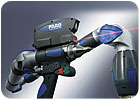
Laser line scanning is a noncontact measurement technique that employs high-end optics to convert light into accurate 3-D data. Source: Faro Technologies Inc.


Laser line scanning is ideal for noncontact measurement applications, including inspection, cloud-to-computer-aided design (CAD) comparison, rapid prototyping, reverse engineering and 3-D modeling. Laser line probes use a triangulation process to find the position of objects in space. A high-performance laser diode inside the unit produces a straight laser stripe that is projected onto a surface, and a camera observes the laser stripe at a known angle to determine the location for each point on the line.

How Laser Scanners Work

A 3-D laser scanner uses laser light to probe objects. It projects a laser line on the subject and uses a camera to look for the location of the laser line silhouette.

Depending on how far away the laser strikes a surface, each point on the laser line profile appears at different places in the camera’s field of view. This technique is called triangulation because the points on the laser profile, the camera and the laser emitter form a triangle.

The length of one side of the triangle-the distance between the camera and the laser emitter-is known. The angle of the laser emitter corner also is known. The angle of the camera corner can be determined by looking at the location of the laser line in the camera’s field of view. These three pieces of information fully determine the shape and size of the triangle and give the location of each point on the scan subject corner of the triangle.

Most laser scanning systems use lens filters to block out ambient light and allow only the laser light to shine through. This improves system performance by reducing noise created by other light sources.

The Laser Line Probe

A laser line probe allows operators to quickly inspect or reverse engineer complex and organic shapes via laser scanning, as well as capture prismatic elements with the high accuracy that contact metrology provides.

A laser line probe can digitize the shape and position of an object that is placed in its field of view. A laser line is generated by fanning out a laser light beam into a sheet of light. When the sheet of light intersects an object, a bright stripe of light can be seen on the surface of the object. The built-in camera views the stripe at an angle and the observed distortions can be translated into height variations.
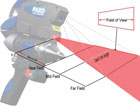
The laser diode inside the unit produces a straight laser stripe projected onto a surface, and a camera observes the laser stripe at a known angle to determine the location for each point on the line. Near-field stripes are captured closest to the device and will have points closer together than far-field stripes. Standoff is the minimum distance required between the laser source and the scan object. Source: Faro Technologies Inc.

Converting Light into Points

Data is collected one slice, or cross section, at a time. A measurement arm acts as a referencing device-or localizer-that tracks and communicates to the host application software the position of each cross section in space. As the laser stripe is swept across an object, hundreds of cross sections are instantly captured. When they are collectively rendered in a CAD environment, the end result is a full 3-D digital representation of the object. The collection of raw data is commonly referred to as a point cloud.

Each of the captured cross sections contains hundreds of points. The number of points in each cross section depends on the size of the camera’s image sensor or charge-coupled device (CCD) and how much of the object is in the camera’s field of view. The maximum number of cross sections that can be acquired depends on the capture frame rate of the camera. A 30-hertz CCD can capture 30 frames, or stripes, per second.

The distance between points in a single stripe varies depending on the position within the field of view. Because of the angle of the camera, the field of view is not rectangular but rather trapezoidal. Stripes captured closest to the device, or in near field, will have points closer together than those captured farther away, or in far field. Standoff is the minimum distance required between the laser source and the scan object.

Higher frame rates and higher resolution CCDs can improve scanning speed and produce high-density point clouds capable of detecting finer details. While this is ideal to increase productivity and data quality, large amounts of scan data can quickly consume computer resources and reduce overall performance, requiring more expensive, high-power computers to get the job done.

To the camera, the laser stripe projected onto a part looks like a thick silhouette or profile. In order to produce a single row of points, the scanner must identify the pixels that run through the center of the profile. One data point corresponds to the position of one pixel in the CCD and each column produces one point on the profile.

The closer the laser line probe gets to the part (near field), the lower on the CCD the profile appears. As the laser scanner is pulled back (far field), the profile moves up on the CCD. The laser line silhouette is better defined in near field than in far field. A simple comparison would be to shine a flashlight on a wall; as the flashlight gets closer to the wall the light is brighter and the center spot is clearly defined, but as the flashlight is pulled back the center spot gets bigger and loses intensity and definition. This means that better accuracy and repeatability can be expected when holding the scanner closer to the part.

Sometimes surface properties such as color, texture and, in particular, reflectivity can diminish the quality of the image on the camera. This makes it more difficult for the laser probe to determine the true center of the profile, thus producing erroneous points that appear as noise in the data. Reflective surfaces can generate double images that typically result in outliers.

Noise in the data is almost inevitable and outliers are typically expected. There are many point cloud processing programs available that employ sophisticated and powerful algorithms to reduce noise and filter outliers.

Pushing the 3-D Envelope

Laser line scanning provides a quick and effective way to inspect and reverse engineer complex parts and surfaces. This noncontact measurement technology employs high-end optics to convert light into accurate 3-D data.

Noncontact measurement devices are becoming more and more popular, driving manufacturers’ research and development efforts to produce better and more effective ways to turn everyday objects into digital computer models and push the envelope of possibilities in 3-D metrology.

Share This Story

Looking for a reprint of this article?
From high-res PDFs to custom plaques, order your copy today!

Orlando Perez is the technical product manager at Faro Technologies Inc. (Lake Mary, FL). For more information, call (800) 736-0234 or visit www.faro.com.

Recommended Content

JOIN TODAY
to unlock your recommendations.

Already have an account? Sign In

  • 2024 Quality Rookie of the Year Justin Wise 1440x750px banner with "Quality Rookie of the Year" logo inset

    Meet the 2024 Quality Rookie of the Year: Justin Wise

    Justin Wise is an exceptional individual who has been...
    Aerospace
    By: Michelle Bangert
  • Man with umbrella and coat stands outside while it rains at night looking at a building.

    Nondestructive Testing: Is there an ethics problem?

    I was a whistleblower who exposed fraudulent activities...
    NDT
    By: Dale Norwood
  • Unraveling Deflategate: Football stadium with closeup of football on field

    Unraveling the Tom Brady Deflategate

    The Deflategate scandal erupted following the 2014 AFC...
    Measurement
    By: Greg Cenker and Henry Zumbrun
Manage My Account
  • eMagazine Subscriptions
  • Newsletters
  • Online Registration
  • Subscription Customer Service
  • Manage My Preferences

More Videos

Sponsored Content

Sponsored Content is a special paid section where industry companies provide high quality, objective, non-commercial content around topics of interest to the Quality audience. All Sponsored Content is supplied by the advertising company and any opinions expressed in this article are those of the author and not necessarily reflect the views of Quality or its parent company, BNP Media. Interested in participating in our Sponsored Content section? Contact your local rep!

close
  • Key Takeaways for Quality Leaders
    Sponsored byComplianceQuest

    Key Takeaways for Quality Leaders from the 2026 Gartner Magic Quadrant™ for QMS

  • This image shows a person seated next to a Bobcat T66 compact track loader.
    Sponsored byPolyWorks by InnovMetric

    Supercharging Digital Gauging at Bobcat North America

  • Dorsey Calibration Lab photo by Tom LaBarbera Picture this Studios
    Sponsored byDorsey Metrology International

    Ensuring Product Quality in a Competitive Manufacturing Landscape

Popular Stories

This image shows a person seated next to a Bobcat T66 compact track loader.

Supercharging Digital Gauging at Bobcat North America

Dorsey Calibration Lab photo by Tom LaBarbera Picture this Studios

Ensuring Product Quality in a Competitive Manufacturing Landscape

a professional in the aviation field performing maintenance, repair, and overhaul (MRO) work

Manufacturing Retention: Strategies for Improving Company Culture, Engagement and Skill Development

2026 Quality Professional of the Year!

Events

June 9, 2026

Future-Proof your Quality Processes with Advanced 3D Optical CMM Technology

Discover how to effortlessly capture complex data, leverage true multi-sensor automation, and ensure continuous operation without creating inspection delays.

June 22, 2026

Automate 2026

Automate is North America's largest robotics and automation event — and the best place to take your ideas from insight to impact.
 
Our show floor features the world’s leading automation solutions, from AI and robotics to motion control, vision systems, and more. Plus, our educational conference is second to none, led by the brightest minds in automation today.
 
Ready to transform the way you work? Take the next step at Automate.
View All Submit An Event

Products

Lean Manufacturing and Service Fundamentals, Applications, and Case Studies

Lean Manufacturing and Service Fundamentals, Applications, and Case Studies

See More Products
Quality Podcast Channel Custom Content

Related Articles

  • Quality 101: Laser Tracking Fundamentals

    See More
  • QTY July 2021 Portable Measurement Feature. Image Source: Morsa Images / E+ via Getty Images

    The Power of Portable Measurement: How 3D Laser Scanning Augments Metal Forming Processes From Start To Finish

    See More
  • 3D Laser Scanning with Blue Laser Technology

    See More

Related Products

See More Products
  • Fundamentals of Manufacturing, 3rd Edition

  • Fundamentals of Plant Floor Layout DVD Package

  • lean manu.jpg

    Lean Manufacturing and Service Fundamentals, Applications, and Case Studies

See More Products

Events

View AllSubmit An Event
  • April 2, 2026

    FAI Reimagined: Accelerating Quality Decisions and Reducing Rework with 3D Scanning

    On Demand Through live demonstrations and real automotive cases, attendees will see how 3D measurement and CAD-to-part comparison simplify inspections and visualize deviations, accelerating approvals and smoothing the transition from first article to mass production.
View AllSubmit An Event

Related Directories

  • Surface Scan

    Professional 3D scanning, CAD, and 3D printing services across the UK. We offer in-house and mobile scanning using advanced equipment for metrology, terrestrial, and color capture. Our high-capacity print facility delivers fast turnaround on thousands of plastic parts. Trusted by engineers, manufacturers, and designers for precision, speed, and quality.
×

Stay in the know with Quality’s comprehensive coverage of
the manufacturing and metrology industries.

Newsletters | Website | eMagazine

JOIN TODAY!
  • RESOURCES
    • Advertise
    • Contact Us
    • Directories
    • Manufacturing Division
    • Store
    • Want More
  • SIGN UP TODAY
    • Create Account
    • eMagazine
    • Newsletters
    • Customer Service
    • Manage Preferences
  • SERVICES
    • Marketing Services
    • Market Research
    • Reprints
    • List Rental
    • Survey/Respondent Access
  • STAY CONNECTED
    • LinkedIn
    • Facebook
    • YouTube
    • X (Twitter)
  • PRIVACY
    • PRIVACY POLICY
    • TERMS & CONDITIONS
    • DO NOT SELL MY PERSONAL INFORMATION
    • PRIVACY REQUEST
    • ACCESSIBILITY

Copyright ©2026. All Rights Reserved BNP Media, Inc. and BNP Media II, LLC.

Design, CMS, Hosting & Web Development :: ePublishing