Reaching Six Sigma levels requires hard work. It requires drive and determination to repeat tests and try new ideas until Six Sigma levels are met. It requires extremely accurate and repeatable equipment, and, to that list of equipment can now be added another technology-machine vision.
In what is believed to be the first time ever, machine vision was used to meet Six Sigma levels. A General Electric (GE) plant in Matoon, IL, achieved this goal for two of its manufacturing lines. While the ability to use machine-vision technology opens up new possibilities for manufacturers, as the trials at the GE plant reveals, it does not replace hard work. These two projects required more than 60,000 gage repeatability and reproducibility (GR&R) tests to ensure that the lines could meet Six Sigma levels.
The reason GE and many companies implemented Six Sigma is to have a true rate of return, reduce variability, increase quality and produce in-process, defect-free parts. While some within the industry believe Six Sigma is a program of the month, it is not.
Six Sigma is a disciplined and data-driven method to eliminate defects and reduce variation. It is a statistical representation of the performance of a process or organization, and a fundamental objective is to implement measurement-based strategies that focus on process improvement and variation reduction.
Six Sigma equates to reaching a 99.9997% level of defect-free products. That may seem like overkill to some, but every digit translates to fewer defective products. A report from the Six Sigma Academy (Scottsdale, AZ), a Six Sigma consulting company, estimates that in everyday life, a 99.9% defect-free rate could be disastrous. At that level, Americans would experience:
• At least 200,000 wrong drug prescriptions dispensed each year.
• Unsafe drinking water for almost an hour per month.
• Ninety-six crashes per 100,000 airline flights, which is about a week's worth of flights.
Not only can Six Sigma reduce defects, it can also save a company money. According to the Six Sigma Academy, Black Belts save companies approximately $230,000 per project and they can complete four to six projects per year if assigned full-time. GE, according to the Academy, estimates corporate-wide benefits of Six Sigma to be near $10 billion during the first five years of implementation.
GE recently completed two Six Sigma projects in Illinois that integrated machine vision systems into their production. After extensive GR&R tests, they met the Six Sigma levels.
Project 1
The first project took two months to complete. GE wanted to inspect automotive light bulb mounts in process. To do so, the system had to be validated through Six Sigma GR&R tests and a lot of data were taken to see if the system passed. In the end, the project required two machine vision cameras; 48 fixtures; seven different measurements; two samples each of the Upper Limits, Target and Lower Limits; and five repeatability tests. This meant that to pass Six Sigma GR&R tests, 20,160 tests were conducted.
The program needed to do more than what a typical machine vision system could do. GE wanted to have process information captured in real time and be displayed on operator-interface screens. Operators could then use the information to make process adjustments on their line in real time. That adds a significant complexity to a typical absence/presence machine-vision application.
A key specification to this project was meeting a ±0.2 millimeter resolution. To meet the resolution, the lensing and lighting could not distort the image. In most machine-vision applications, the resolution is not as critical, so not as much attention is put on the lens and lighting. In this case, specific lighting and lensing had to be selected because if the image is distorted, the part cannot be properly measured.
The camera supplier allowed calibration values to be taken for each head on the multi-head machine. This value was used to scale an engineering value, a value that an operator can understand and take back to a comparator, and be able to measure the same part on a different gage.
The other complexity was to coordinate a measurement between two cameras. Two cameras were needed because the angle at which one camera could be mounted did not provide a view to take the required measurements between the coils of the bulb. The data from both cameras were combined to produce the value.
Using mapping software, the data from the two cameras were mapped, which made it simple for the operator to understand and use the information to make machine adjustments. Without this, the operators could not make the adjustments, but they could produce scrap, and their rate of return could rapidly increase.
The new system not only became an on-line quality system that could be used to check a part and reject it, but also an information basis so that the operator could make their products to centerline.
Project 2
In many ways, the second project was the more difficult of the two. While much of the architecture was the same as Project 1, it did require a custom-built machine that had to be integrated with existing equipment, three machine vision cameras, three-axis motion control, and in-process centerline software.
One of the biggest difficulties was that the bulbs had to be inspected 360 degrees at high rates of speed. A machine was needed for material handling and presenting the bulb to the camera. A custom machine was built that moves the bulb onto the vision station, positions it for the cameras, which then makes more than 140 inspections within
850 milliseconds.
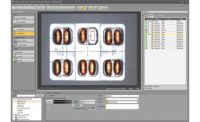
Another area in which production improved was the addition of in-process bulb centerline software. Operators watching a viewing screen are shown red boundaries overlayed on the image of the bulb. The boundary shows the region of interest of the part and is a thumbnail that operators can double click to see where the bulb needs to be placed. This technology offers a simple approach instead of giving the operators measurement data that says, for example, they should move the part 0.02-millimeter.
The real-time data provided by these systems allows the operators to make fundamental changes to their machine to produce a lower scrap rate, and produce a high quality and less expensive product.
Tech Tips
1. The two projects required more than 60,000 GR&R tests.
2. Distortion-free lenses and improved lighting were critical to correct measurements.
3. Data from the multiple cameras were mapped together and operators were given real-time data.