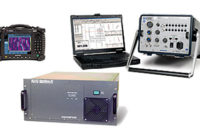
Eddy current array testing is used in a number of different fields. Source: Olympus
Eddy current array (ECA) technology electronically drives and reads several eddy current sensors positioned side-by-side in the same probe assembly. Data acquisition is made possible through the use of multiplexing, which avoids mutual inductance between the individual sensors.
Benefits of Eddy Current Arrays
Compared to single-channel eddy current technology, eddy current array technology provides the following benefits:
The main advantages of the ECA technology are increasing inspection speed, better reliability due to C-scan imaging, and better reproducibility and probability of detection due to the coverage of the whole surface assured by the array. Source: Olympus
Eddy Current Array Probes
An eddy current array probe can be optimized for a specific application by changing the coil configuration and the probe shape. Different types of probes can be realized like absolute bridge, differential bridge, absolute reflection, differential reflection, transmit-receive, shielded and cross-axis.Probes can be designed to detect a specific type of flaw or to follow the shape of the part being inspected. Standard designs are available to detect surface defects, such as cracks and pitting, and subsurface defects, such as cracks in multilayer structures and corrosion.
Representation of the data plays a major role in the use of eddy current array. Certain probes allow the use of C-scan imaging, which is a color-coded 2-D mapping of the inspected surface. The data from each individual coil are recorded so the impedance plane is always available.
The ECA probe moves over a flaw and each coil produces an EC signal. The C-scan gives the position of the flaw as well as its size. The use of a C-scan image increases the reliability of the inspection because it guarantees full coverage of the surface inspected.

Friction stir welding (FSW) can be subject to defects such as lack of penetration, oxide layers and galling. Source: Olympus
Friction Stir Welding Inspection
Eddy current array testing is used in a number of different fields such as aircraft and engine maintenance and manufacturing, power generation, oil and gas, and tube manufacturing.Friction stir welding (FSW), a new solid-state welding process, revolutionized the aluminum welding industry of aerospace components. Offering high performance, this state welding can be subject to defects such as lack of penetration, oxide layers and galling. Eddy current array is used to assure the integrity of such welding.
The ECA probe sits on the opposite tool side of the weld. As the ECA probe covers the whole width of the weld, only one pass over the weld is necessary. Lack of penetration and galling are easily detected. The oxide layers-also known as kissing bonds-are undetectable. But, the ECA measures and displays the conductivity of the parent metal and the welded metal. The C-scan representation shows the width of the weld and helps the operator to characterize the weld and identify areas with a high probability of presence of oxide layers.
Galling is a defect created by the rotation tools that creates parent metal shrink in the weld due to insufficient lubrication. Eddy current array can detect galling easily.
The main advantages of the ECA technology are increasing inspection speed, better reliability due to C-scan imaging, and better reproducibility and probability of detection due to the coverage of the whole surface assured by the array.