Test & Inspection
Consider CoaXPress
CoaXPress combines the best features of other machine vision interfaces into just one interface solution.
High-resolution and high-speed digital cameras are taking on a critical role in military and aerospace applications as the industry strives to achieve real-time image acquisition requirements while meeting an ever increasing demand for more “pixels on target.” The development of new larger and faster image sensors and the applications that they enable means that higher speeds are required to acquire and process the data. The bandwidth provided by the transport mechanism (the interface between the camera and host processor) often becomes the limiting factor. Other characteristics such as distance, latency, power, connectivity and reliability are considered equally as critical in many demanding vision applications.
TECH TIPS
|
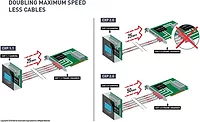
CoaXPress is a high-speed, point-to-point, serial communications standard for the transmission of video. It provides an interface to connect devices (typically cameras) to hosts (typically frame grabbers) through a standard 75 ohm coaxial cable. It includes a high-speed downlink (camera-to-host) of up to 6.25 Gbits/second for video transport plus a lower speed 20 Mbits/second uplink (host-to-camera) for communications and control. The protocol is also scalable, allowing multiple coax cables to be used if additional video bandwidth is required. The protocol defines the transfer of video data, control data, triggers and general purpose I/O over a single link. Power is also available over the cable and cable lengths in excess of 100 meters can be achieved.
CoaXPress combines the simplicity of coaxial cable with state-of-the-art high-speed serial data technology. The combination of these two highly desirable features—standard coaxial cable plus high speed—provides a revolutionary leap forward in high-speed image and data transmission.
Current digital video interfaces such as Camera Link, GigE Vision, USB and FireWire all have limitations and do not meet the requirements of next generation imaging applications. CoaXPress overcomes these limitations and combines the best features of each of these interfaces into one interface solution. The benefits of CoaXPress include:
- High data rates
- Long cable lengths
- Real time behavior through fixed,
- low latency
- Precise triggering capability
- Flexible and reliable through the use of standard coax
- Ease of integration: video, communication, control and power over a single cable
- Cost effective cable solution
- Hot pluggable
- Plug-n-play
Each CoaXPress link provides the following signaling connections:
- A high speed downlink (camera-to-host) at up to 6.25 Gbits/second carrying streaming video data, control responses, trigger, and general purpose I/O (GPIO).
- A low speed uplink (host-to-camera) at 20.83 Mbits/second carrying control commands, trigger, and GPIO.
- A power connection (host-to-camera) of up to 13 Watts at 24 volts.
Why Coax?
There are several advantages to specifying coaxial cable over other medium. These include:
- Coax is acknowledged to be the best electrical medium for high speed transfer.
- Coax cables are very reliable and cost effective.
- Coax does not suffer from intra-pair skew, an important performance limiter for differential cables at high speeds.
- Excellent EMI/EMC performance.
- A large variety of low cost cables are available including thick ones for longer distance, thin or flexible for shorter distance.
- It is easy to install and terminate connectors in the field.
- There is a legacy Coax cable infrastructure, using analog cameras for security, surveillance or broadcast applications that need to be upgraded to high resolution digital cameras.
- It can be used with slip-ring or rotary joints, typically used in defense, robotic and surveillance applications, where continuous 360 degree panning may be a requirement.
Features
The CoaXPress specification provides many features including:
- Plug-n-play. The protocol contains mechanisms for automatic link setup, (i.e. discovery, bit rate selection, packet size negotiation) as well as camera and host setup (i.e. image format, bit depth, data packing format). A Gen<i>Cam compliant XML file located inside the camera, accessible by the host, exposes all of the features that the camera supports.
- Power over Coax. The protocol defines an automated mechanism for the host to supply power to the camera. The available power per cable is 13 watts at a nominal 24 volts. The protocol implements device detection and short circuit protection to minimize the risk of damage should a non-compliant device be accidentally connected to a CoaXPress host.
- Link Protocol. The link protocol defines a point-to-point interface between the camera and the host. The link includes a Stream Channel as well as a Control Channel.
- Stream Channel. The stream channel transfers video data where video frames are first encapsulated into “streams” and then segmented into fixed length “packets.” The use of 8B10B encoding as well as CRC ensures data integrity across the link.
- Control Channel. The camera is controlled by the host via registers. The control channel is used to provide access through specific control commands, transmitted from the host to the camera, and the resulting acknowledgement responses, transmitted from the camera to the host. Following the Gen<i>Cam method of device control, the protocol requires that the host read an XML file stored in the camera. This XML file exposes the camera’s features to the host and provides register addresses and attributes for each feature. The control channel protocol uses 8B10B encoding, as well as CRC to ensure data integrity.
- Triggers. The protocol defines a bi-directional trigger mechanism. Low-latency trigger signals can be carried across the link via trigger packets. To minimize trigger jitter, the time between trigger event and the trigger packet being sent is coded into the packet as a delay value. The receiver can then use this delay value to recreate the trigger event with low jitter and a fixed latency. Triggers on the camera-to-host downlink have an accuracy equal to 10 transmitter bit periods (i.e. ±2 nSeconds at 3.125 Gbps). Triggers on the host-to-camera uplink have a low fixed latency of 3.4 uSeconds with an accuracy of ±4 nSeconds.
- GPIO. The protocol defines a bi-directional general purpose I/O mechanism. The transmitting side monitors the state of 8 signals and transmits a GPIO packet when the logic state changes in order to maintain the same logic level at the receiving end.
- Link Test. The protocol defines a bidirectional link test facility to test the quality of the link. Two link tests are defined: host-to-camera and camera-to-host. All link tests are initiated by the host. A pair of test pattern generators and receivers are included in both the host and the camera. The test generator transmits a link test packet containing a known test pattern. The test receiver compares the received test data packet against its local test generator. Test pass/fail statistics are accumulated and made available to the host.
Standardization
CoaXPress is a public, royalty free standard that was originally developed by a consortium of semiconductor, camera, frame grabber and cable companies. The research and development of the technologies required for CoaXPress started as an activity of the European Eureka project in 2006 and culminated in a product demonstration at the 2009 Vision show in Stuttgart, Germany. A draft version of the specification was formally transferred to the Japan Industrial Imaging Association (JIIA), which offered to host the standardization of CoaXPress. JIIA has invited both the Automated Imaging Association (AIA) and the European Machine Vision Association (EMVA) to join as liaison groups in the standardization effort. JIIA has also formed an Adopters Group for companies outside of the machine vision industry who wish to develop CoaXPress products. The inclusion of the liaison and adopters groups will help to ensure that CoaXPress becomes a true worldwide standard. The JIIA CoaXPress Standard v1.0 was officially approved in December 2010.
CoaXPress offers an attractive solution to many of the issues presented by current video standards. By offering high-speed video transport over long distances, it meets the needs of many demanding imaging applications including machine vision, military, aerospace, aerial mapping, traffic management, security and many others. Its use of standard coax cables provides many benefits including high reliability, lower cost, excellent EMI characteristics, ease of retrofit into an existing coaxial infrastructure and compatibility with low cost rotary joints or slip-rings for 360 degree panning applications. Its use of a single BNC style connector for video, control, triggers and power add to its convenience. Its acceptance by all three of the major international standards bodies (JIIA, AIA and EMVA) ensures that it will be widely adopted in the imaging market place and will be around for many years to come.
Looking for a reprint of this article?
From high-res PDFs to custom plaques, order your copy today!