Vision & Sensors - Inspection
Short Wave Infrared Enhances Machine Vision
The machine vision professional gains a new tool with SWIR.
Short wave infrared (SWIR) machine vision imaging is a key tool in manufacturing and industrial processes to measure, monitor, control or otherwise manage the reliable and quality-conforming production of goods that do not respond well to standard range machine vision cameras. SWIR imaging adds more solution tools to boost the core machine vision concept “I can control that which I can reliably measure” and aid a digital pass /fail decision on a given inspected process. The beauty of the SWIR camera is that the data feels familiar to a standard black and white signal in both observed images as well as in the digital data stream, and since the underlying silicon and indium gallium arsenide (InGaAs) sensors are both photoelectric effect detectors, speedy results are the norm.
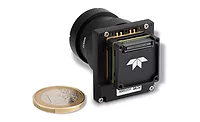
SWIR cameras are available in both 2-D imaging cameras and 1-D linescan cameras. Just as in the visible, the 2-D picture format makes for an easily interpreted image for discrete inspections, while a line-scan has a frame size unlimited in the motion direction ideally suited for moving web waterfall images. Room-temperature SWIR 2-D cameras operate at standard video rates—typically 30 to 60 frames per second (fps)—as well as faster under digital machine vision applications. For critical, high speed machine vision applications, consider a continuous-frame-rate camera that exceeds 90,000 lines per second at a full 1024 pixel resolution at 12 bits.
The Color of Infrared
SWIR is a unique wavelength color zone of light: the physical ways light is seen in the visible also applies to the methods in the NIR and SWIR. Light is radiated from a source; it absorbs, reflects or interacts with the scene, and is detected by a charge-generating camera. As a result, SWIR images look very much like a black and white silicon-camera image, with some unique information added. Since color is a human eye function, there is no true “color” beyond the visible range, and black and white or even pseudo color displays can be used. SWIR differs from a long wave IR (LWIR) thermal application where the temperature of the sample is the main source of signal, yet SWIR can be leveraged when the objects are sufficiently hotter than boiling water. An intermediate mid wave IR (MWIR) band blends some properties of SWIR and LWIR, yet the MWIR detector material requires cryogenic cooling, making for very expensive, consumable-hungry, uniquely-lensed, maintenance-intensive, and otherwise inappropriate machine vision cameras.
Standard SWIR cameras are made using indium gallium arsenide (InGaAs) focal planes and see wavelengths of ~940 to 1700 nanometers (nm) or 0.9 to 1.7 microns (µm). Enhanced versions of InGaAs can extend the blue cutoff to as low as 400 nm (violet): Such cameras cover the full range of a silicon camera plus adding the range above 1,000 nm where common silicon cameras become ineffective if not downright unusable. Typically, such an extended wavelength range application is rare and often undesirable, requiring filters to eliminate the added zone. Additionally, the linescan cameras can push the red end of the sensitivity to 2.2 µm and beyond, using an altered detector crystal matrix not appropriate for area cameras, resulting in a noise-limited camera favored for brighter, redder applications.
Traditional Glass Optics and Illumination Sources
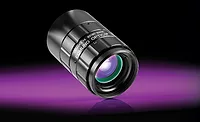
One of the many advantages of SWIR imaging in machine vision is that glass optics and windows are the favored materials. Placing a shortwave infrared camera into unfriendly manufacturing environments is easily accomplished with commercial camera housings, which do not require special expensive window materials with unique care or toxic properties. While COTS lenses can work, SWIR or even NIR optics assure the greatest performance, since a COTS lens is often designed for best focus and transmission in the visible and often near the blue instead of the red. The availability of specifically-SWIR optics has dramatically increased in the past few years (Note: many microscope optics work well in the SWIR, too).
Lighting is critical to machine vision success. Another SWIR advantage is that filament-based light bulbs actually generate more SWIR light than visible. Thus, either smaller, lower-power bulbs can be used, or a standard bulb can be run at much lower power, greatly enhancing lifetime. LED illumination of the correct “color” is also becoming more widely available, noting white LEDs have minimal SWIR content and can be used for auxiliary lighting, if needed.
Hot Processes
While SWIR and visible cameras traditionally do not measure temperature, a glowing electric stove element is an example of a visible temperature measurement. SWIR is likewise used to measure temperatures when LWIR cameras are inappropriate. Hot glass bottle inspection is an application using both linescan and 2-D arrays. In this case, hot glass, right out of the mold or furnace, can be inspected for defects. The glass matrix is transparent to the SWIR camera, while at the same time the hot material emits a soft glow allowing a machine vision program to evaluate the bottle for critical defects such as wall thickness, wedged bottom and other technical glass-forming terms such as bird swing, shape, spikes, thin spots and inclusions. By monitoring at the hot end, the product quality can be addressed and any process error quickly corrected in a prevention mode, instead of rejecting poor quality at the cold end as a costly correction mode. With the competition from other bottling styles, the cost control of glass vs. plastic or metal becomes critical to survival and SWIR machine vision is a wise investment.
Going hotter yet, SWIR has proven to be advantageous to the molten metal processes industries. Given that a ladle of several tons of molten steel will have residual unwanted slag content, it is advantageous to know when the pour is of good quality steel or of slag-contaminated steel. While a thermal camera has some ability in this technique, SWIR is particularly sensitive to the change in emissivity associated between the steel and slag. This combines with the advantage of easily-serviced windows that protect from the splatter in the steel mill environment: a glass-windowed enclosure is by far much cheaper and easier to obtain, handle and dispose or replace than expensive, exotic windows required for a LWIR camera. As both camera styles can work in elevated temperatures, and neither camera features moving parts, the advantage goes to the SWIR camera over the lifetime of expected service.
Detecting Fill Levels & Moisture Content
At room temperature, different wavelengths can image unexpected color changes. For example, a bottle of clean, clear water in the visible becomes a dark inky solution in the SWIR, owing to several strong water absorptions in this range. Utilizing a filter centered on the strong absorption(s) results in a very sensitive arrangement able to contrast water pathlengths as short as 100 microns (a tenth of a millimeter). Machine vision applications that benefit from a filtered SWIR camera include quality controlling the fill level and/or presence of bubbles in medical syringes, tubing and modern disposable micro-applicators. On a macro scale, the fill level of thick, highly-colored plastic detergent bottles is an easy task in the SWIR. Since food is also high in moisture content, one company inspects french-fry potato slivers for the ideal moisture content to ensure the perfect quality fry, avoiding burned or mushy slivers.
High Tech: Silicon and Solar
Another surprising color change in the SWIR occurs with silicon. A silicon wafer used for semiconductor chips for possibly the next cell phone, memory chip or implanted pacemaker becomes transparent like glass beyond 1,100 nm. It is this “clear” property that contributes to a silicon camera being unable to see into the shortwave infrared spectral region. A SWIR-InGaAs camera can be mounted into a microscope system and used to verify the alignment of two-sided wafer masks, multi-wafer stacks, and even MEMS devices with 3-D structures built into the silicon thickness. One application to quickly verify the thickness of a thinned device simply measures the distance between the surface of the device to the Z-axis translation of the stage as it focuses down to the device layers. Applying a conversion for the optical density results in a quick, easy, noncontact measuring system with accuracy better than 2 µm. Yet, thin wafers are only one application. The cast amorphous silicon block used for solar cells is a 6 x 6 x 10-inch “boule” that may contain inclusions that could damage the diamond wire sawing machine. SWIR imaging through this large block (without dangerous X-rays) tells the operator when and where to slice the block into individual 200 µm thick blanks.
SWIR cameras provide many advantages in an ever-increasing array of machine vision applications. With no moving parts such as fans and shutters, they are easy to use and integrate. They operate in a similar way to commonly used, more familiar silicon cameras. As the demand for reduced size, weight and power with increased pixel count and speed increases, SWIR cameras will continue to enhance detection in applications such as biomedical, OCT and other machine vision tasks that will benefit from imaging beyond the visible wavelength.
|
TECH TIPS
|
Looking for a reprint of this article?
From high-res PDFs to custom plaques, order your copy today!