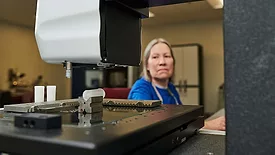
Manufacturing teams continue to use handheld gages during daily quality work, even as they expand their automated inspection systems and adopt more software-driven processes.
Because aerospace often involves frequent engineering model changes, the ability to modify a fixture in hours—rather than building a new one over weeks—is a major competitive advantage.
I’m fond of the phrase “These words say this. These words don’t.” I first encountered it in the marketing of the company Pig Newton, the production company of comedian Louis C. K.
Aircraft lap joints can be fast-screened for surface deformation caused by hidden corrosion using visual inspection or an automated machine vision system.
Any conversation about automation and quality has to start with an acknowledgment that robots inherently improve quality. Robots produce more consistent work than humans.
By knowing the material, thickness, composition, and smallest feature of interest, you give your testing partner the information they need to design an efficient and accurate inspection.
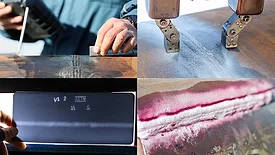
X-ray inspection has long been one of the most trusted methods for inspecting a part without cutting it open. Within the broader field of nondestructive testing (NDT), radiography remains a remarkably flexible tool—able to reveal hidden flaws, confirm weld quality, or verify internal structures that can’t be seen by eye. It’s used everywhere from aerospace and defense to energy, electronics, and manufacturing.
Over the past decade, global data-center infrastructure has evolved faster than at any other time in history. AI clusters, cloud computing, and digital services have driven unprecedented increases in power needs and thermal loads.
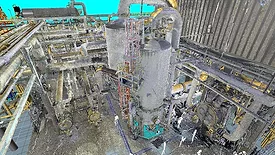
The phrase “digital twin” is everywhere these days, but it’s also widely misunderstood. Ask ten people what it means, and you’ll likely hear ten different answers. Many assume it’s simply a CAD model or a 3D scan. Those are important tools, but they’re not the whole story.
In medical device manufacturing, precision is not optional. Every molded component must meet exacting requirements for safety, reliability, and compliance.
 RSS
RSS
.webp?height=168&t=1770832317&width=275 "This image shows an automated industrial inspection system using a KSCAN-E 3D scanner mounted on a robotic arm.")



.webp?height=168&t=1765568312&width=275 "ATEQ Metrology Laboratory,")