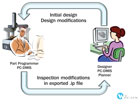
The PC-DMIS Planner allows the user to identify changes to an original part model or inspection plan. Source: Wilcox Associates
The pressure is on in the automotive industry to generate more and better dimensional data for designing and building the next generation of automobiles and trucks.
The sheet metal team at Chrysler’s Advanced Metrology Group (Belvidere, IL) is responding to this challenge. New inspection procedures and software to manage them have dramatically improved the team’s productivity during the past two years. For example, during the first four months of 2009, the team delivered approximately 200 coordinate measuring machine (CMM) programs for evaluating new Chrysler truck and passenger car designs, including model launches scheduled for 2010 and 2011.
Judging from the number of inspection programs that were written, sheet metal team leader Howard Casey believes his team was at least 40% more productive last year than they have been in previous years. As it becomes even more proficient with the new procedures and tools, he anticipates that its productivity could increase by as much as 60%.<
e-Tool and Inspection Plans
The new approach evolved rapidly between 2007 and 2009 when Chrysler was making its transition to CATIA v5. Since this upgrade would require substantial changes in the corporate design software anyway, it was a perfect opportunity to correct longstanding problems in the way design intent information is communicated to CMM programmers.Part designers need to communicate to the CMM programmers creating inspection routines which dimensions and tolerances to evaluate. There are many ways to do this, but each shares the same flaw: Designers may print out 2-D blueprints of the part, model and mark up the critical dimensions; they may jot down some notes in a text document or they may pass this information along via phone calls. In each case, the electronic link between manufacturing and the original design data is broken, and there is no assurance that the parameters used to inspect the parts are current.
Chrysler knew there had to be a better way. So, as part of its upgrade to CATIA v5, it developed a module inside a software package called eTool that allows designers to embed their inspection plans in the CATIA file. This ensures that the link between design data and its inspection requirements is never broken. The inspection plans include datum definitions, feature measurement information and dimensional evaluation information.
Chrysler’s next objective was to find software tools that would automatically transform these inspection plans into inspection programs for a range of CMMs used at several of its facilities. This would save a substantial amount of time and money.
Hexagon’s software arm, Wilcox Associates (North Kingstown, RI), was already at work on this very problem. It was developing a new, standalone product, PC-DMIS Planner, which would let designers embed inspection plans inside its computer-aided design (CAD) data so that it could be used by inspection system programmers to create programs.
The tool set Wilcox was developing within PC-DMIS Planner was very close to what Chrysler had envisioned to round out its eTool software. It included a plan importer, a probe path optimization module, an auto clearance move insertion tool, and a Change Manager for keeping the inspection plan and the part program in sync.
During the next two years, Chrysler and Wilcox worked together to incorporate these tools into the Chrysler software while Wilcox worked independently to refine its own commercial product based on its experience with the Chrysler eTool system.
Clear Communication
Both Chrysler’s eTool and the commercial version of PC-DMIS Planner close the loop between design and inspection by providing tool designers and inspectors with special tools that allow for the clear communication of design intent along with the verification and incorporation of changes that occur during the product development process. This is accomplished by automating previously informal lines of communication between design and inspection personnel to establish bidirectional data flow between a CAD model and its related inspection part programs.The design engineer can use PC-DMIS Planner to identify and embed information about critical characteristics in a planning file that is associated with the product’s CAD file. PC-DMIS Planner offers Direct CAD Interface to the CAD model in the original CAD database so updated planning files can be easily associated with updated CAD files.
Bidirectional change management tools within PC-DMIS Planner allow the user to identify changes to an original part model or inspection plan, and provide fast and easy methods to update part programs based on the new information.
Wilcox Associates
(800) 218-7125
www.pcdms.com