Machine Vision 101: Imaging Small Objects
A judicious lens and camera selection will overcome the challenges that small objects pose.
Machine vision systems are commonly used in inspection applications where small objects need to be identified, measured or checked. These systems can resolve orders of magnitude in finer detail than the human eye and can provide quantitative analysis, eliminating human interpretation and error. A well-designed machine vision system also can improve speed and accuracy, compared to tedious manual inspection. However, a number of issues arise when designing machine vision systems for small objects, due to hardware limitations, optical tradeoffs and space constraints. These issues need to be understood and addressed to maximize system throughput and accuracy.
interpretation and error. A well-designed machine vision system also can improve speed and accuracy, compared to tedious manual inspection. However, a number of issues arise when designing machine vision systems for small objects, due to hardware limitations, optical tradeoffs and space constraints. These issues need to be understood and addressed to maximize system throughput and accuracy.
br> Many lenses that view small objects have large apertures to collect the maximum amount of light from the small area being viewed. Also, shining a lot of light on that area usually requires a large light source. This problem can be solved by using a lens with a long working distance because the lens and camera can be mounted farther from the object, rather than being crowded in a cramped workspace. Working distance, however, is usually inversely proportional to lens magnification, which brings up the second problem-field of view.
Increasing pixel count per area helps in a number of ways. The main benefit is that the machine vision software has more data points to work with, increasing accuracy. While the same effect can be produced using a sensor with more pixels, this approach overtaxes system optics because each pixel must pass information through a smaller portion of the lens. High-resolution sensors need better optics, and incorporating high-quality optics into a large lens to image a small area gets very expensive.
One way to avoid using a camera with a large, expensive sensor is by making many images of the area of interest with a smaller-sensor camera. The smaller fields of view can then be combined in software to form a composite image of the larger area. The result is an image with similar data, but with lower overhead cost. While this cost needs to account for calibration errors, software and processing time, this approach is a better option in many inspection systems.
Stopping down the aperture can increase depth of field. However, there is a limit to how much depth of field can be increased before the aperture is so small that light diffracting off the aperture blades causes more problems. This is called the diffraction limit and is an inescapable limitation that cannot be avoided with very small objects.
Small objects pose a number of challenges to imaging devices, including short working distances, resolution limits and depth of field. All these issues relate to the lens and camera choice because the hardware will dictate the seriousness of each problem. These problems can be solved easily with a judicious lens and camera selection that offers the most options in the easiest configuration to produce the best images possible within budget.
Machine vision systems are commonly used in inspection applications where small objects need to be identified, measured or checked. These systems can resolve orders of magnitude in finer detail than the human eye and can provide quantitative analysis, eliminating human interpretation and error. A well-designed machine vision system also can improve speed and accuracy, compared to tedious manual inspection. However, a number of issues arise when designing machine vision systems for small objects, due to hardware limitations, optical tradeoffs and space constraints. These issues need to be understood and addressed to maximize system throughput and accuracy.
interpretation and error. A well-designed machine vision system also can improve speed and accuracy, compared to tedious manual inspection. However, a number of issues arise when designing machine vision systems for small objects, due to hardware limitations, optical tradeoffs and space constraints. These issues need to be understood and addressed to maximize system throughput and accuracy.
Space Constraints
One problem with imaging small objects is fitting all the system components within the production or inspection area. The camera lens and lighting equipment are the largest parts to be accommodated.br> Many lenses that view small objects have large apertures to collect the maximum amount of light from the small area being viewed. Also, shining a lot of light on that area usually requires a large light source. This problem can be solved by using a lens with a long working distance because the lens and camera can be mounted farther from the object, rather than being crowded in a cramped workspace. Working distance, however, is usually inversely proportional to lens magnification, which brings up the second problem-field of view.
Field of View
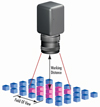
Field of view usually decreases as the distance between the lens and the object decreases. Therefore, a long working distance usually means a larger field of view, increasing the possibility that small details may be missed. Long working distance, high-magnification lenses, however, produce small fields of view from long distances. This type of lens also improves resolution because the smaller field of view results in higher resolution on the object. This happens because each pixel views a smaller area-there are more pixels per area.Increasing pixel count per area helps in a number of ways. The main benefit is that the machine vision software has more data points to work with, increasing accuracy. While the same effect can be produced using a sensor with more pixels, this approach overtaxes system optics because each pixel must pass information through a smaller portion of the lens. High-resolution sensors need better optics, and incorporating high-quality optics into a large lens to image a small area gets very expensive.
One way to avoid using a camera with a large, expensive sensor is by making many images of the area of interest with a smaller-sensor camera. The smaller fields of view can then be combined in software to form a composite image of the larger area. The result is an image with similar data, but with lower overhead cost. While this cost needs to account for calibration errors, software and processing time, this approach is a better option in many inspection systems.
Depth of Field
Another challenge in imaging small objects is a small depth of field. Depth of field is the range from the central focus under the lens, where the object is still in sharp focus. Three factors determine depth of field: focal length of the lens, lens to object distance and f-number (ƒ/#). Most lenses that image small objects will have a long focal length, short working distance and large ƒ/#-a combination that significantly decreases depth of field compared to that of a standard lens.Stopping down the aperture can increase depth of field. However, there is a limit to how much depth of field can be increased before the aperture is so small that light diffracting off the aperture blades causes more problems. This is called the diffraction limit and is an inescapable limitation that cannot be avoided with very small objects.
Small objects pose a number of challenges to imaging devices, including short working distances, resolution limits and depth of field. All these issues relate to the lens and camera choice because the hardware will dictate the seriousness of each problem. These problems can be solved easily with a judicious lens and camera selection that offers the most options in the easiest configuration to produce the best images possible within budget.
Looking for a reprint of this article?
From high-res PDFs to custom plaques, order your copy today!


