Making Better Medical Devices with Multisensor Metrology

A GD&T analysis of a point cloud of data from multiple laser scans of a prosthetic knee shows deviations from the CAD model. Source: Optical Gaging Products Inc.
Multisensor metrology is becoming a preferred quality control technology for manufacturers to develop, maintain and improve the quality of medical devices.
Since the goal of any measurement is comparison to the design drawings, a 3-D fit of all the data points compared to the computer-aided design (CAD) data can actually make decision-making based on large sets of data points easier than interpreting printouts of individual measured values. Although it may seem counterintuitive, using multiple sensors to get lots of data can actually make decisions about parts and processes easier.
Specialized parts demand specialized measurement
Medical devices and their component parts are usually extremely specialized in form and function. For example, they may be very small, such as the parts that form middle ear prostheses for ear nose and throat (ENT) applications. Regardless of size, medical device parts also are almost always fabricated to extremely tight tolerances. Measurement systems that characterize these medical device parts must be capable of high precision, often to the submicron level.Orthopedic implants, such as prosthetic hip ball joints, or tibial and femoral knee and ankle implants, are a challenge to measure accurately. The surfaces that define their shape are higher-order curves made up of non-uniform rational B-splines (NURBS) or point coefficients. The forms they embody often are variable and organically curved because the parts must fit with mating prosthetic parts and even mate with parts inside the human body. Their complex 3-D curves make it difficult to measure all surfaces from a single direction, making it simply impossible for certain types of sensors to measure them.

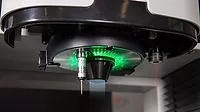
A prosthetic knee mounted to a rotary indexer is being scanned by a laser sensor on a multisensor measurement machine. Source: Optical Gaging Products Inc.
Since video sensors excel at measuring edges, video measurement of these parts would be limited to widths of outer edges illuminated from behind. Video can measure surface points, but using multiple focus points to gather enough data to support even a linear section of a contoured surface would be laborious and impractical. A touch trigger probe would have a similar limitation because each single point requires approach, trigger and back off-possible but impractical in a manufacturing environment.

Video measurement of the OD and length of a plastic syringe body is shown. Source: Optical Gaging Products Inc.
Measuring a replacement knee
A good way to verify that the organically curved profile of a replacement knee matches its design is with a laser. Laser sensors in multisensor systems work by projecting light toward a surface, collecting the reflected and/or scattered light on a dedicated sensor, and automatically calculating the distance of a measured point between the laser and the part in 3-D space.Laser measurement can be accomplished for a single point, or alternately, a series of data points can be gathered and calculated as the part is translated beneath the laser or the laser is moved over the part. The point spacing and sampling rate can be user-specified.
Metrology software continuously calculates the distance between the laser and the part surface as the laser beam moves across the part, keeping the laser sensor within its capture range through closed-loop positioning of the multisensor system’s Z-axis stage control. By keeping the laser sensor within its capture range, precise point positions can be collected quickly. Laser focus is faster and more accurate than video autofocus, and because it is noncontact, it avoids potential damage to the part surface and contamination of sterile parts.
In most instances, the operator may not be able to fixture the knee replacement to ensure a direct line of sight between all its critical surfaces and the laser sensor. In those cases, mounting the replacement in a rotary indexer may provide a solution, as well as an opportunity to speed measurement throughput by eliminating multiple positional fixtures while cutting down on manual part handling.
Typically a datum is established from surfaces on the back of the knee with a touch probe. Then, the rotary indexer rotates the knee replacement to present its desired surface to the laser sensor for measurement. Because the opposite side of the measured surfaces defines the datum, it is imperative that the metrology system be equipped with fully 3-D-capable metrology software that rotates the coordinate system when the indexer rotates. In this way, every data point captured by the laser can be tracked in 3-D space by the metrology software, regardless of the rotary indexer position.
A different method of measuring the complex contours of a prosthetic knee implant is with a multisensor system equipped with a Renishaw SP25 scanning touch probe. Like the laser, the operator specifies start and end points for the scan on the knee replacement, but in this case, the probe tip maintains constant contact with the implant surface as the system moves it along the part surface acquiring data points as it goes.
Unlike touch trigger probes that must approach the surface, trigger and then back off, the SP25 scanning probe maintains constant contact. As with a laser, the data point density and scan rate are user-definable. The multisensor system must be configured for the SP25, and also must be equipped with 3-D-capable metrology software to track the data points in XYZ space.
There are other ways to measure a knee replacement that is fixtured in a rotary indexer. As mentioned, a linear laser or contact probe scan can be performed across the rotary-fixtured knee’s top surface. Because such a line scan represents a section across the 3-D part, that section may be measurable as an edge using a video sensor. By rotating the knee 90 degrees, that “section” becomes a distinct edge when the part is illuminated from behind. This technique requires a good metrology lens system that has a long working distance and limited influence from the knee’s steep surfaces.
Because the “section” is larger than an optical field of view, functions such as edge trace are good for this application where the system automatically follows the edge over multiple fields, acquiring points at each position.
When mounted in a rotary indexer, the knee’s entire surface also can be measured by rotating it incrementally, a few degrees at a time, and performing multiple linear scans (or edge traces). With tight point sampling density, the collection of all the points from these multiple scans will yield point clouds of data. These point clouds can be imported into 3-D-capable fitting software, which, by knowing the center of rotation, can show how all the part data coincide with the CAD model of the part.
Some fitting software even has the capacity to perform a geometric dimensioning and tolerancing (GD&T) analysis of the point cloud data satisfying simultaneous requirements, and showing graphically any deviations from the design file. Not only can this information be used for acceptance testing of each part, the manufacturing engineer can use the information to make changes to manufacturing processes to enhance accuracy and/or efficiency for subsequent parts.
GD&T analysis of point cloud data could potentially support a critical conclusion that would not be immediately obvious otherwise. For example, point cloud data may show that two perpendicular linear laser scans are within spec, but GD&T analysis of both of those scans taken as a whole, may show the entire part to be out of tolerance.

Shown is video measurement of the diameters of a plastic syringe when rotated 90 degrees. Source: Optical Gaging Products Inc.
A custom video solution
At the other end of the spectrum of medical devices, seemingly simple plastic syringe bodies require numerous dimensional measurements. Sometimes a custom solution is the best way to measure batches of medical device parts such as this.As a minimum, the length and outside diameter of each of the tubular syringes is measured. This could easily be accomplished by fixturing a syringe horizontally on the stage of a multisensor system, backlighting it, and using a video sensor to measure the edges that define its outer diameter and length to determine the distance between those edges. The syringe bodies could be measured one at a time, but could be more efficiently measured if mounted in a multi-part fixture, better supporting production volumes and lowering the cost per syringe.
The aforementioned solution works for the outer cylinder, but for these parts, other diameters are important too. Video measurement of these perpendicular other diameters cannot be gathered while the syringe body is in a horizontal position. The operator could re-mount the syringes vertically in a separate fixture, but that would add parts, labor costs and time to the process.
It also would be possible to mount each syringe, one at a time, on a rotary indexer. That way, the length and outside diameter can be measured with the syringe body in one position, then rotated 90 degrees so the important diameters can be imaged and measured. This would automate the measurement process, but again it is not efficient. Each syringe body must be loaded and unloaded, and measured one at a time, and indexer rotation takes time, too.
A specially designed multi-part fixture solves this measurement problem. With syringes mounted horizontally relative to the video optics (in the system’s XY plane), a 45-degree mirror could allow direct imaging and measurement of the diameters with the part in a fixed position. By fixturing a number of syringe bodies side by side, the video optics can perform all the measurements with quick XY position moves and autofocus. A part routine created for one syringe can easily be copied and reused for all others to speed throughput and because video measurement is noncontact, potential part deformation of the soft plastic syringe bodies will not be a problem.
This custom video measurement technique will only work if the video sensor optics have a long enough working distance to focus on the part after reflecting the imaging path. As an optical technique, this type of fixture also can work with a through-the-lens (TTL) laser measurement sensor. Like the optics, the TTL laser would require a long working distance, as well as minimal beam triangulation.
The name of the game
Medical device manufacturers are required to have documented, controlled manufacturing processes that include the inspection equipment used for quality control and monitoring. Multisensor measurement systems are capable of verifying many of the important dimensions of medical devices quickly, accurately and with minimal part handling. Verifying that manufactured parts meet design specifications is the name of the game. The final outcome affects the health of medical device manufacturers’ balance sheets-and ultimately, the health of the patient. Q
Tech Tips
Quality Online
For more information on multisensory metrology, visit www.qualitymag.com to read the following:Looking for a reprint of this article?
From high-res PDFs to custom plaques, order your copy today!