Quality Measurement: In-Line Probing for Process Improvement
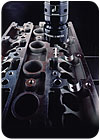
Rather than back-end detection, attention is shifting to front-end prevention. In-line probing by the machine tool during the machining process gives manufacturers the means to make 100% good parts, right the first time, in the lowest possible total processing time.
Integrating metal cutting and probing allows programmed actions to be taken by the machine tool based on data collected, eliminating downtime for operator intervention and giving confidence for lights-out unattended operation.
New offline probing software makes it easy to apply probing measurement feedback and process control logic without specialized programming or probing knowledge. Probing routines can be programmed and simulated offline on CAD/CAM systems in the same manner by the same people and at the same time as toolpath generation.
When the machine tool's process capability is established, automated probing can ensure that the process stays in control and the parts coming off the machine stay on specification. Probes can be programmed to monitor the process and automatically apply cutter compensation or adjust work coordinates-all helping to eliminate scrap, reprogramming or potential rework. Simply put, probing eliminates most causes of process variation. What results is a closed-loop process that requires no on-the-fly operator intervention.

Comprehensive Process Control
Machine-tool probing can increase machining efficiency and accuracy at nearly every stage of the machining process:• Setup. Used to locate the part automatically and establish a work coordinate system, probing cuts setup time, increases spindle availability, lowers fixture costs and eliminates nonproductive machining passes. For complex parts, 45 minutes of fixture alignment can be replaced by 45 seconds of probing, performed automatically by the computer numerical control (CNC).
• Fail-Safe Operation. Memory resident macro programs for probing allow work coordinate updates, tool geometry changes and part measurement to be automatically determined and updated by the CNC after the successful completion of a probing cycle. This eliminates errors resulting from miskeyed information or incorrect calculations.
• Part Identification. Probing can determine that the correct part has been loaded and call up the corresponding NC program, essential for automated part processing. This part ID procedure also yields a safe-machine sequence and delivers an added level of protection for the machine tool.
• Toolsetting. A toolsetting probe is an economical solution for on-machine verification of tool geometry and condition. The toolsetting probe can automatically set length, diameter and identify broken tools. After tool condition is known, a "sister" tool may be automatically called or an operator message may be issued.
• In-Process Control. This uses probing to monitor size and position of machine features during the cutting process. A probe can be programmed to monitor the process and automatically apply cutter compensation or adjust work coordinates-all helping to eliminate scrap, reprogramming or potential rework. A probing technique called artifact or reference comparison, lets machining centers test positioning accuracy against dimensional masters. The artifact is located in the machining envelope, typically mounted in the fixture or even integrated into the fixture. By probing the artifact before a critical machining pass, the CNC can check its own positioning against the master's known dimensions and program an offset to compensate for any discrepancy.
• First-Off Part Inspection. Probing makes first part inspection- to verify that the required dimensions have been achieved-seamless and automatic. Probing eliminates the delays and lost spindle time for manual inspection, particularly when the operator needs to tear down the setup to inspect the part, then reinstall it for any compensating cuts.
• Final Inspection. Used to inspect parts after machining, probing reduces the need for off-line inspection, and in some cases can eliminate it altogether. A traceable artifact, resident in the machine envelope, allows probing routines to compare final dimensions of the machined features to known dimensions for the reference master. Using on-machine probing to "buy off" a part while still fixtured can shorten in-process time, eliminating the need to remove clamps, transport the part to a coordinate measuring machine (CMM), refixture the part, account for thermal effects and reestablish datum points before measuring. Inspecting on the machine is particularly beneficial with large, expensive workpieces-such as molds or large aerospace parts-that can be especially difficult and time-consuming to move.

POINT-AND-CLICK Programming
New programming software provides intuitive menus, removing the need for knowledge of probing macro commands, which vary by machine controller and are a time-consuming method to produce inspection routines. A graphical user interface (GUI) enables importing of CAD models for probe-cycle generation. Prismatic features can be selected from a CAD model with single click capture to define the program, while a drag-and-drop interface uses the measured data to update machine parameters.Advanced software allows point-and-click automatic programming of surface normals, saving time and reducing manual input errors. The instructions required to control the probe are automatically inserted in the same post-process files as for toolpath.
Programming software can allow development of powerful probing routines for both contact probes and noncontact laser probes. Besides new program generation, existing programs can be reprocessed to include probing. The machining programs can be read and probing routines added at the desired points in the program, removing the need for cutting and pasting into text editors or on-machine editing.
After programs are completed, they may be fully simulated to identify errors and detect potential crashes. The software protects against stylus and probe collisions by flagging a warning if any move will violate the part being inspected. After simulation delivers a clean routine, programs can be post-processed for a variety of control systems. Operators can program and prove-out even complex probing operations, eliminating accidents that can occur with macro programming.
Establishing Machine Capabilities
Buying parts off the machine demands that the machine tool be able to produce parts to specifications. Being able to document the process capability and the accuracy of the machines, and proving control of the machining process, is the foundation of ISO 9000 and QS-9000. To do this, machines are inspected to a nationally recognized and accepted standard, such as ISO 230 or ASME B5.54. Both call for a ballbar and laser interferometer to be used with a recommended procedure for checking machine-tool accuracy.Technology advances are making this easier. First, today's standard machine tools deliver accuracy and repeatability approaching levels formerly available only on CMMs.
Second, test and calibration technologies are now available and affordable to enable shops to ensure the accuracy and health of their machine tools. Telescoping ballbars are affordable for most shops. Plants and large shops increasingly maintain their own laser interferometers and electronic levels, while rental equipment and diagnostics services are commercially available to small shops from various sources.
After a machine tool's performance as a measuring instrument has been established, the probe becomes the operator's CNC gage. It saves operators from using dial indicators and shim stock, or eliminates error in manually entering fixture, part and tools offsets into the control.
When operators can trust the machine tool's ability to move a probe around accurately and consistently, they can inspect the part immediately after cutting it without the extra time and costs for handling, refixturing and post-process inspection. Q
Looking for a reprint of this article?
From high-res PDFs to custom plaques, order your copy today!