Quality Innovations: Analyzer ‘Sees' the Light

The alloy content of these turnings is determined within seconds. The analyzer can quantify up to 25 elements simultaneously. Source: Thermo Electron Corp.
When it comes to analyzing alloy content in components on the shop floor, in a production setting, when speed is of the essence and accuracy is paramount, one of the handiest tools in the toolbox is a portable X-ray fluorescence (XRF) analyzer. But these handy instruments have had a drawback; one that recently has been solved.
X-ray fluorescence technology is a nondestructive technique for identifying and quantifying metal alloys. It works by subjecting a component to high-energy X-rays that contact the surface, and at the atomic level strikes an atom in the sample that dislodges an electron from one of the atom’s inner orbital shells. To fill the void, an atom from an outer shell drops into its place, and as it does, it releases excess energy in the form of fluorescent X-rays, the energy of which is measured in kiloelectron volts (KeV).
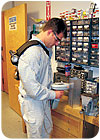
An operator tests for the alloy content of this component with a helium purge system. The 2.5-pound helium tank is harnessed on his back. Source: Thermo Electron Corp.
Traditionally, portable XRF analyzers were very good at analyzing higher alloy materials-those with elemental content from titanium and up on the periodic table. They could identify and analyze alloy materials from titanium to nickel super-alloys to high-temp nickel and stainless steel. They can screen for the presence of prohibited materials such as high-purity tin (Sn), selenium (Se), cadmium (Cd) and zinc (Zn) for aerospace applications and lead (Pb), chromium (Cr), Cd, bromine (Br) and mercury (Hg) for products going to countries in the European Union. And, it can do all of this in a matter of a few seconds and be accurate to within 2 sigma, or even better if the analysis is continued for more than those few seconds.
However, one of the biggest limitations of a portable XRF analyzer has been its inability to measure lighter elements in alloy materials, those below argon on the periodic table. This is because portable analyzers could only measure energy levels above 2.5 KeV. Lighter elements have energy levels below this threshold and are absorbed in the air that is found in the _ inch or so between the sample and the X-ray collector. For these elements, which include aluminum (Al) alloys, magnesium (Mg), silicon (Si) and phosphorus (P), other techniques were required.
Often optical emission spectroscopy was used, but its limitation was that it uses a spark, which burns a spot on the sample, and then measures the ultraviolet emissions from the spark. This is sufficient for some uses, but not for all, and certainly not for materials that could be damaged in any way.
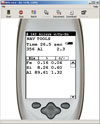
Thermo Electron’s proprietary software features a suite of data management functions and remote instrument operation through a wireless connection to a PC or PDA. Source: Thermo Electron Corp.
A nondestructive system, particularly a portable system was needed. The challenge was to bring the laboratory capability to a portable, point-and-shoot XRF analyzer.
“What we ran into,” says Thomas Anderson, marketing manager for Thermo Electron’s Niton Analyzers, “is that people love the technology; they love the handheld instrument. And it does a great job with higher alloy materials, but if they worked with aluminum materials, the instrument is limited.”
Now, however, Thermo Electron Corp. (Billerica, MA) has come up with a way to fill this void.
Light Element Analysis
Thermo Electron has developed a portable analyzer that can identify these lower elements. The Niton XLt898He system uses the helium purge technique in a portable format.
The solution was to create a tool with a sealed measurement head at the front of the instrument. The XLt898 fills the interior of the measurement head with pure helium, purging the air from the X-ray analysis path. This allows the light element X-rays to pass through and contact the high-resolution X-ray detector.
With this system, says Anderson, the instrument can detect the X-rays from the lighter elements and other materials that could not be attained in the past with a portable, nondestructive system. Now, the system can quantify Al, Si and Mg levels in aluminum alloys, Al in nickel and titanium alloys, and a host of other materials. As many as 25 different materials can be analyzed simultaneously.
The helium is carried in a harness that is strapped to the operator’s back. This may have connotations of large cylinders having to be lugged around the shop floor, but this tank weighs 2.5 pounds and its operating time typically last two to three days. Longer, in fact, than the 8 to 12 hours of charge given by the rechargeable lithium-ion batteries that power the system.
Standard testing modes include the Alloy Chemistry Mode and the Signature Match Mode. In the Alloy Chemistry Mode, the most commonly used mode, the analyzer uses the fundamental parameters calibration, which provides the specifications for pure elements and are stored in a library on the unit, to determine the chemical composition of the sample. After it determines the composition of the sample, it looks to the library to determine the alloy grade based on minimum and maximum specifications for each element programmed into the unit.

An XRF analyzer will identify the alloy content and the percentage of each alloy in this weld. Because of U.S. and European regulations, some alloys are banned above certain levels. Source: Thermo Electron Corp.
The system can capture and store as many as 6,000 readings, which is several days’ worth of testing for a typical shop, says Anderson. The XLt898He can be used with an RS-232 serial cable or an optional Bluetooth wireless connection so that it can connect wirelessly to a PC or PDA that has Bluetooth capabilities. Using one of three types of test stands to hold the instrument, the technician can remotely operate and monitor the analysis.
The software used is a proprietary suite of data transfer software called Niton NDT (Niton Data Transfer). In addition to remotely capturing the data, the unit can store the data on the PC in real-time as it collects it on the instrument.
“You can download all or any portion of the readings that are stored in the instrument,” says Anderson. “The NDT file format is completely encrypted and locked against any edits.” After the data is downloaded, the NDT software can produce reports, such as a certificate of verification, from any individual measurement. While the raw data cannot be edited, which is particularly important for some industries such as aerospace that requires complete disclosure, the system does allow the data to be downloaded to an Excel spreadsheet that can be edited for tailored report. “But,” says Anderson, “the NDT file is always intact. That is a bullet-proof means of proving out the data that was collected.”

Each analyzer comes with a holster to hold the analyzer until needed. Source: Thermo Electron Corp.
Regulatory matters
The Niton Xlt898He uses a miniature X-ray tube, which means that it will likely need to be registered with the state or country in which it is used. This varies by region.Anderson says that using a miniature X-ray tube as the excitation source generally does not carry the same regulatory burden as does other excitation sources, specifically sealed radioisotope. Thermo Electron offers instruments that use both technologies; each has its own advantages and disadvantages. The sealed isotope system is more rugged because it does not have an X-ray tube that will eventually fail; radioisotopes never fail and because they do not have an X-ray tube to power, battery life is longer.
However, it is not as precise as an X-ray tube system, and in most countries, including the United States, it carries far more regulatory burden because it is typically considered radioactive material, and it has to be licensed virtually everywhere. Some states require specific licenses, some states require a general license, and the regulations differ state by state. Also, Anderson says it can be more difficult to ship a radioisotope-based instrument into a state or move it from one state or region to another.
X-ray tube systems are more precise than its counterpart and are typically less burdensome as far as regulatory issues are concerned, Anderson says. They typically do not have to be licensed but do have to be registered in the state or country in which it is going to be used. One exception to that is Canada, where the regulatory burden is actually less for a sealed radioisotope than for an X-ray tube.
Another issue of which operators need to be aware is radiation exposure, but Anderson says that in correct use, this is not a major problem because of the low levels of exposure. New operators are provided training, and the company conducts free radiation safety training classes around the country on an ongoing basis.
“When used properly, users are exposed to less radiation than the background radiation that they come in contact with every day,” Anderson says. “Even though radiation levels are very low, the rule is to expose yourself to it as little as possible and to use standard operating procedures.”
TECHNOLOGY CONTACT
For more information on the
Niton XLt898He, contact:
Thermo Electron Corp.
Niton Analyzers HQ
900 Middlesex Turnpike, Building #8
Billerica, MA 01821
(978) 670-7460
(800) 875-1578
E-mail: [email protected]
URL: www.thermo.com/niton
Sidebar: Quality Specs
- Traditionally, portable X-ray fluorescence analyzers could accurately identify heavy element alloy content, but it could not identify lighter elements.
- The Niton XLt898He identifies lighter elements by purging the air with helium from the X-ray analysis path, allowing X-rays from lighter elements to contact a high-resolution detector.
- The unit can directly identify Al, Si and Mg levels in aluminum alloys, Si in steels, Al in nickel and titanium alloys, and a host of other elements.
Sidebar: XRF Analysis Process in Brief
- Primary X-ray energy is produced by the analyzer and directed at the sample surface.
- The primary energy causes inner-shell electrons to be ejected from their orbits in individual atoms.
- Vacancies left by ejected electrons are filled by electrons from outer shells, resulting in emissions of fluorescent X-rays, each of which is characteristic of the element from which it is emitted.
- The fluorescent X-rays enter the detector, which registers the individual X-ray events and sends electronic pulses to the preamp.
- The preamp amplifies the signals and sends them on to the Digital Signal Processor (DSP).
- The DSP collects and digitizes the X-ray events occurring over time, and sends the resulting spectral data to the main CPU for processing.
- The CPU, using various advanced spectral processing algorithms, mathematically analyzes the spectral data to produce a detailed composition analysis. For metal alloy samples, the resulting data is then compared against an internal table or library of minimum and maximum specifications to determine an alloy grade or other designation for the tested material.
- The composition data and any resulting identification is then simultaneously displayed on the instrument screen and stored in memory for later recall or download to an external PC.
Source: Thermo Electron Corp.
Looking for a reprint of this article?
From high-res PDFs to custom plaques, order your copy today!