Quality Magazine logo
search
cart
facebook twitter linkedin youtube
  • Sign In
  • Create Account
  • Sign Out
  • My Account
Quality Magazine logo
  • NEWS
  • PRODUCTS
    • FEATURED PRODUCTS
    • SUBMIT YOUR PRODUCT
  • CHANNELS
    • AUTOMATION
    • MANAGEMENT
    • MEASUREMENT
    • NDT
    • QUALITY 101
    • SOFTWARE
    • TEST & INSPECTION
    • VISION & SENSORS
  • MARKETS
    • AEROSPACE
    • AUTOMOTIVE
    • ENERGY
    • GREEN MANUFACTURING
    • MEDICAL
  • MEDIA
    • A WORD ON QUALITY PUZZLE
    • EBOOKS
    • PODCASTS
    • VIDEOS
    • WEBINARS
  • EVENTS
    • EVENT CALENDAR
    • IMTS
  • DIRECTORIES
    • BUYERS GUIDE >
      • Supplier Insights
    • NDT SOURCEBOOK
    • VISION & SENSORS
    • TAKE A TOUR
  • INFOCENTERS
    • Digital Quality Management Systems
    • NEXT GENERATION SPC & QUALITY ANALYTICS
  • AWARDS
    • ROOKIE OF THE YEAR
    • PLANT OF THE YEAR
    • PROFESSIONAL OF THE YEAR
  • MORE
    • Expert Columns
    • NEWSLETTERS
    • QUALITY STORE
    • INDUSTRY LINKS
    • SPONSOR INSIGHTS
  • EMAG
    • eMAGAZINE
    • ARCHIVES
    • CONTACT
    • ADVERTISE
  • SIGN UP!

Automate Thread Gaging

By Edward Neff
January 27, 2009
Automatic thread checking makes the job of 100% inspection easier and more accurate. Source: SMAC


The effort to reduce problems and increase durability in automobiles and other complicated mechanisms is a prime factor in quality control development. Statistics have played a major role in improvement. But producing the huge variety of parts and then assembling them forces the manufacturer to deal with a great number of variables, each of which has the ability to change and create problems.

A good quality control system has a number of key elements: controlled processes, good documentation and good data, along with the ability to verify the quality level of each individual product and filter out those not meeting the quality standard. It also should have the ability to adjust processes to eliminate problems.

A significant challenge has been finding the tools that can verify the quality level of individual products, particularly when the level of precision is high and the quantities are large.

Cameras and lasers have been applied to this problem with some success. But these devices are limited because of difficult shop environments and when the areas requiring inspection are internal-as with threads and bores.

Because of the push toward 100% inspection and the limitations of older technology such as lasers and cameras, a new generation of robotic devices are emerging, which overcome the limitations of these past technologies.

For instance, a linear rotary motor combination developed initially for precise electronic parts assembly has been successfully used in more than 100 field applications to 100% inspect machined threads on the shop floor.

The device is made up of a single pole linear motor whose piston carries a rotary servo motor. The linear motor is servo positioned using its integrated linear encoder. The single coil allows the operator to program speed, position and, uniquely, force. The rotary servo can be programmed in position speeds and torque modes as well.

The shaft has a manual thread gage attached to it and has several degrees of play allowing lineup of the gage to the automatically positioned part.

A standard go thread gage member attached to the end of the shaft of the linear/rotary actuator can be programmed to do this typical thread check operation as follows, based on the customer’s requirements:

The device is made up of a single pole linear motor whose piston carries a rotary servo motor. Source: SMAC

1. Rapid advance: The linear axis does a rapid advance close to the part to be inspected.

2. Soft-land: The linear axis searches for the part in a soft-land mode. The soft-land mode prevents damage from occurring to the thread gage member as well as damage occurring to the threaded part. After the soft-land is completed, the linear position can be checked to verify that the starting height is within a settable tolerance.

This also is useful when verifying that a counter bore is present. At this time, the linear position can be stored as a reference for the starting height location for that particular part setting in the fixture. This allows for flexibility of the height of the part setting in the fixture.

3. Locating first thread: This is optional. The rotary can rotate in reverse while the linear is monitored to locate the thread of the gage member and the first thread of the part is aligned. Also, double-tapped conditions can be checked for. The rotary position of the first thread is stored, and then the actuator rotates in reverse for 360 degrees while monitoring for another lead in thread on the part. If another thread is found, the part is failed and an error message can be sent. If another thread is not located, the actuator is back where it started, and this linear position can be stored as the reference starting height location.

4. Starting into the thread: The rotary starts running forward and, if the hole is threaded, the linear axis will begin extending. If the thread is not present, the linear axis will not extend indicating a “no thread present” error message as well as sending a failed part message.

5. Monitoring the threaded hole condition: The rotary continues to thread into the hole, and both axes are monitored for error conditions, rotary torque and linear position. Also, a target depth for a minimum thread depth condition is monitored. The minimum thread depth location can be calculated on the fly and can be based on the learned linear height reference position that was stored earlier in the cycle.

6. If there is a condition that would be considered a failure-for example, shallow/dull or broken tap, debris and cross threading-this is detected by the rotary axis and the part would be rejected. If the linear calculated minimum thread depth is achieved, and no failure conditions are detected to this point, the thread can be considered good, unless further testing is desired such as thread depth or oversized thread conditions. If so, continue to the next step. If these are not required then the cycle is completed.

7. Thread depth and oversized thread: If the complete thread depth is required, the actuator can continue threading in and monitoring for the bottom of the threaded hole. After it is located, the actuator can report the threaded hole depth as well as the number of threads. Now it can rotate in reverse to a pre-calculated location near the start of the threaded hole. After the linear axis locates the position, the rotary axis is stopped, and the linear axis can extend and store the position. From these two positions, the thread clearance can be calculated and compared to a pass/fail limit for the thread oversize condition.
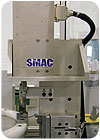
Automatic thread checking has become a much more economical solution than older generation noncontact methods. Source: SMAC

Data captured by the measurement sensors built into the actuator- encoders and current monitoring-can be analyzed in the devices’ controller or can be passed on to general data collection and analysis systems, or both.

An interesting additional benefit is in gage compatibility. Principal automatic measuring systems are checked periodically by off-line manual stations. If the two measurement methods are different-such as cameras and calipers, for example-this can lead to an error from the different measurement methods.

A better solution is always to use the same basic method in both the manual and automatic systems.

Certain thread check systems do just that. In fact these systems automate the normally used manual thread gage, and replace the human hand with a robotic one.

Robotic measurement tools:

  • Emulate manual measurement tooling methods

  • Are fast enough to match production rates and

  • Provide results that are changing the way manufacturers work to achieve zero defect production.

    Automatic thread checking, multi-axis coordinate measurement verification systems, robotic calipers and the like make the job of 100% check easier and more accurate. And as cost drops, they also become much more economical solutions than older generation noncontact methods. Q


  • Quality Online

    For more information on thread checking, visit www.qualitymag.com to read these articles:
    • “Effects of Screw-Thread Geometry”
    • “Follow the Thread”
    • “Tighten the Reign on Threading”


    • Tech Tips

    • A good quality control system has controlled processes, good documentation and good data.

    • Quality control systems should have the ability to verify the quality level of each product and filter out those not meeting the quality standard.

    • Successful quality control systems also should have the ability to adjust processes to eliminate problems.
    • Share This Story

      Looking for a reprint of this article?
      From high-res PDFs to custom plaques, order your copy today!

      Edward Neff is the president of SMAC Moving Coil Actuators (Carlsbad, CA). For more information, call (760) 929-7575, e-mail [email protected] or visit www.smac-mca.com.

      Recommended Content

      JOIN TODAY
      to unlock your recommendations.

      Already have an account? Sign In

      • 2024 Quality Rookie of the Year Justin Wise 1440x750px banner with "Quality Rookie of the Year" logo inset

        Meet the 2024 Quality Rookie of the Year: Justin Wise

        Justin Wise is an exceptional individual who has been...
        Aerospace
        By: Michelle Bangert
      • Man with umbrella and coat stands outside while it rains at night looking at a building.

        Nondestructive Testing: Is there an ethics problem?

        I was a whistleblower who exposed fraudulent activities...
        NDT
        By: Dale Norwood
      • Unraveling Deflategate: Football stadium with closeup of football on field

        Unraveling the Tom Brady Deflategate

        The Deflategate scandal erupted following the 2014 AFC...
        Measurement
        By: Greg Cenker and Henry Zumbrun
      Manage My Account
      • eMagazine Subscriptions
      • Newsletters
      • Online Registration
      • Subscription Customer Service
      • Manage My Preferences

      More Videos

      Sponsored Content

      Sponsored Content is a special paid section where industry companies provide high quality, objective, non-commercial content around topics of interest to the Quality audience. All Sponsored Content is supplied by the advertising company and any opinions expressed in this article are those of the author and not necessarily reflect the views of Quality or its parent company, BNP Media. Interested in participating in our Sponsored Content section? Contact your local rep!

      close
      • Key Takeaways for Quality Leaders
        Sponsored byComplianceQuest

        Key Takeaways for Quality Leaders from the 2026 Gartner Magic Quadrant™ for QMS

      • This image shows a person seated next to a Bobcat T66 compact track loader.
        Sponsored byPolyWorks by InnovMetric

        Supercharging Digital Gauging at Bobcat North America

      • Dorsey Calibration Lab photo by Tom LaBarbera Picture this Studios
        Sponsored byDorsey Metrology International

        Ensuring Product Quality in a Competitive Manufacturing Landscape

      Popular Stories

      iStock-1352825159-jpg.jpg

      U.S. Should Substantially Boost Support for Manufacturing USA Program, Issue National Industrial Manufacturing Strategy, Says New Report

      a factory floor during what appears to be a training session or a daily briefing

      The Root Cause of Defects We Rarely Name or Address

      Dorsey Calibration Lab photo by Tom LaBarbera Picture this Studios

      Ensuring Product Quality in a Competitive Manufacturing Landscape

      2026 Quality Professional of the Year!

      Events

      July 14, 2026

      Quality Leaders Forum: Better Communication, Better Quality Data

      The Quality Leaders Forum is a quarterly, editor-moderated fireside chat series hosted by Quality Magazine, featuring candid conversations with senior manufacturing and operations executives shaping enterprise-level quality.

      August 12, 2026

      Eliminate Manual FAI Processes and Reduce Inspection Time by Up to 90%

      Discover how advanced FAI software automates First Article Inspection workflows by generating inspection plans, validating results in real time, integrating 2D/3D data, and reducing quality escapes to improve efficiency and compliance.

      View All Submit An Event

      Products

      Lean Manufacturing and Service Fundamentals, Applications, and Case Studies

      Lean Manufacturing and Service Fundamentals, Applications, and Case Studies

      See More Products
      Rookie of the Year Custom Content

      Related Articles

      • Sorting Out Thread Gaging

        See More
      • Renishaw_Robot_Calibration_Cell.jpg

        Renishaw to Showcase Robot Efficiency Solutions, Advanced Gaging Systems at Automate 2026

        See More
      • Thread ring gages

        Adjustable Thread Ring Gages: Functional External Thread Inspection

        See More

      Related Products

      See More Products
      • Gaging and Inspection Tool Design DVD

      • Measurement and Gaging DVD

      See More Products

      Related Directories

      • Thread Check Inc.

        Thread Check Inc. is a full-service gage company offering a complete line of precision thread plug and ring gages, plain plug and ring gages, custom gauges, 3-wire thread measuring systems, API pipe gages, thread comparators, thread engineering software, gear measuring wires, measuring instruments, cutting tools, and calibration services.
      • Gage Assembly Co.

        Gage Assembly, a leading manufacturer of precision thread plug and ring gages, offers virtually every type of thread gage including American Inch, Metric, Acme, Buttress, Straight and Tapered Pipe, our size capabilities run from 000-120 threads per inch to 15 ½ inch diameter and one thread per inch. Superior wear and extended performance are achieved through fine tool steels and advanced calibrated inspection equipment.
      ×

      Stay in the know with Quality’s comprehensive coverage of
      the manufacturing and metrology industries.

      Newsletters | Website | eMagazine

      JOIN TODAY!
      • RESOURCES
        • Advertise
        • Contact Us
        • Directories
        • Manufacturing Division
        • Store
        • Want More
      • SIGN UP TODAY
        • Create Account
        • eMagazine
        • Newsletters
        • Customer Service
        • Manage Preferences
      • SERVICES
        • Marketing Services
        • Market Research
        • Reprints
        • List Rental
        • Survey/Respondent Access
      • STAY CONNECTED
        • LinkedIn
        • Facebook
        • YouTube
        • X (Twitter)
      • PRIVACY
        • PRIVACY POLICY
        • TERMS & CONDITIONS
        • DO NOT SELL MY PERSONAL INFORMATION
        • PRIVACY REQUEST
        • ACCESSIBILITY

      Copyright ©2026. All Rights Reserved BNP Media, Inc. and BNP Media II, LLC.

      Design, CMS, Hosting & Web Development :: ePublishing