Measurement
Making Better Height Gage Measurements
The quality of the result depends on the instrument and the care with which the operator handles the procedure.
The need for long range height measurements has been around since the principles of layout work became a fundamental requirement in machine shops. The first step in the manufacturing process is to lay out a piece by transferring a design or pattern to a workpiece. The common tools for layout work include a surface plate, a surface gage with scriber or dial indicator, and a long range height gage.
As with most inspection, the surface plate provides a reference plane for the part and the height gage. Height gages are used to set and mark a certain height on the workpiece, or to measure the piece after it has been machined.
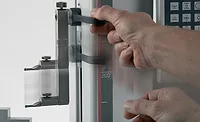
The height gage is a conceptual extension of the handheld caliper gage, except that it rests on a heavy base that keeps the scale square to the surface. Originally, when used for layout work, height gages had a beveled pointer on the moveable jaw that was sometimes used to mark or scribe the part, or, by setting the reference height on the base surface, the scribing point was used to find a height characteristic on a part and display it on the gage’s readout. Today height gages are really designed to do what their name implies— measure heights—but also diameters, distances and even bolt circle patterns. So instead of a beveled pointer, a family of interchangeable contact points is available with a vast array of diameters and shapes, even with offsets to get into virtually any characteristic on a part.
Types of Height Gages
There are three types of basic height gages. The classic Vernier height gage has been around for 100 years or so, and is still used by those machinists who feel really comfortable counting grads to make sure their readings are correct. The circular scale height gage uses a dial indicator to set the measurement height. And the most recent addition is the digital height gage that allows for direct reading of the height or even setting zero locations at places other than the reference surface plate. Add a small computer based controller and a motor, and all types of parameters can be checked, programs created and data analyzed.
Digital height gages are available in sizes up to 40 inches, and usually incorporate a rapid hand crank or motor to help speed positioning for scribing or measuring. Some models also incorporate a quick-adjusting release that allows the moveable measuring point to be moved directly to the location of the check before the measuring system takes over.
Measurement Setup
Using a manual height gage is simple. Once you have the height gage set in place, there are two critical references that need to be established. The first is the zero-reference for the measuring system. With automated height gages, this is done automatically whenever the gage is turned on. In a manually driven gage, the gage must be zeroed on the granite plate before it can be used. With a motor driven unit, the gage will automatically move down to touch the surface to set its reference point. It’s not a bad practice to initiate this zeroing routine a second time, just to make sure that no dirt or other anomaly has introduced an incorrect reference. Since setting this reference is critical to all the measurements you will make, it is certainly worth the time and effort.
The other important reference is the correction for probe ball diameter. If a height gage is to be used only for length measurements taken with the probe moving down, then probe diameter is not important. The contact point of the probe will be the same as in zeroing. But, if grooves, diameters, or hole locations are being measured, or if any measurements are taken with the probe moving upwards, then the probe ball diameter must be known and taken into account.
TECH TIPSSince the height gage is used with a surface plate, it is only as good as the plate, which provides the reference for the part and the gage. Next to dirt, the actual surface of the granite surface plate will play a key role in the performance of the gage. Any slight imperfection of the surface between where the part and the gage are staged will get amplified by the height of the measurement. |
Ball diameter is specified for the probe, of course, but there is always some degree of variation. Actual ball diameter should be added to any dimension that is probed in the upward direction.
On height gages that have even the most basic electronic control this dimension can be measured as part of a setup routine and is automatically included in all measurements. The automated process uses a fixture provided with the gage, or the test can be simulated with a couple of gage blocks. The fixture sets up a plane that is measured by the gage from both directions. The gage then looks at the difference between the two measurements and calculates this as the ball diameter.
The same gage block check can be done by hand on purely manual machines, or the ball diameter may be measured off-line with a micrometer. Just as with setting the zero reference, this check should be repeated a number of times. A lot of gages will provide this repeat check automatically and reject the ball diameter reference if it does not repeat to within a preset limit.
Failing to recheck for ball diameter when a probe tip is changed can be a deadly pitfall. Going from a 10-mm to a 5-mm ball tip would be disastrous if not recalculated.
Making a Measurement
Now you’re ready to begin making a measurement. With a manual gage, simply bring the sensitive contact up to the designated height and touch off on the surface being measured. With a small workpiece, it is usually easier to bring the part to the gage, but if the gage is lighter, bring it to the workpiece. The analog dial or digital counter will give you the height you are looking for.
With the new motorized digital versions, measurement is an easy key stroke function, but the process is very similar. A button on the height gage controller commands the measuring contact to move down to the surface plate to set its zero. (There are other setup parameters in the background that set contact speed, settling time and gaging pressure to help ensure repeatable zeroing and measuring). When ready to make a measurement, say a height in reference to the zero point, slide the measuring carriage up over the part and press the height measurement button, approaching from the top. The motorized drive will bring the contact to the surface and the measurement is completed and displayed.
However, with the modern height gage this only begins the measuring capabilities. As measurements are made they are stored, and from the measurement, data heights, midpoints, diameters and relationships are only a keystroke away. The automation of height gages with digital control and motorized slides has also sped up the measuring process and made the systems more and more repeatable by taking operator influence out of the measuring cycle.
Sources of Error
Regardless of type, all height gages have a similar inherent problem: they measure height. And the larger the height gage, the bigger the potential problem.
It’s not the actual height that’s the problem. It’s the relationship of the height to the base. Like a lever, the longer the arm, the larger the multiplied force. With a height gage this can be a problem, not only of errors coming from the gage itself, but also errors in the setup. These get magnified and can potentially distort an otherwise carefully planned comparison.
A major error in the design of a basic height gage is taking a design that was meant to measure 12 inches and simply extending the post to measure 36 inches, without changing the base design or the cross-area of the measuring post. What then naturally happens is that the gage will tend to wobble and flex. Although you may not be able to see the 0.001 inch wobble, it can become a significant part of the part tolerance and certainly influence the measurement.
A normal step in trying to increase the performance of the gage is to beef up the column to reduce the flexure of the post. However, this is only a partial improvement, as such a gage may still tend to be top heavy. What’s needed is to make the base longer and wider, and build in some mass. Decreasing the ratio of the post to the base will significantly improve performance.
Since the height gage is used with a surface plate, it is only as good as the plate, which provides the reference for the part and the gage. Many surface plates are clean and well maintained, but others may not be as clean as they look. A small metal chip or even a hair, while almost impossible to see, could throw off the measurement by 0.020 inch at a height of only 10 inches.
Next to dirt, the actual surface of the granite surface plate will play a key role in the performance of the gage. Any slight imperfection of the surface between where the part and the gage are staged will get amplified by the height of the measurement. Most surface plates have a flatness spec of 50 microinches. If the base is six inches long, a 50 microinch error would grow to more than 0.0003 inch over a 36 inch height, and even more if the plate is out of spec.
Improving Measurement Results
As with any measurement, the quality of the result depends on the measurement instrument and the care with which the operator handles the measurement procedure. Height gages, for example, are most often used in the lower 300 mm/12 inches of their range. With any length measuring system, accuracy degrades the further you move from the reference point. If measuring on the upper end of the scale, performance can be improved by zeroing on a 300mm/12 inch gage block, or something closer to the midpoint of the operating range for the particular test piece.
Height gages are also particularly susceptible to temperature. Thus, any heat conveyed to elements of the measuring circuit (base plate, test piece, height measuring instrument, stylus) can cause local heat expansion and thus measurement error. For this reason:
- Only touch the height measuring instrument at the points provided for this purpose: handle, plate for resting the hand, switch for activating the air bearings. Do not touch other elements of the measuring circuit.
- Avoid locating the gage where there are likely to be any drafts or direct sunlight.
- Do not set up the measuring station in the proximity of radiators.
- Avoid touching the test piece directly before the measurement with your bare hands. Use gloves.
- Do not check test pieces that were recently transported through very hot/cold rooms.
- For high precision measurements: put the test piece on the base plate and let it adapt to ambient temperature (approximately ¼ hour to eight hours depending on part size).
Other good height gaging practices include the following:
Generally, use the air bearings only for positioning the height measuring instrument before a measurement. If the air bearings are required during the measurement (e.g., of heavy test pieces), the reference point should also be measured with the air bearings switched on.
Gages with motor drives tend to improve performance by using a constant gaging force as the test piece is measured. When using hand-wheel driven gages, try to use the same “touch” when contacting the part’s surface.
Whenever two elastic bodies contact one another, they bounce for a short time. This is also true when the stylus contacts the test piece. During this time, the measuring values “oscillate” accordingly. Thus, the instrument has to wait until the measuring value is stable before it acquires the value: adjust the gage settling time to best match the application.
Long contact points—especially those with small contacts and narrow extensions—are apt to flex when they contact the part. It may be necessary to build contacts with “bridge” reinforcements if deflection is noticed.
With experience and by following these steps, these giant calipers can become an inspector’s best friend.
Looking for a reprint of this article?
From high-res PDFs to custom plaques, order your copy today!