Quality Magazine logo
search
cart
facebook twitter linkedin youtube
  • Sign In
  • Create Account
  • Sign Out
  • My Account
Quality Magazine logo
  • NEWS
  • PRODUCTS
    • FEATURED PRODUCTS
    • SUBMIT YOUR PRODUCT
  • CHANNELS
    • AUTOMATION
    • MANAGEMENT
    • MEASUREMENT
    • NDT
    • QUALITY 101
    • SOFTWARE
    • TEST & INSPECTION
    • VISION & SENSORS
  • MARKETS
    • AEROSPACE
    • AUTOMOTIVE
    • ENERGY
    • GREEN MANUFACTURING
    • MEDICAL
  • MEDIA
    • A WORD ON QUALITY PUZZLE
    • EBOOK
    • PODCASTS
    • VIDEOS
    • WEBINARS
  • EVENTS
    • EVENT CALENDAR
    • IMTS
  • DIRECTORIES
    • BUYERS GUIDE >
      • Supplier Insights
    • NDT SOURCEBOOK
    • VISION & SENSORS
    • TAKE A TOUR
  • INFOCENTERS
    • Digital Quality Management Systems
    • NEXT GENERATION SPC & QUALITY ANALYTICS
  • AWARDS
    • ROOKIE OF THE YEAR
    • PLANT OF THE YEAR
    • PROFESSIONAL OF THE YEAR
  • MORE
    • Expert Columns
    • NEWSLETTERS
    • QUALITY STORE
    • INDUSTRY LINKS
    • SPONSOR INSIGHTS
  • EMAG
    • eMAGAZINE
    • ARCHIVES
    • CONTACT
    • ADVERTISE
  • SIGN UP!
NDT

The Importance of Force Testing

Force measurement results arm quality professionals with the data they need to ensure a reliable supply of high quality products.

By Mark Fridman
November 9, 2015

A truck driver, seeking to overtake another vehicle, flips his turn signal. A busy mom opens the door to a washing machine. A CNC machine operator presses the start button to begin a cycle.

Throughout these everyday occurrences, a force was applied to a part or assembly to engage it. As consumers and employees, we are accustomed to applying a certain amount of force to accomplish a task. This amount of force is not coincidental, as engineers take into account the intended use in the design process. Whether meeting human ergonomics, safety, or other requirements, manufacturers must thoroughly evaluate samples from production lines to ensure that these specified forces remain consistent. 

Numerous force tests result in sample destruction, such as the peeling force of a sealed medical device pouch or the crushing force of a pharmaceutical tablet. However, the focus here is on nondestructive force measurement, which engages an item in a way that does not preclude it from onward use. Let’s take a look at some applications:

Typical Nondestructive Force Measurement Applications

Spring testing

The first coiled spring appeared in the 15th century, and although advancements in materials and manufacturing processes have greatly increased their consistency and cost effectiveness, the basic operating premise remains. Springs are designed to store and release mechanical energy by changing the length of the spring itself. Tension (extension) and compression springs of many force ranges are used in countless products we use every day, from ballpoint pens to cars. For any spring, verification of the spring rate is critical. Determining this rate is accomplished by compressing or extending a sample until a desired deformation is achieved. Dividing the resulting force by the change in height equals the spring rate.

Wire crimp pull testing

Wiring harnesses help power and control everything from refrigerators to commercial aircraft. In helping to prevent failures, the quality of crimped terminals can be assessed by measuring the force required to pull off a terminal—a destructive test. However, nondestructive tests, such as those prescribed under UL 486 A/B, require a specified load to be applied to the sample for a specified period of time. If the terminal remains attached, the sample is considered acceptable.

Flip caps

Force measurement cannot escape us, even while taking a shower. Shampoo and hair care bottles are a perfect example of nondestructive forces. A common shampoo bottle contains a flip cap, featuring a small tab that can be flipped up by the user and re-secured. The amount of force required to flip the cap open, and then click it closed again, must be closely monitored to ensure acceptable operation by the consumer. A cap that was too easy to flip open might cause a spill, while one that is too tight would frustrate the bather.

Force Measurement Instrumentation

Measuring force is achieved with a wide range of portable and cost-effective instrumentation, reflecting the complexity and force range required for the test. In any force test—destructive or nondestructive—a minimum force requirement or force range is established by the manufacturer and test results are compared to these acceptance criteria.

Force gage

One of the most basic force measuring instruments is the digital force gage, a handheld device containing a load cell and digital readout. The gage will typically display force in units of pounds, Newtons, or kilograms. A force gage is at home in virtually any lab or tool crib, and is a versatile instrument for numerous destructive and nondestructive requirements. Force gages are available in a wide range of force capacities, generally from 0.12 lbF (0.5 N) full scale up to 2,000 lbF (10 kN).

Test stand

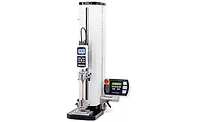
Although handheld force gages are useful in basic measuring applications, it should be mounted to a test stand for better accuracy and consistency in more stringent testing environments. Test stands axially align the force gage and provide ample fixture mounting locations. Certain samples are more sensitive to off-axis loading, as extraneous stresses can lead to an invalid test result.

Test stands vary by force capacity, sample size, and loading type, but motorized versions are recommended because of their ability to move at a consistent rate of speed. Consistent speed reduces variability from operator to operator, which can affect the accuracy of measurements in some cases.

For tests requiring the characterization of a sample based on force and deflection, such as spring testing, travel measurement is a generally available option.

Accessories

Thousands of different sample holding fixtures were developed over the years to cover a broad range of industries and requirements. However, tool and die makers are still needed for unique sample dimensions or testing needs.

Making Sense of the Data

Data is typically transferred from the instrument to a PC via USB or RS-232 communication in one of the following ways:

Discrete data points

Individual data points may be saved from multiple tests, typically a collection of peak force measurements, such as the force required to flip open a bottle cap.

Discrete force data points at a specified distance

The force measured at a specified distance is common in applications such as spring testing, foam testing, tensile testing of materials, and other applications.

Continuous output of force vs. time

A continuous output of force vs. time, with corresponding graph, can help the user better understand the behavior of a material or assembly. For example, an acceptable sample may produce a straight curve from the start of the test to the finish. An unacceptable sample can be detected if the graph is bowed, for example, or has spikes or other anomalies.

Continuous output of force vs. deflection

As with force vs. time, a graph of force vs. deflection is helpful in evaluating the performance of samples which compress or stress in a controlled manner, such as springs, elastomers, foams, etc. Advanced materials testing values, such as Young’s Modulus, rupture, and ultimate tensile strength may be calculated from the raw force and deflection data.

Force measurement instruments and their associated data collection software can automatically calculate statistics from the test data to provide actionable data for quality control managers.

Conclusion

Through the use of nondestructive force measurement techniques, many materials, assemblies, and components can be properly evaluated without damaging them. Force measurement results arm quality control and production professionals with the data they need to ensure a reliable supply of high quality products, the way their engineers intended.

KEYWORDS: deflection wire crimp pull testing

Share This Story

Looking for a reprint of this article?
From high-res PDFs to custom plaques, order your copy today!

Mark Fridman is the president of Mark-10 Corp. (Copiague, NY). For more information, call (888) MARK-TEN, e-mail [email protected] or visit www.mark-10.com.

Recommended Content

JOIN TODAY
to unlock your recommendations.

Already have an account? Sign In

  • 2024 Quality Rookie of the Year Justin Wise 1440x750px banner with "Quality Rookie of the Year" logo inset

    Meet the 2024 Quality Rookie of the Year: Justin Wise

    Justin Wise is an exceptional individual who has been...
    Aerospace
    By: Michelle Bangert
  • Man with umbrella and coat stands outside while it rains at night looking at a building.

    Nondestructive Testing: Is there an ethics problem?

    I was a whistleblower who exposed fraudulent activities...
    NDT
    By: Dale Norwood
  • Unraveling Deflategate: Football stadium with closeup of football on field

    Unraveling the Tom Brady Deflategate

    The Deflategate scandal erupted following the 2014 AFC...
    Measurement
    By: Greg Cenker and Henry Zumbrun
Manage My Account
  • eMagazine Subscriptions
  • Newsletters
  • Online Registration
  • Subscription Customer Service
  • Manage My Preferences

More Videos

Sponsored Content

Sponsored Content is a special paid section where industry companies provide high quality, objective, non-commercial content around topics of interest to the Quality audience. All Sponsored Content is supplied by the advertising company and any opinions expressed in this article are those of the author and not necessarily reflect the views of Quality or its parent company, BNP Media. Interested in participating in our Sponsored Content section? Contact your local rep!

close
  • Key Takeaways for Quality Leaders
    Sponsored byComplianceQuest

    Key Takeaways for Quality Leaders from the 2026 Gartner Magic Quadrant™ for QMS

  • This image shows a person seated next to a Bobcat T66 compact track loader.
    Sponsored byPolyWorks by InnovMetric

    Supercharging Digital Gauging at Bobcat North America

  • Dorsey Calibration Lab photo by Tom LaBarbera Picture this Studios
    Sponsored byDorsey Metrology International

    Ensuring Product Quality in a Competitive Manufacturing Landscape

Popular Stories

This image shows a person seated next to a Bobcat T66 compact track loader.

Supercharging Digital Gauging at Bobcat North America

a professional in the aviation field performing maintenance, repair, and overhaul (MRO) work

Manufacturing Retention: Strategies for Improving Company Culture, Engagement and Skill Development

Dorsey Calibration Lab photo by Tom LaBarbera Picture this Studios

Ensuring Product Quality in a Competitive Manufacturing Landscape

2026 Quality Professional of the Year!

Events

June 22, 2026

Automate 2026

Automate is North America's largest robotics and automation event — and the best place to take your ideas from insight to impact.
 
Our show floor features the world’s leading automation solutions, from AI and robotics to motion control, vision systems, and more. Plus, our educational conference is second to none, led by the brightest minds in automation today.
 
Ready to transform the way you work? Take the next step at Automate.
July 14, 2026

Quality Leaders Forum: Better Communication, Better Quality Data

The Quality Leaders Forum is a quarterly, editor-moderated fireside chat series hosted by Quality Magazine, featuring candid conversations with senior manufacturing and operations executives shaping enterprise-level quality.

View All Submit An Event

Products

Lean Manufacturing and Service Fundamentals, Applications, and Case Studies

Lean Manufacturing and Service Fundamentals, Applications, and Case Studies

See More Products
Quality Podcast Channel Custom Content

Related Articles

  • A force measurement testing machine is shown with a pair of wedge-action grips.

    The Importance of Grip Selection in Force Measurement

    See More
  • quick connection tool

    Leak Testing Trends, Best Practices & the Importance of the Connection

    See More

Related Products

See More Products
  • ZEuCDwAAQBAJ.jpg

    Lean Six Sigma In The Age Of Artificial Intelligence: Harnessing The Power Of The Fourth Industrial Revolution

  • Failure Mode Effects Analysis (FMEA) DVD

  • Building Lean Supply Chains with the Theory of Constraints

See More Products

Related Directories

  • Starrett Co., The L.S.

    Founded in 1880, The L.S. Starrett Company is a leading global manufacturer of precision measuring tools and gages, optical comparators and vision systems, force and material testing and hardness testing solutions. Starrett also manufactures laser measurement systems, custom engineered granite solutions, custom gaging, band saw blades, power tool accessory saw blades, workshop tools and jobsite tools.
  • American Institute of Nondestructive Testing

    The American Institute of Nondestructive Testing offers online and hands-on training in RT, UT, ET, MT, PT and VT nondestructive testing methods. Let us customize an NDT training program that fits your company's needs. We offer training online, at your facility or at our 22,000 Sq Ft facility.
×

Stay in the know with Quality’s comprehensive coverage of
the manufacturing and metrology industries.

Newsletters | Website | eMagazine

JOIN TODAY!
  • RESOURCES
    • Advertise
    • Contact Us
    • Directories
    • Manufacturing Division
    • Store
    • Want More
  • SIGN UP TODAY
    • Create Account
    • eMagazine
    • Newsletters
    • Customer Service
    • Manage Preferences
  • SERVICES
    • Marketing Services
    • Market Research
    • Reprints
    • List Rental
    • Survey/Respondent Access
  • STAY CONNECTED
    • LinkedIn
    • Facebook
    • YouTube
    • X (Twitter)
  • PRIVACY
    • PRIVACY POLICY
    • TERMS & CONDITIONS
    • DO NOT SELL MY PERSONAL INFORMATION
    • PRIVACY REQUEST
    • ACCESSIBILITY

Copyright ©2026. All Rights Reserved BNP Media, Inc. and BNP Media II, LLC.

Design, CMS, Hosting & Web Development :: ePublishing