Measurement
Increase Efficiency through Better Part Quality Communication
There are many ways to collect, manage, and search data generated in the course of an ongoing metrology operation.
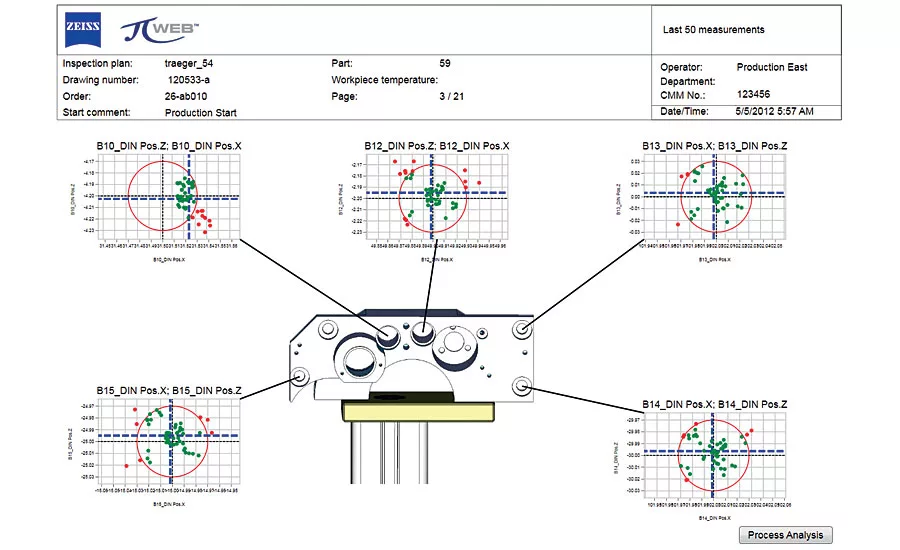
Graphics present a lot of data quickly and clearly. Source: Zeiss
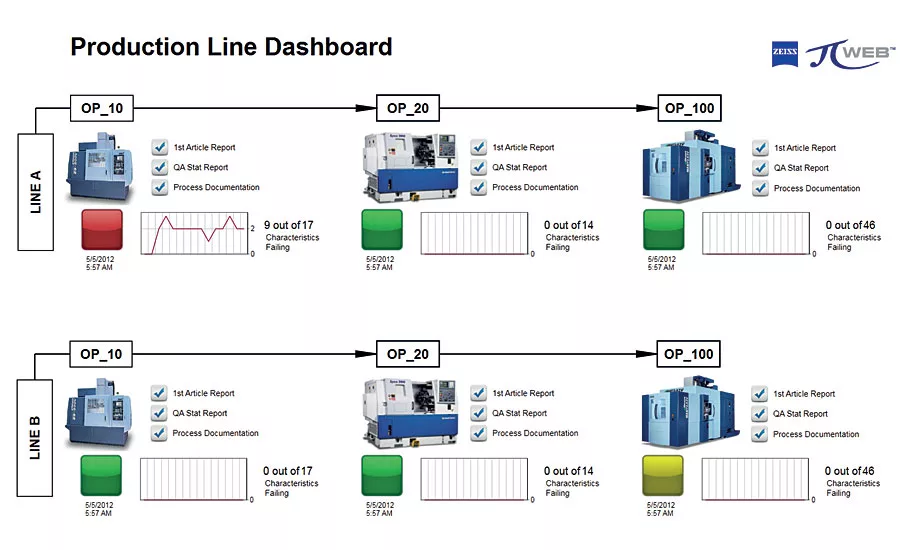
A dashboard can provide an overview of an entire operation, allowing engineers to navigate from high level indicators to more specific measures.
Source: Zeiss
Modern manufacturing relies on consistency, and tolerances are tighter than they’ve ever been. Production capabilities are up to the task, and CMM systems help ensure that completed or in-process parts are within tolerance. The real challenge comes when anything goes wrong. The CMM can tell that a part is out of spec, but that’s just a symptom and rarely provides enough information to identify and correct the problem. The standard first question is “Is there a trend; will this be an ongoing problem?” It’s not an easy question to answer since the cause could be in a fixture, in the tooling, in the stock material, or elsewhere.
It’s the kind of challenge a doctor faces in an initial patient visit. The patient presents a symptom, and the doctor’s job is to identify which of many possible causes to treat. Uninformed treatment can be ineffective or even harmful, and a trial-and-error approach will almost certainly waste valuable time. The experienced doctor’s approach is to collect as much additional information as possible—health history, X-rays, blood tests, and the like—and to add that additional data to the base of information provided by the patient. With this expanded knowledge, the doctor can proceed to narrow the possibilities, delve further if necessary, diagnose the problem, and prescribe effective treatment.
A comprehensive metrology reporting system lets production or quality engineers do the same thing when the symptom is an out-of-spec part: explore all aspects of previous measurements, look for trends, move from “big picture” to detailed views of data, and share information with multiple parties to quickly diagnose and correct the causes of the symptom.
There are many ways to collect, manage, and search data generated in the course of an ongoing metrology operation. In its simplest form, data on individual parts can be written or printed and attached to the part; that’s fine for confirming that a part is in spec but not very helpful in diagnosing a problem. Data can be entered into spreadsheets and filed; more effective for aggregating data, but not a very effective way to store data or easy to search. Or data can be automatically entered into a comprehensive, searchable reporting package.
Clearly, if you’re going to the trouble of measuring parts for compliance to spec, the goal is to be able to act as quickly and effectively as possible when an anomaly is found. An effective reporting capability can help diagnose problems quickly, reduce scrap and the need for rework, and keep the whole production process moving. Considering the potential cost of producing bad parts and idling a production line, a comprehensive reporting capability can be extremely cost effective.
AGGREGATION OF DATA
Like a doctor’s diagnostic process, information used to diagnose a production problem can come from multiple sources. It isn’t unusual for a production floor to use measuring systems from several manufacturers, each with its own format for data output. A reporting system that can aggregate them into a single set of reports, as opposed to a system that only provides reporting on a single equipment brand, can shorten the path from problem to cause to solution.
MULTI-LEVEL INSIGHT
The ability to view data at any scale, from high-level overview to close up detail, can allow engineers to rapidly move from the general to the particular in diagnosing a problem. A dashboard can provide a “fifty-thousand foot” overview of an entire operation, highlighting those areas where measurements have crossed preset thresholds. This can indicate the development of problems even before parts have reached the point of unacceptability, allowing emerging issues to be nipped in the bud, before they impact yield. Such a system can allow engineers to drill down from high level indicators to more specific measures. This kind of hierarchical data structure eliminates the need to waste time digging for relevant information or be deluged with too much information to actually be able to spot problems before they call attention to themselves.
ACCESSIBILITY AND DATA SHARING
Reach makes a difference. Traditionally, the quality department “owns” measurement data and handles all problems, large or small. In many cases, a smarter distribution of responsibility will allow some problems to be handled closer to the production floor without having to queue for overbooked quality engineers. This can be difficult when reporting is closely held; a preferable approach is to make data readily accessible across the manufacturing operation. And when a problem is more complex—identifying an anomaly, diagnosing the problem, tracking down its cause and correcting it—several individuals and skillsets may need to access data and focus on different aspects of the problem. Reporting will be most effective when it can be shared across process engineering, quality control, and management areas, rather than being sequestered within a limited area.
FLEXIBILITY
Every manufacturing operation is as unique as the products being manufactured. So it just makes sense that reporting formats should be flexible enough to precisely fit the needs of different audiences and processes. Without that flexibility you could only hope that the available formats meet your current and anticipated future needs. And while “close” may seem acceptable, remember that on the production line, time really is money. Setting up PPAP and first article inspection reports (FAIR) can take significant time and energy and sometimes delay production. A flexible reporting package can help develop those documents much faster and in your own form instead of tying you to a software’s pre-designed format.
GRAPHICAL PRESENTATION
You can argue about the relative value of words and pictures, but when it comes to representing a complex part, pictures win hands down. While text, tables, or charts may provide useful information, they cannot present as much data as quickly and clearly as a graphic. Graphics are ideal for highlighting variation between a part’s CAD model and the actual part, and can be of enormous help in diagnosing and correcting a problem.
EASE OF USE
When it comes to software, a claim of “user friendliness” is the price of admission. What feels friendly to a software designer may seem less friendly to an engineer in the field with a serious production problem. No one can tell you what your view of user friendly might be, but a hands-on demo will help you make that decision. Capabilities like custom report design and graphical presentation can contribute to a package’s usability.
DATA STORAGE AND MANAGEMENT
Clearly, a production system is going to gather a lot of data, probably involving a number of different projects and designs. Much of this data will need to be stored for some time, and there’s no way to know for certain what data will need to be accessed, and in some cases whether it will need to be accessed at all. As the volume grows, the challenge isn’t just having the data; it’s being able to find exactly what you need quickly when the need arises. It’s being able to provide access for everyone who needs it and controlling the permissions of those who have access. At the same time, there’s the challenge of protecting sensitive product data from the unauthorized. Utilizing a company’s active directory login credentials and ensuring suitable encryption of the data should be explored. And, to keep storage and reporting systems efficient and control costs, you must be able to purge what is no longer needed and compress what isn’t needed now.
A REPORTING CHECKLIST
An ideal reporting system is one that:
- handles input from multiple brands and systems
- allows secure sharing of information
- permits format customization
- provides high-level overview with easy drill-down for detail
- supports graphical data presentation
- is demonstrably user friendly
- permits efficient data storage, search, purging, and compression
Q
Looking for a reprint of this article?
From high-res PDFs to custom plaques, order your copy today!