Silicone Optics Deliver Maximum Light Control at Minimum Cost
Optical-grade silicone is set to change the solid-state lighting industry by enabling injection molding of complex optical designs that combine some of the best properties of glass and plastics.
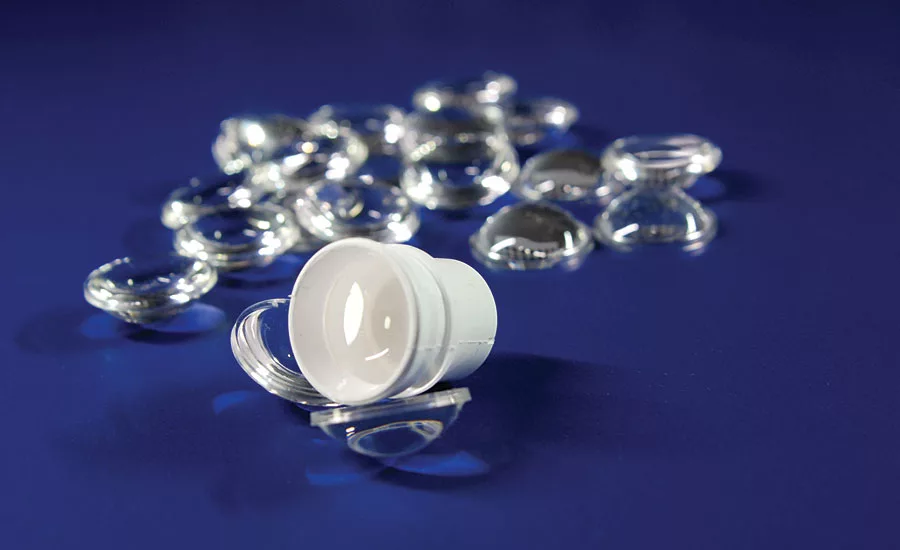
A two-part silicone optic accommodates a wire polarizer in an ultra-high-power line-scan light for industrial imaging applications. Source: Smart Vision Lights
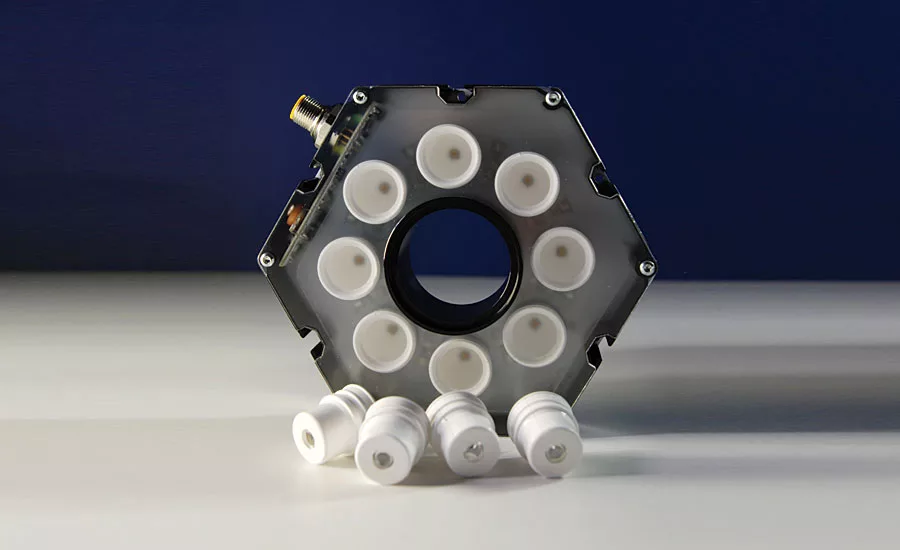
With a light that generates five million lux, only silicone optics could withstand such heat without significant degradation over time. Source: Smart Vision Lights
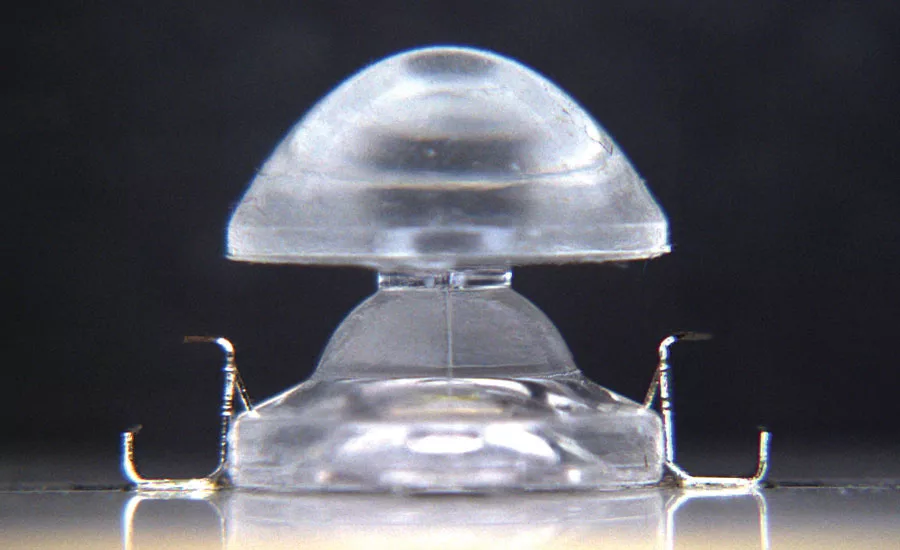
The silicone optic comprises two 40-mm molded large-aperture silicone lenses placed back-to-back. Source: Smart Vision Lights
When it comes to cameras and the need for high-quality optics, lenses often represent the majority of the component costs. Multipart complex optical designs require the highest-quality glass or other optically transparent materials, as well as precision design and manufacturing processes, all of which add to the cost of the lens.
But while a camera may need a lens to collect and focus the light on a focal plane, it’s capturing the light emitted from many different light sources. For today’s architectural and industrial imaging applications, those light sources are increasingly high-efficiency solid-state LED lights.
SILICONE OPTICS: TAILOR-MADE FOR LEDS
LEDs offer numerous benefits, including greater spectral control, low cost, high efficiency, and low maintenance. However, solid-state emitters are similar to their incandescent ancestors in one critical way: They emit light in all directions.
When an application needs more light, the traditional solution is to add more bulbs. The same holds true for LED lights. Unfortunately, more bulbs consume more power and generate more heat, neither of which is efficient or desirable. LEDs are much more efficient at converting electrical power into light than incandescent, fluorescent, and gas-discharge (halogen) lamps. But to make them even more efficient, the lamp needs to collect all of the available light and direct it where it needs to be. This is an important goal for any lighting application, but in the machine vision world, controlling light is critical to success, whether it be generating bright field, dark field, diffuse, structured, polarized, or some combination of these different types of lighting systems.
Unfortunately, standard glass molding and grinding methods would result in micro lenses that far exceed the chip in cost. Plastic-molded optics are another option, but plastics yellow over time, especially in the presence of ultraviolet (UV) light; are not resistant to high temperatures found in lighting applications, leading to crazing (developing microscopic cracks) and other adverse conditions; and cannot hold fine features required of complex optical design, among other shortcomings. Attempts to add phosphors to the plastic materials to improve plastic optical performance have seen limited success.
Silicone optics overcome all these challenges and more. Silicone optics allow end users to control light with precision only found in complex glass optics—optics far too expensive for the majority of architectural or machine vision applications.
WHAT MAKES SILICONE SPECIAL
New optical-grade silicones offer an alternative for lighting manufacturers. Unlike glass and plastics, silicone:
- does not age like polycarb, vinyl, or acrylic.
- does not yellow with time.
- does not craze due to heat, exhibiting no material changes in temperature ranges from –115°C to 200°C.
- does not react to UV light.
- does not react with most harsh chemicals.
- offers high transmission across a broad spectrum, with 95% transmission or better from 365 nm (UV) to 2000 nm (IR).
While silicone offers these material benefits compared to plastic molded lenses, it also offers advanced manufacturing benefits. For example:
- Silicone is very robust. It maintains its optical function over its lifetime and is resilient to changes in the environment.
- Optical-grade silicones are capable of holding fine structure patterns and can possess reverse curves in a single molding tool; this cannot be done in conventional plastics.
- Silicone’s ability to form complex optical elements using multiple shots in a single injection mold allows for a lower total cost solution for complex, multipart optics.
MORE LIGHT, FEWER LAMPS, BETTER CONTROL
The benefits of silicone optics are numerous, and all have their root in the unique properties of the silicone molecule. Its long, spaghetti-like structure results in a liquid that slowly cures into a flexible solid with a low index of refraction, which lowers light losses at the interface between optic and air or multipart optics.
Despite retaining a flexible semi-rigid shape, silicone’s liquid origin means it can be formed into very fine structures below 10 nm to create diffractive, holographic, Fresnel, and other optical structures with minimal loss. And because the silicone maintains this flexibility for up to a year or more, the injection-molded optics easily can be blown out of the mold without sacrificing fine structures. (Most optical materials with rubber-like properties do not return to their original shape after the stretching that occurs when blowing an injection-molded part out of a mold.)
Silicone also can be molded at much lower temperatures than plastic and glass. This means prototype molds can be created using polyethylene and polyester resins that can generate up to 3,000 prototype optics with good repeatability. It also allows the optical design to include other low-melting-point materials in the mold, such as seals, O-rings, and snap fixtures for attaching the silicone lens to the LED.
Using this feature, optical engineers recently created multiple prototypes for a 5-million-lux LED linear light for a fraction of the normal $100,000-per-mold tooling cost.
SILICONE AND THE 5M-LUX LED LIGHT
Linear lights are regularly used on large area production lines to illuminate products for high-speed machine vision camera–based quality inspection systems. The brighter the light, the faster the camera can acquire images of the product.
Engineers had looked at extruded acrylic rods to focus the light from the water-cooled LEDs, but they would need to be upwards of two inches in diameter. Poor surface quality was compromising the integrity of the light line as well. High temperatures also put the acrylic material at risk, and it would eventually craze and misshape over time.
The engineering team designed a 40-mm-diameter silicone complex optic that could handle the 5 million lux and associated heat, and still maintain the focus of the light line. The silicone optic comprised two 40-mm molded large-aperture silicone lenses placed back-to-back.
Each cylinder included a complex conic structure that reduced induced aberrations common to rod optics. Since silicone remains a “living material,” the lenses could be made in 6-inch segments and butted together. Due to the fluidity of the material—within a short time, there was no difference between the optic and the joint material—the molecules simply flowed back together. This allowed manufacture of the light at lengths up to nine feet.
The back-to-back lenses also allowed for a larger object distance; that meant less heat stress on both the optics and the LEDs. Finally, the back-to-back placement allowed the inclusion of a wire polarizer, which to that point was unheard of in LED lights of that intensity.
Thanks to its unique chemical makeup, molecular geometry, and exceptional optical properties, optical-grade silicone enables LED manufacturers to explore new applications while saving end users money. As demonstrated by the development of a 5-million-lux linear light, silicone is poised to become a leader in molded optical materials and technology. Q
Looking for a reprint of this article?
From high-res PDFs to custom plaques, order your copy today!