Why Use and Integrate Calibration Software with Maintenance Management Software
More and more process manufacturers use calibration software alongside their maintenance management software (MMS) to optimize calibration work.
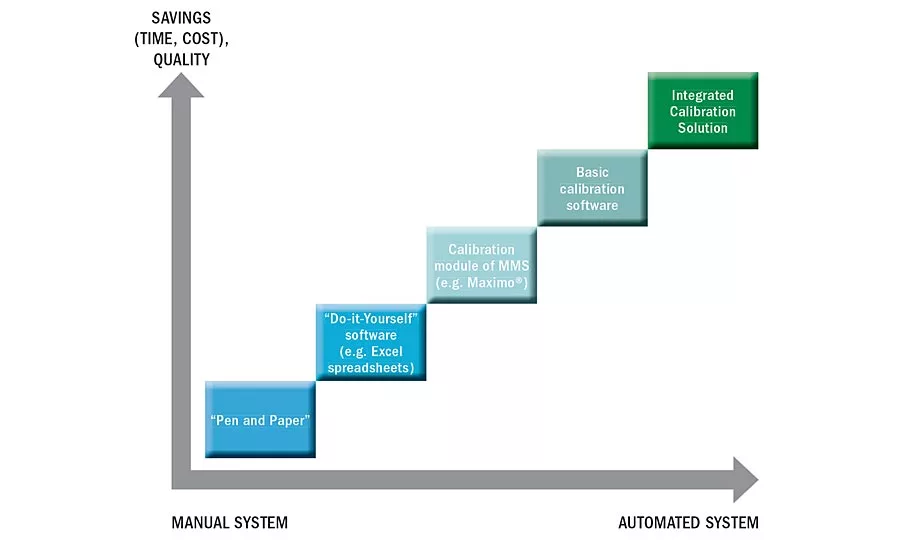
As this chart describes, there are various levels at which process engineers are managing and documenting calibration data, from a very basic level of traditional pen and paper all the way to integrated solution with calibration software and MMS.
Integration of IT systems is a requirement in almost any business these days. System integration itself is beneficial in several ways. First, productivity can increase significantly, as data only needs to be entered and kept up to date in one place, instead of manually re-keying the data into two or more separate systems. Second, because data needs to be entered only once, human typing errors and delays related to manual re-keying of data are minimized, thus data integrity is enhanced. Third, it gives the business transparency and in manufacturing, a full plant view which can enable management to make better decisions to run the plant more efficiently. Fourth, it allows for easy location of necessary documentation for audits, compliance to internal standards of excellence and regulatory requirements. There are more benefits, but let’s stop here.
Even still with all of these fantastic benefits of system integration in mind, many times, calibration software and maintenance management system (MMS) integration projects do not get budget approval because they are considered too costly and risky. But why? Most often it is because someone has heard or even experienced a “horror story” where it’s been near impossible to stay within the original project budget and timetable during the implementation of the new system—so it’s just not worth it. This “it’s not worth it” mentality is usually because the process in which the software will be utilized in day to day operations was not totally thought through or planned. Many times, there is a change in the user specifications and scope of work that causes the suppliers to react by creating a totally customized solution. Then, afterward, the highly customized solution turns out to be difficult to maintain and use as well as expensive. This article will outline a standardized approach to integration to help avoid these types of unnecessary situations. But, first let’s talk about the benefits of using calibration software.
Calibration Software Benefits
With software-based calibration management, planning and decision-making are improved. Procedures and calibration strategies can be planned and all calibration assets managed by the software. Position, device and calibrator databases are maintained, while automatic alerts for scheduled calibrations can be set up. Organization also improves. Calibration instructions are created using the software to guide engineers through the calibration process. These instructions can also be downloaded to a technician with a handheld documenting calibrator while he is in the field. Execution is more efficient and errors are eliminated. Using software-based calibration management systems in conjunction with documenting calibrators means that calibration results can be stored in the calibrator memory, then automatically uploaded back to the calibration software. There is no re-keying of calibration results from a notebook to a database or spreadsheet. Human error is minimized and engineers are freed up to perform more strategic analysis or other important activities.
Documentation is also improved. The software generates reports automatically and all calibration data is stored in one database rather than multiple disparate systems. Calibration certificates, reports and labels can all be printed out on paper or sent in electronic format. Analysis becomes easier too, enabling engineers to optimize calibration intervals using history trending functionality.
Also, when a plant is being audited, calibration software can facilitate both the preparation and the audit itself. Locating records and verifying that the system works is effortless when compared to traditional calibration record keeping. Regulatory organizations and standards such as FDA and ISO place demanding requirements on the recording of calibration data. Calibration software usually offers many functions that help in meeting these requirements, such as change management, audit trail and electronic signature functions.
Let’s dive into a basic overview of a standardized system integration between a MMS and calibration software.
About MMS and calibration software integration
Today, more and more process manufacturers use calibration software alongside their MMS to most efficiently and effectively plan, schedule, document, analyze and optimize calibration work. Although there are various possible integration setups, most often, linking a MMS with a calibration software means that plant hierarchy and all work orders for instrumentation are generated and maintained in the MMS. When a calibration needs to be performed, a work order is transferred to calibration software. Then, the calibration work order is executed. If a documenting calibrator is used, results are uploaded into the calibration software from the calibrator and marked complete. If a non-documenting calibrator is used, manual entry of the results is required. Either way, afterward the results are communicated, the calibration software sends an acknowledgement of completion of this work back to the MMS. All detailed calibration results are stored in the calibration software, while the MMS records the completion of the work order and any big data needed for reporting and compliance purposes.
The key responsibilities to understand here are that the calibration software stores the complete calibration history of each individual instrument which produces fully traceable calibration records, while the MMS uses the information to ensure work is completed for safety and profitability metrics and possibly other reporting purposes.
Use a standardized integration
An approach to increase the likelihood of a successful solution is to use a standardized integration. Utilizing a standard connection, instead of a custom-built solution, forces the specifications and requirements to be defined prior to implementation. When specs and requirements are agreed to by both parties, it creates a better situation to avoid run over of budget and timeline, the solution is more apt to have evolution, updates and continued support. During a system integration project implementation, a standardized solution requires less customer-specific software development work. This means a quicker and more reliable delivery. A standardized solution also means availability of long-term software maintenance contracts with regular software updates and helpdesk services. Availability of long-term support contracts also decreases IT system lifecycle risks.
Even more with enterprise integration
Enterprise Asset Management (EAM) integration between MMS and calibration software is the pinnacle of an automated system. EAM is more than just maintenance management software. It’s about companies taking a business-wide view of all their plant equipment and coordinating maintenance activities and resources with other departments and sites, particularly with production teams. Savings from EAM are reasonably well-documented and come in various guises, the most common benefits being: less equipment breakdowns (leading to a reduction in overall plant downtime); a corresponding increase in asset utilization or plant uptime; better management of spare parts and equipment stocks; more efficient use of maintenance staff; and optimized scheduling of maintenance tasks and resources. But the key to success is really the quality of information entered in the software; the data has the ability to be almost 100% accurate because of the elimination of manual entry, which allows users to realize the maximum benefit.
Key takeaways
There are various levels at which process engineers are managing and documenting calibration data, from a very basic level of traditional pen and paper all the way to integrated solution with calibration software and MMS. The more automated and integrated the calibration system the more time and costs are saved and quality is increased.
Overall, an ideal calibration program would include documenting calibrators and calibration software integrated with a MMS and EAM. The integration of these systems provides the best quality and assures data integrity. Furthermore, a significant amount of time is saved resulting in a quick, significant ROI without compromising safety. Integrated systems where data is shared and more easily analyzed allows companies to make better business decisions and achieve easier compliance with process requirements as well as regulations.
Looking for a reprint of this article?
From high-res PDFs to custom plaques, order your copy today!