Quality Management: Strengthen the Six Sigma Portfolio
Two years after Six Sigma deployment, Flexsys (Akron, OH) brought in its Black Belts to focus on the next round of process improvements, the manufacturer asked: What improvements are the most important? Which ones support the company's strategic goals?
The Black Belts were assigned inventory reduction as one key corporate initiative. Ironically, Flexsys met its lowest inventory levels every December-in time for annual performance reviews-which then began creeping up again each January. The company had the ability to reduce inventory but not to sustain it.
Inventory reduction is the consummate project to save money or cut costs. But before any Six Sigma team can fix this problem, it is important to understand how inventory, and the performance metrics tied to inventory, fit into the overall goals and strategies of the company. To do this, the manufacturer launched a pilot project to incorporate a strategic toolset for the Black Belt's toolbox, the Supply Chain Operations Reference (SCOR) Model.
Pilot project
SCOR is a roadmap that allows a company to analyze its supply chain processes, measure its performance and determine where weak links exist. It also suggests best practices for improving them. Correctly applying SCOR aligns company strategies and supply chain processes. This strengthens a Six Sigma project portfolio by ensuring optimal selection of high-impact improvement initiatives that help companies achieve their strategic goals.
In this pilot project, the goal was to assess inventory levels and align them with Flexsys' corporate strategies for servicing each supply chain while validating the project's overall merit. They also hoped to gain new insights for identifying and validating other black belt improvement projects that could be aligned with corporate strategy.
What potential impact would lowering inventory levels have on delivery reliability? And more importantly, which inventory should be lowered? These were major issues for this company, whose culture was based on customer service. With competition heating up, increased production and expediting were common to improve service in order to remain competitive. However, with a mature product and increasing competition in the Far East, Flexsys needed to cut costs while maintaining quality and its customer base.
The Flexsys Black Belts already had determined the pilot project's scope-inventory reduction within the product lines of one European plant. Next, they defined the plant's supply chains and segmented customers by market requirements and service needs. This resulted in defining five separate supply chains by market channel.
Like Six Sigma, SCOR encourages data-driven decisions. Phase 1 of the roadmap analyzes a company's performance compared to its competitors. Baseline metrics for each supply chain include financial and performance data on each organization, its best-in-class industry peers and its competition. A comparative look at these metrics assesses performance against industry leaders and competition. This helps to identify realistic goals for each supply chain.
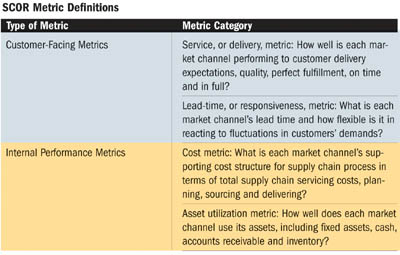
To level the playing field, the SCOR model provides standardized metric definitions. These definitions support apples-to-apples comparisons while encouraging world-class behavior.
Metrics were gathered in four major categories. Two categories, delivery performance and overall responsiveness were outward, or customer-facing, metrics. The other two categories, cost management and asset utilization, were inward, or internal company performance metrics.
Once the Black Belts gathered actual data for the selected supply chain, benchmark data was gathered from several sources including a SCOR consultant's database, online sources, academic sources in Europe specific to the industry and the company's internal marketing group. Comparing the actual data to benchmark data confirmed that inventory reduction was possible.
Priorities
After the Black Belts understood performance metrics, the next step was to overlay the corporate strategy for servicing each supply chain. Performance requirements, with respect to the competition, were prioritized by supply chain through a chip exercise. In this process, the Six Sigma team played four chips for each supply chain, each chip possessing a perceived priority: one chip for superior performance, one chip for advantage and two chips for parity.
This chip prioritization prevents the impractical tendency of choosing a superior target in every category. For Flexsys, this exercise identified its desire to be the lowest-cost producer with the best on-time delivery reputation. Another inherent trait of the SCOR Model is that it promotes a balanced SCORcard. In other words, it forces supply chain improvements to be viewed in the same context as the profit and loss statement. Measurements are viewed as metrics or goals prioritized by supply chain. No one metric can be optimized at the expense of another. For example, in one supply chain, the SCORcard indicated a gap in delivery reliability between the processor's actual performance vs. the competition's benchmark.
"Flexsys was initially attracted to SCOR because of the ability to compare and contrast benchmark data against a consistent series of process definitions, always an issue with benchmark data," according to John Kilkenny, global IT and supply chain director for Flexsys.
Kilkenny says, "In addition, the use of the chips enabled us to have an agreed focus on what was important to the particular business line. This sharper focus enhances the likelihood of success. The drive then required us to distill supply chain data down to a very detailed level and prove what actually happens operationally in the organization as opposed to what people think happens."
Map physical material flow
With the new prioritization of performance metrics, it was time to examine the Flexsys culture of delivery at any cost. To accomplish this, the Six Sigma team needed to understand the "As Is" physical material flow. Without this, they could not see the physical disconnects that were lowering profitability. Only then could they develop a "To Be" process for each market channel that would capitalize on the 95% metric.
The Black Belts were skeptical about geographically mapping their inventory and distribution processes. They had assumed that distribution protocols were being followed. But the exercise was telling in more ways than one.
Transactions were gathered to determine where material was moving, how much and how often. For instance, they captured transaction volume, freight costs, shipping time and customer locations. This allowed a better analysis of days of inventory. Three key disconnects were found through mapping material flow:
• The inability to "see" inventory when on the water in transport. This resulted in the plant producing more product because of the perception that more inventory was needed right away.
• Regional distribution strategy was not following protocol. There were multiple regional warehouses, yet each warehouse routinely shipped all products to all customers. Practice was not following strategy. They were literally shipping anything from anywhere to get on-time delivery, which the SCORcard had demonstrated was not necessary to compete.
• Intra-company freight was not being tracked. If a warehouse could not ship locally because it was out of inventory, then another warehouse supplied it to them and then it was shipped to the customer. Freight costs were skyrocketing because expediting inventory was a common occurrence. This also resulted in other stock outs, hording inventory and useless MRP (material requirements planning) runs. The result: higher delivery costs and inventory levels were lowering profitability.
A different view
Results from these two levels of the SCOR roadmap-
financial analysis and material mapping-helped the Black Belts gain a different view of their business and how to run it when supplying different customers. In the past, if two different market channels were competing for limited inventory, the one that screamed the loudest received product first. Now, inventory levels are set and maintained to support the customer service strategy for each supply chain. And, on the occasion of stock outs, expediting only is applied to the most profitable customers whose margins can tolerate the higher support cost.
SCOR provides an additional level related to work and information flow. As the inventory optimizations are implemented, Flexsys will consider front-end-planning and
releasing-and back-end-receiving, stocking and accepting- processes in order to gain increased efficiencies. By minimizing physical movement of material, transactions and error risks are reduced and inventory accuracy increased because it is not being handled as often.
The 12-week SCOR process spawned 24 Six Sigma projects targeted to strategic "disconnects" in the company's processes and aimed at "To Be" process improvements. This project portfolio represents $1.5 million in potential savings and a three-time return on the company's investment. For example, one Six Sigma project will develop safety stock levels for the regional warehouses in order to have the correct product in the right place at the right time. Another will validate that customers are serviced out of the right warehouse and more effectively using distributors.
"The principles of the SCOR approach continue to be used in Flexsys as the basis for both operational and strategic decision making," Kilkenny says.
The integration of both best practices helped the Black Belts to uncover their next wave of improvement projects by using SCOR as a strategic toolset to ensure that Black Belts are applied to the right areas for the right reasons. As companies struggle with identifying value-added projects after reaping the "low-hanging fruit," SCOR can strengthen the Six Sigma project portfolio by applying science to the project selection process. Q
Jane H. Malin is a management consultant with PRAGMATEK Consulting Group (Minneapolis). She can be reached at [email protected]. Elaine Reichardt is director of operations for UnitedHealth Group (Minnetonka, MN).
Tech tips
• SCOR is a roadmap that allows a company to analyze its supply chain processes, measure its performance and determine where weak links exist.
• It also suggests best practices for improving weak links.
• Like Six Sigma, SCOR encourages data-driven decisions.
• The SCOR model provides standardized metric definitions that support apples-to-apples comparisons while encouraging world-class behavior.
Looking for a reprint of this article?
From high-res PDFs to custom plaques, order your copy today!