Surface Measurement Learns Tolerance


It's not really news. Everyone working in manufacturing experiences the same phenomenon-tolerances are increasingly tighter. Every time a company receives drawings for new parts, they find that the tolerances are tighter than the tolerances on the components they currently make. It is not just the dimensional tolerances that are tighter, form and surface finish tolerances are decreasing as well. These tighter tolerances drive the work of manufacturing engineers and quality engineers every day.
This trend is not likely to change direction. Higher precision components make up the bulk of U.S. manufacturing. Non-precision components are seldom manufactured in the United States, but are often outsourced to low-cost, offshore suppliers. This presents challenges for the adaptation of the manufacturing base. As dimensional tolerances on these high precision parts become tighter, the relationship between the dimensional tolerances, form tolerances and surface finish requirements are more important, and are often misunderstood or underestimated.
Many engineers do not realize, for example, that when specifying surface roughness with the average roughness (Ra) parameter, the actual peaks of material present on the surface are typically in the range of four to 10 times higher than the Ra value measured or specified. The rule of thumb is that if the value of the form or dimensional tolerance is 10 times or less the Ra value, the tolerances are interfering with each other. The surface roughness tolerance is using up dimension or form tolerance budget and vice versa.
Additionally, many forget that when looking at form tolerances, some are applied only to one side of a component for flatness, while others are applied to both sides of a component for parallelism. These factors must be taken into account when comparing these form tolerances to dimensional tolerances on the same components.
Today's Trends
Tighter tolerances mean more than just having to make complex measurements; they also mean that the processes creating the components are harder to control. Because process control can only be accomplished with reliable data, getting this data makes taking measurements on the components more difficult as well. In turn, more capable instruments are required to make those measurements.
To address these issues, manufacturers are moving high-precision measuring equipment closer to the process, making the equipment less susceptible to the environment of the shop floor, making the equipment easier to use and automating tasks.
Moving measurement equipment from a quality laboratory and closer to the process is not always easy. Generally, these laboratories are set up to eliminate the enemies of precision measurement, namely, temperature variation, cleanliness and vibration.
Temperature variation is the most obvious problem and it is a fundamental tenet of physics that materials change size as temperatures change. This flies in the face of the idea of moving measuring equipment nearer to the process.
The temperature in the manufacturing environment, even if it is air-
conditioned, is not as tightly controlled as in the laboratory environment. Moving the measurement equipment closer to the process means that the components are more likely to change size as they are measured vs. waiting to measure the part as the component is transported to a remote laboratory. In addition, the measuring instruments themselves are subject to the same fluctuations.
While the basic laws of physics cannot be changed, manufacturers of measurement instruments are minimizing temperature effects on their instruments. New materials are used to build measuring instruments and while they still change size with temperature, the effects of temperature variation are less than before and often less than the variations in the parts being measured.
At times, building instruments from such materials is not possible, and so many manufacturers have developed enclosures for the equipment that create a micro-environment around the measuring machine to allow it to perform at a higher level. Another approach is to build temperature compensation algorithms into the measuring system software, but because the dynamics of temperature, dimension and form variation are complex, these systems seldom perform to expectations.
Getting the components to a stable temperature, then, is the last challenge and perhaps the most difficult. Ultimately, this can only be accomplished with time. Using heat sinks or normalizing baths can help speed the process of normalizing the component temperature, but time is needed in order to achieve a high-quality measurement.
Changing Hands
Putting measuring instruments out on the shop floor and closer to the process also means taking it out of the hands of dedicated measurement technicians in the lab and putting it in the hands of process operators. Operators often do not have the same level of training in metrology as dedicated measurement technicians, nor are they likely to have the time to spend on it. To accommodate this, many instrument manufacturers have devoted themselves to making sophisticated measurement instruments easier to use.
Making the instruments easier to use has taken many forms. In some cases, manufacturers have brought in psychologists to examine how people can more effectively interface with computers in performing complex tasks. One such example is a surface finish instrument that has a user interface similar to one of the most commonly used computers in our society, the ATM machine.
For even more complex tasks, some manufacturers have developed simple-to-use touch-screen interfaces for computerized systems. For many users, a touch-screen interface is less intimidating than a Windows interface using a mouse. Using a touch screen is more like pushing buttons on a machine than manipulating a computer.
Finally, the latest products combine a Windows interface and a touch-screen interface, and allow the user to choose the way he or she is most comfortable using the instrument. User profiles can be created, and as each user logs into the system, his or her preferences are used to configure the system in the way that is most comfortable for them to use.
Automation
Automating instruments to remove the influences of operator error, as well as to free the operator to do other tasks, is another trend. Take for example, the roundness, or cylindrical form, measuring instrument. For several decades it has been possible to automate the necessary alignment of the component being inspected through the use of a computer numeric controlled (CNC) centering and leveling turntable. A newer development is that of the CNC-controlled probing system. The simplest of these allow a measurement program to switch the direction of measurement automatically in two directions. This is useful, for example, when switching between internal and external measurements on round components.
However, the more advanced systems now allow full CNC control to accurately position the probing system to any position in a full 360-degree rotation. This allows automatic switching, not only from internal to external measurements, but also 90-degree rotation to measure on the top face of a component, or under a shoulder, and any position in between: for example, at a specific angle to measure perpendicular to a conical surface. The benefit of this level of automation is that a measuring instrument can work completely independently, without operator intervention at any stage of the process, and yet ensure the highest level of measurement capability.
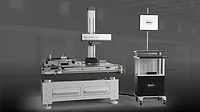
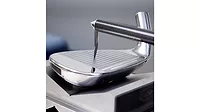
Another example of functional automation is a new series of surface gages available for automotive components. Measuring surface finish on the shop floor is difficult for a number of reasons, including the need to protect delicate probes; problems in positioning gages on inaccessible component surfaces such as thrust faces and camshaft bores; and the need for measurement speed to satisfy the demands of statistical process control systems.
The solution was to develop a series of modular fixtures, keyed to the requirements of specific components, that would enable operators to simply place the fixture in the area to be measured and with the touch of a single button or two, affect the entire measurement process. The fixture itself takes care of accurately positioning the gage, engaging the probe, and taking and recording the measurement.
The widespread application of tighter tolerances in U.S. manufacturing has pushed the limits of process control for many companies, forcing them to look for better data on which to base their processes. This is not always easy, and frequently involves thinking differently about what to measure, how to measure it and where to do the measurement. Factors such as the relationship of the form and surface roughness tolerances to dimensional tolerances must be taken into account. The desire is to measure form and surface as part of the process control plan, and to get the measuring instruments as close to the process as possible. To this end, instrument manufacturers are designing equipment that is more capable of tolerating temperature variation, is easier to use, and increasingly automated.
Tech Tips
1. Tighter tolerances are driving the work of manufacturing and quality engineers.
2. As dimensional tolerances become tighter, the relationships between the dimensional tolerances, form tolerances and surface-finish requirements become increasingly important.
3. Equipment that is more capable of tolerating temperature variation is being designed.
Looking for a reprint of this article?
From high-res PDFs to custom plaques, order your copy today!