Five Steps to Cutting Inspection Costs

Quality inspection now has the burden of keeping pace with modern manufacturing. In addition to this challenge, ISO 9000 standards, shape complexity, dimensional tolerance and customers’ increasing quality demands can create delays in inspection, affecting the entire manufacturing process.
The challenge of quality assurance is to apply new technology and methods to ultimately create a new quality management system. Modern manufacturing demands fast and accurate inspection during production while simultaneously reducing cost through reduced scrap rates and improved process efficiency and profitability. In addition, new systems must provide inspection data that can be manipulated easily for multiple uses and stored away for future reference and process control. Here are five steps to begin to modernize the quality process and reduce inspection costs.
1. Review current inspection methods.
The first step in reducing inspection costs is to review current inspection methods. Simply monitoring the entire inspection process can show manufacturers a number of ways to update quality programs. The following methods should be evaluated.- Part Inspection. Find out how parts are inspected. Is it a manual or automatic process? A detailed 100% inspection on a manual machine is often time-consuming and requires skilled operators.
- Measurement Tools. Are hand tools used for measurement? Hand tools can be limited to only a few types of measurements and can produce different results when used by different people.
- Inspection Reports. How is inspection data kept? Are reports written manually and therefore subject to human error? Manual record keeping makes statistical analysis, statistical process control (SPC) and custom reports laborious and time consuming. Also, written inspection data is often not suitable for analysis and process improvement. Find out if measurement data is taken from a drawing, which can be misread or misunderstood.
- Quality Data Communication. How is part compliance relayed to different areas of the facility? Sharing this information in paper format causes delays because workers throughout the facility must wait. Real-time data sharing via a computer network can increase efficiency.
2. Define the objectives or goals of the new method.
After reviewing current inspection systems, any evident problems and limitations in current methods of inspection can be used to develop a new approach. This new approach should be based on several key principles.
- Inspection during production must be objective, consistent and standardized.
- Inspection must be fast, automatic and comply with modern metrology requirements.
- Inspection data must be generated in a standardized format and shared on a computer network.
- New inspection methods must provide improvement by reducing cost and enhancing process control and profitability.
Determine the basis for the new methods and goals with these principles in mind. The first goal should be to eliminate manual inspection. This outdated method is time-consuming and has a high probability of error. Manual inspection and handwritten reports also make it difficult to compile, store and share inspection data for future use. Automated systems can eliminate the logjams created by antiquated inspection techniques.
3. Determine measurement equipment requirements.
The next step in creating a new, cost-effective quality system is determining inspection needs. When choosing an inspection machine, consider the following four requirements:- The inspection machine must be able to handle the largest parts being manufactured.
- It should measure parts quickly enough to keep up with production.
- It must be rugged enough to withstand the rigors of a manufacturing environment.
- Machine accuracy must be a minimum of three times greater than the computer numerical control (CNC) machine and part tolerances.
Take a look around the production floor. Most manufacturers spend money on CNC machines because they are eight to 10 times more productive than manual machines. So why would that same manufacturer use or buy an inexpensive, manually operated measurement machine? Modern inspection machines can scan parts quickly and produce detailed inspection reports to eliminate delays in verifying part conformity.
If parts are measured using a manual machine, how many hours are lost when production must stop and wait for the part inspection to be completed? Or how much time is wasted if it is assumed that the part is correct and production continues, only to find out the parts must be scrapped. Reducing inspection times from hours to minutes significantly improves part production and cost per part. The more parts inspected per day, the more productive quality assurance will be.
The inspection machine selected to perform these tasks is a critical aspect of a cost-reduction plan. When selecting and justifying a new inspection machine, the criteria used should be similar to the criteria used when deciding to purchase a CNC machine.
Whether it is a new production or inspection machine, the most important reason to buy a specific machine is its ability to produce quality parts in the most efficient manner possible. Today’s flexible, easy-to-use quality-assurance systems ensure that manufacturers keep pace with the ever-changing demands of modern manufacturing while reducing inspection costs.
4. Evaluate organization and solicit feedback.
After reviewing current inspection methods, evaluate the organization and workflow. Listen to operators who use the equipment every day. Such dialogue will illustrate limitations or problems with the current methods and is critical to organizing part inspection. This feedback will bring to light new ways to increase productivity and accuracy. When quality measurement tasks are too difficult or time consuming, operators cannot do their jobs effectively and are more apt to make mistakes.The setup process presents another opportunity to increase productivity. Setup can be time consuming, especially if it does not begin until the part is already manufactured and awaiting measurement. To increase efficiency, setup decisions must be supplied to the inspection department in an electronic format before the parts are manufactured. Any information flow delays directly affect the inspection time.
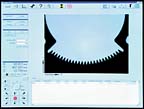
One inspection method available incorporates visual inspection machines that can create inspection programs before the part arrives, using computer-aided design as the basis for inspection. Part geometry is imported into the system through a network connection. Then a measurement program is created through user-friendly software. Appropriate individuals are alerted immediately to the parts’ conformity via the network connection.
5. Organize data generation and management.
The final step in reducing inspection costs is to look at how quality inspection data is generated and managed. Today’s quality standards demand that this information be easy to access and interpret. Inspection data kept in an inconsistent or written format can create huge libraries of information that are difficult or nearly impossible to use. Extracting the needed data from such formats requires significant time to perform process analysis. Inspection data must be created on a computer network in a standardized and consistent format to improve process control and efficiency. By managing the generated data, the following analyses can be performed:- The effect of manufacturing process parameters on part conformity.
- The design tolerance effect on rejection and scrap rates.
- Individual machine performance.
These analyses enhance understanding of current manufacturing process boundaries and make it easier to forecast changes in performance as a result of design changes or process parameters. In addition, they give manufacturers the ability to determine accurate calculations of rejection rate changes and better ensure correct parts costs. It is important to use inspection data to understand the boundaries of each manufacturing machine and determine whether or not a part can be made to the design criteria. Directing high tolerance parts to the correct machine can eliminate part rejection. Machine problems can be determined and resolved more quickly as well.
By integrating these five methods, manufacturers can create up-to-date and modern inspection systems that can inspect complex geometries in less time, increase the efficiency of the manufacturing equipment and allow immediate decisions to reduce scrap rates.
TECH TIPS
- Learning current inspection methods can help set the stage for future improvements. New inspection methods should eliminate manual inspection and record keeping.
- By determining inspection needs, the correct inspection tool can be selected.
- Solicit information from a diverse group of employees.
Looking for a reprint of this article?
From high-res PDFs to custom plaques, order your copy today!