Quality Innovations: Tool Solves Measuring Challenge

Calipers are one of the handiest tools in the toolbox. Lightweight but rugged, simple to use but extremely accurate, calipers are used on small parts and large. But, as the saying goes, one should use the right tool for the right job and calipers are not always the best choice to measure every part. They do have their limitations.
Traditionally, calipers have trouble measuring slanted walled parts-those parts with corners that are not 90 degrees but, according to industry standard, must be measured to a theoretical sharp corner (TSC), which are sometimes called points of intersection, mold lines or apexes. A TSC is the point in space where the edges would meet had the part's walls continued on a straight path.
A new caliper, the CornerCalipers, has solved this dilemma. The tool is the brainchild of designers Chris Penna and Dale Watson, of SPS Industries (Farmington, CT).
"We don't consider ourselves inventors," says Penna. "In a number of situations, we recognized that this type of measurement posed a problem. A specific problem that led to the development of CornerCalipers included a request from production who was having difficulty measuring a specific part. The quality department did not have access to something that would easily measure the part.
The part was a telecom tray that featured slanted walls on two sides and a piece of metal that needed to fold over to line up with tapped holes. The part was difficult to measure with a hand tool. Now, after more than two years of development and the securing of patent protection, SPS Industries has developed a caliper that can measure that part.
According to Dave Poulin, president of Precision Inspection Inc. (Terryville, CT), a calibration house, CornerCalipers is an innovative product that solves the ongoing problem of taking "quick and easy measurements on the shop floor." He adds, "After testing CornerCalipers, the accuracy was confirmed to print without using a CMM."
Handy way to do it
Other technologies can measure these parts. Tools such as optical comparators, coordinate measuring machines, vision systems or dedicated hard gages are other solutions. However, these solutions have their own issues: training, cost, cycle times, ability to take a measurement at any location, inline or off, and to do so on myriad parts-and none that fits as snugly in a tool belt.
According to the ASME Y14.5M standard, parts with slanted walls and rounded corners need to be measured to a TSC. On a 90-degree part, traditional caliper jaws can fix on two parallel walls to make the measurement. On an angular part such as the telecom tray, Watson says that a traditional caliper jaw cannot locate at the TSC. To measure to a theoretical sharp corner, three surfaces must be gaged against.
"In this telecom tray example, to confirm the dimension, a traditional jaw can locate against a straight wall on the back of the part. However, at the theoretical sharp corner, its location is in space, and is defined as the projected intersection of two walls," says Watson. "And any measuring device would need to locate on both of these walls. In total you have three gaging surfaces and whatever tool you use, a CMM or a comparator, you must consider those three surfaces. That is why no other caliper or micrometer can solve this problem; they obviously don't have three gaging surfaces."
It is this "three-surface" concept that makes up the first of two primary principles behind CornerCalipers.
TWO PRINCIPLES
Principle 1: The edge of the beam of a traditional set of calipers makes a perfect gaging surface-it is a bearing surface for the slide and, by definition, it is ground flat, straight and it is hardened.
"What we needed was an instrument that has three gaging surfaces," Penna says. "When we took a step back, we realized that a caliper beam could be that third gaging surface. A caliper beam is ground flat. It is hardened. You can locate the part against the beam."
If principle 1 solved the problem of a third surface from which to gage a theoretical corner, the next problem was how to use the flat jaw to measure a rounded intersection. That is where the second principle comes into play.
Principle 2: The pivot axis is located precisely on the beam edge. As the jaw rotates, the intersection of the jaw and the beam stays at zero.
"If you locate the axis of that pivot jaw, that axis is on the horizontal edge of the beam," says Penna. "That means that as the jaw rotates, the intersection of the jaw and the beam stays at the exact same spot; the jaw is going to stay pointed exactly at the caliper zero. It is like a pair of scissors. If the pivot is on the knife edge, it will stay stationary."
As with traditional calipers, the jaws are slid together to zero the tool. To measure the part, the slide jaw is pushed back, the beam is put against the part, and the pivot jaw is rotated to conform to the slanted edge.
Two Models
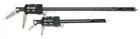
The CornerCalipers come in sizes of 6, 8 and 12 inches and additional lengths are on the drawing board. It is also available in two versions, a single pivot and a double pivot. The single pivot features the rotating pivot jaw and the more traditional slide jaw and has a range of motion between 35 and 160 degrees.
The double pivot caliper allows the lengths between two TSCs to be measured. The slide jaw also pivots and rides on the caliper slide in a semi-circular track that is located on the beam edge. As the second jaw pivots, it also stays zeroed. The double pivot's range of motion is between 20 and 160 degrees.
CornerCalipers can also be used as a traditional caliper. A square set is supplied with each double pivot caliper and can lock the jaws in a 90-degree position. Then, after removing the square set, the calipers can be used as a standard caliper.
The designers say that a key idea for CornerCalipers is that it is easy to learn. In part, this ease-of-use stems from its standardized design. "We wanted to start with what everybody recognizes as a traditional caliper platform," says Penna. "We didn't want anything that was odd or different."
QUALITY SPECS
CornerCalipers are designed to measure the distances to theoretical sharp corners, or points of intersection or mold lines.
The calipers come in single pivot and double pivot models to measure slanted wall parts.
The single pivot version has a range of motion between 35 degrees and 160 degrees. The double pivot's range of motion is between 20 degrees and 160 degrees.
A square set is provided to set the jaws at a 90 degree angle so as to function as a traditional caliper.
Looking for a reprint of this article?
From high-res PDFs to custom plaques, order your copy today!


