Quality Measurement: When It Comes to Measuring, First Things First
Whether measuring with calipers-or large-volume scanners-basic knowledge of dimensional metrology first principles enables better results.

Today’s ever-expanding repertoire of metrology applications-and the frequency with which they are employed-is outstripping the supply of “gray beard” measurement specialists who have the experience to set up and execute them.
The field of large volume, portable 3-D metrology is no exception, where for the past decade, development of technologies, such as laser scanners and trackers, electronic theolodites, photo- and videogrammetry, articulated arms and enhanced coordinate measuring machines (CMMs) have been enabling accurate measurement of large-scale volumes. These systems can measure the volumetric features of vehicle interiors and exteriors, aircraft or naval structures, buildings and even whole environments.
Typically, the data is used for quality control, reverse engineering and rapid manufacturing routines. The latest technologies offer fast data capture and surprising accuracy, which, even when measuring on a scale of tens-of-meters, can be as accurate as ± 0.001 inch over distances of 100 feet.
With the application of these systems exceeding the availability of experienced metrology specialists to run them, it is now common to see technicians who are classified as machinists, manufacturing cell operators, tooling people, and the like tackling 3-D metrology tasks. This situation is eased somewhat by the fact that these measurement systems typically incorporate powerful enabling software. This software makes it relatively easy for even inexperienced operators to set up and obtain measurements.
The problem is that in order to obtain accurate results, a measuring routine must be planned and set up in accordance with good/best practice before the measuring device is even powered up. And doing so requires an understanding of the axiomatic, self-evident “first principles” of dimensional metrology. These principles have to do with accounting for environmental effects such as temperature variations, cleanliness of measured surfaces, instrument cleanliness, stability of the instrument’s measurement platform and any remote components and instrument wear.
First principles also include traceability of the equipment’s deviation from known standards of measurement and the subsequent need for calibration. Finally, first principles address the variation introduced by individuals’ differing behavioral approaches to taking measurements.
While these factors apply to every type of dimensional metrology regardless of the equipment used-from gage blocks to the most sophisticated systems-in some respects, they are amplified in the application of 3-D measuring. That is because together with the expanded scale of the workpieces comes an expanded degree of freedom with respect to setup. And with that freedom come many more variables-and the opportunity to lose control.
The somewhat problematic measurement performance stemming from this situation-and resulting quality/ productivity issues-have become a concern for operators of 3-D metrology systems, not the least with manufacturers of the equipment. It was in this context that leading manufacturers approached the Coordinate Metrology Society (CMS) looking for help and guidance.
According to Talion Edwards, Boeing associate technical fellow and CMS chairman, “Users of 3-D measurement were telling us that they needed a centralized examination process that empowered a third party to certify whether a person possessed a practical body of knowledge regarding operation of 3-D measuring systems. Dovetailing with that, users were also asking whether the CMS could help in defining the matching training curriculum.”
As it happened, in early 2010, Edwards had participated in a program addressing training of “First Principles of Metrology” presented by the UK’s National Physical Laboratory (NPL). The NPL is the UK’s National Measurement Institute-government owned and contractor operated-and equivalent to the United State’s NIST.
Edwards elaborates, “The NPL sessions were especially relevant because they targeted nonmetrology specialists who were required to conduct high-level measurement tasks. Instruction and exercises using the simplest measurement tools, such as gage blocks and calipers, demonstrated dramatic improvement in subjects’ capabilities as reflected in improved gage R&R (gage repeatability and reproducibility) results. It occurred to me that it would be of great value to demonstrate this phenomenon to the community of portable 3-D metrology. And it seemed especially relevant since the NPL was seeking to develop a large-volume metrology module.”
Edwards contacted Keith Bevan, NPL training product development, to see whether NPL’s “First Principles of Metrology” training could be adapted for a workshop at the July 2010 CMSC Conference in Reno, NV. Since NPL had no physical presence in the United States, Bevan called on his relationship with Mitutoyo America (Aurora, IL) to see if that company, with its metrology training operations, would be interested in having a hand in the CMSC project. As a result, a collaborative effort among CMS, NPL and Mitutoyo was born with Mitutoyo sponsoring the workshop.
The methodology was loosely inspired by a formal gage R&R. But instead of determining variation among tools or workpieces or individuals, the idea was to show how measurement behavior-that is, how methods, procedures, approaches and assumptions-varied between those individuals who received instruction and those who did not.
Participants joined the study randomly as they came out of other CMSC presentations, talks and seminars. They represented the aerospace, nuclear, automotive, scientific and woodworking industries. Job titles included quality, scientist, management and metrology, with experience ranging from newly hired to in excess of 15 years.
Participants were provided with equipment including digital micrometers, digital calipers, gage blocks and paper towels. They also were given workpieces consisting of a a short pin, a long pin with a threaded hole and a sleeve. One of the pins had distortions not apparent to the eye; it was tri-lobed and twisted with a 60-degree offset end-to-end. After using a caliper to measure the inside diameter of the sleeve and the outside diameters of the two pins, it appeared that the short pin, 0.4995 inch, would barely fit inside the sleeve, 0.4995 inch, and that the long pin, 0.4945 inch, would fit easily. In fact, the short pin fit easily and long pin would not go in at all, due to the undetected lobes.
Mitutoyo’s U-Wave system wirelessly linked the digital instruments to a PC for data capture via Mitutoyo’s MeasurLink software. The software would later be used to facilitate analysis and charting.
According to Bevan, “Almost 100 subjects participated on day one. We provided minimal information, saying, ‘Please take these measurements for us…here are the instruments and supplies…here are the workpieces.’ Behaviors were quite mixed. For example, some, but not most, of the participants rolled the pin on the table noticing, ‘This is not round.’ Similarly there were various behaviors with respect to checking instruments against gage blocks and cleaning instruments and workpieces.”
It was explained that questions asked by participants would be answered but that information would not be volunteered. In any case questions were rare.
The order sequenced tasks to guide the measurement practitioner in application of first principles/good/best practices, for example, clean the equipment; check equipment for damage; ascertain equipment calibration status by checking against known artifact and measure these positions on the workpieces.
Correct measurement behaviors were built into the procedure. Again, data was captured via Mitutoyo’s MeasurLink software.
Edwards concludes, “The results were extremely promising. It is evident that even a basic application of dimensional metrology first principles enables much improved measurement performance-and this should apply to portable 3-D measurement systems as much as to hand tools. We’re working on demonstrating just that by organizing a follow-on study at CMSC 2011 focusing on large volume measurement systems such as laser trackers or articulated measuring arms.” Q
Participants in the study were provided with equipment including digital micrometers, digital calipers, gage blocks and paper towels. They were also given workpieces consisting of a short pin, a long pin with a threaded hole and a sleeve. Source: MultiMetrics Inc.
Today’s ever-expanding repertoire of metrology applications-and the frequency with which they are employed-is outstripping the supply of “gray beard” measurement specialists who have the experience to set up and execute them.
The field of large volume, portable 3-D metrology is no exception, where for the past decade, development of technologies, such as laser scanners and trackers, electronic theolodites, photo- and videogrammetry, articulated arms and enhanced coordinate measuring machines (CMMs) have been enabling accurate measurement of large-scale volumes. These systems can measure the volumetric features of vehicle interiors and exteriors, aircraft or naval structures, buildings and even whole environments.
Typically, the data is used for quality control, reverse engineering and rapid manufacturing routines. The latest technologies offer fast data capture and surprising accuracy, which, even when measuring on a scale of tens-of-meters, can be as accurate as ± 0.001 inch over distances of 100 feet.
With the application of these systems exceeding the availability of experienced metrology specialists to run them, it is now common to see technicians who are classified as machinists, manufacturing cell operators, tooling people, and the like tackling 3-D metrology tasks. This situation is eased somewhat by the fact that these measurement systems typically incorporate powerful enabling software. This software makes it relatively easy for even inexperienced operators to set up and obtain measurements.
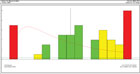
The part was a standard pin gage that is used to size holes. Values ranged from a low of 12.523 millimeters to a high of 12.714 millimeters, with a range of 0.191 millimeter. The histogram shows the amount of variation and also indicates more measurements went to the higher values rather than lower, for example, it was weighted to the high side. Source: Mitutoyo
A Double-Edged Sword
However, industry is finding that these enabling solutions can be a double-edged sword. That is because the programs generally have limitations, sometimes known, but often unknown to nonmetrology specialists operating them.The problem is that in order to obtain accurate results, a measuring routine must be planned and set up in accordance with good/best practice before the measuring device is even powered up. And doing so requires an understanding of the axiomatic, self-evident “first principles” of dimensional metrology. These principles have to do with accounting for environmental effects such as temperature variations, cleanliness of measured surfaces, instrument cleanliness, stability of the instrument’s measurement platform and any remote components and instrument wear.
First principles also include traceability of the equipment’s deviation from known standards of measurement and the subsequent need for calibration. Finally, first principles address the variation introduced by individuals’ differing behavioral approaches to taking measurements.
While these factors apply to every type of dimensional metrology regardless of the equipment used-from gage blocks to the most sophisticated systems-in some respects, they are amplified in the application of 3-D measuring. That is because together with the expanded scale of the workpieces comes an expanded degree of freedom with respect to setup. And with that freedom come many more variables-and the opportunity to lose control.
The somewhat problematic measurement performance stemming from this situation-and resulting quality/ productivity issues-have become a concern for operators of 3-D metrology systems, not the least with manufacturers of the equipment. It was in this context that leading manufacturers approached the Coordinate Metrology Society (CMS) looking for help and guidance.
Looking for Guidance
The CMS is a group of users, service providers and OEM manufacturers of close-tolerance, portable, industrial coordinate measurement systems, software and peripherals. The CMS hosts an annual Coordinate Metrology Systems Conference (CMSC). This is a venue where the latest in portable 3-D industrial measurement technologies is presented by industry experts via a large slate of technical paper presentations, exhibits, seminars and advanced workshops.According to Talion Edwards, Boeing associate technical fellow and CMS chairman, “Users of 3-D measurement were telling us that they needed a centralized examination process that empowered a third party to certify whether a person possessed a practical body of knowledge regarding operation of 3-D measuring systems. Dovetailing with that, users were also asking whether the CMS could help in defining the matching training curriculum.”
As it happened, in early 2010, Edwards had participated in a program addressing training of “First Principles of Metrology” presented by the UK’s National Physical Laboratory (NPL). The NPL is the UK’s National Measurement Institute-government owned and contractor operated-and equivalent to the United State’s NIST.
Edwards elaborates, “The NPL sessions were especially relevant because they targeted nonmetrology specialists who were required to conduct high-level measurement tasks. Instruction and exercises using the simplest measurement tools, such as gage blocks and calipers, demonstrated dramatic improvement in subjects’ capabilities as reflected in improved gage R&R (gage repeatability and reproducibility) results. It occurred to me that it would be of great value to demonstrate this phenomenon to the community of portable 3-D metrology. And it seemed especially relevant since the NPL was seeking to develop a large-volume metrology module.”
Edwards contacted Keith Bevan, NPL training product development, to see whether NPL’s “First Principles of Metrology” training could be adapted for a workshop at the July 2010 CMSC Conference in Reno, NV. Since NPL had no physical presence in the United States, Bevan called on his relationship with Mitutoyo America (Aurora, IL) to see if that company, with its metrology training operations, would be interested in having a hand in the CMSC project. As a result, a collaborative effort among CMS, NPL and Mitutoyo was born with Mitutoyo sponsoring the workshop.
Workshop/Study
The workshop was conceived as an experiment. Participants would make measurements and in the process generate data to support a hypothesis that, “Training in core principles of metrology will reduce or minimize variation of measurement.”The methodology was loosely inspired by a formal gage R&R. But instead of determining variation among tools or workpieces or individuals, the idea was to show how measurement behavior-that is, how methods, procedures, approaches and assumptions-varied between those individuals who received instruction and those who did not.
Participants joined the study randomly as they came out of other CMSC presentations, talks and seminars. They represented the aerospace, nuclear, automotive, scientific and woodworking industries. Job titles included quality, scientist, management and metrology, with experience ranging from newly hired to in excess of 15 years.
Day One: Behavior With Minimal Instruction
Upon entering the exhibit, participants were informed of the study’s two-day structure with results presented on day three. Day one participants were encouraged to participate on day two.Participants were provided with equipment including digital micrometers, digital calipers, gage blocks and paper towels. They also were given workpieces consisting of a a short pin, a long pin with a threaded hole and a sleeve. One of the pins had distortions not apparent to the eye; it was tri-lobed and twisted with a 60-degree offset end-to-end. After using a caliper to measure the inside diameter of the sleeve and the outside diameters of the two pins, it appeared that the short pin, 0.4995 inch, would barely fit inside the sleeve, 0.4995 inch, and that the long pin, 0.4945 inch, would fit easily. In fact, the short pin fit easily and long pin would not go in at all, due to the undetected lobes.
Mitutoyo’s U-Wave system wirelessly linked the digital instruments to a PC for data capture via Mitutoyo’s MeasurLink software. The software would later be used to facilitate analysis and charting.
According to Bevan, “Almost 100 subjects participated on day one. We provided minimal information, saying, ‘Please take these measurements for us…here are the instruments and supplies…here are the workpieces.’ Behaviors were quite mixed. For example, some, but not most, of the participants rolled the pin on the table noticing, ‘This is not round.’ Similarly there were various behaviors with respect to checking instruments against gage blocks and cleaning instruments and workpieces.”
It was explained that questions asked by participants would be answered but that information would not be volunteered. In any case questions were rare.
Day Two: Behavior With Instruction
On day two, participants (approximately 39, including the return of some day one participants) were provided with instruments, supplies and workpieces as per day one. In addition, they were given what amounted to a work order.The order sequenced tasks to guide the measurement practitioner in application of first principles/good/best practices, for example, clean the equipment; check equipment for damage; ascertain equipment calibration status by checking against known artifact and measure these positions on the workpieces.
Correct measurement behaviors were built into the procedure. Again, data was captured via Mitutoyo’s MeasurLink software.
Day Three: Results Presentation
Study results were presented to all participants on the afternoon of the last day of the conference. Histograms of day one and day two measurements were generated and prepared as a PowerPoint. The study validated the hypothesis: a large variation in measured values was seen on day one, a much smaller variation was seen on day two.Edwards concludes, “The results were extremely promising. It is evident that even a basic application of dimensional metrology first principles enables much improved measurement performance-and this should apply to portable 3-D measurement systems as much as to hand tools. We’re working on demonstrating just that by organizing a follow-on study at CMSC 2011 focusing on large volume measurement systems such as laser trackers or articulated measuring arms.” Q
Looking for a reprint of this article?
From high-res PDFs to custom plaques, order your copy today!