Quality Magazine logo
search
cart
facebook twitter linkedin youtube
  • Sign In
  • Create Account
  • Sign Out
  • My Account
Quality Magazine logo
  • NEWS
  • PRODUCTS
    • FEATURED PRODUCTS
    • SUBMIT YOUR PRODUCT
  • CHANNELS
    • AUTOMATION
    • MANAGEMENT
    • MEASUREMENT
    • NDT
    • QUALITY 101
    • SOFTWARE
    • TEST & INSPECTION
    • VISION & SENSORS
  • MARKETS
    • AEROSPACE
    • AUTOMOTIVE
    • ENERGY
    • GREEN MANUFACTURING
    • MEDICAL
  • MEDIA
    • A WORD ON QUALITY PUZZLE
    • EBOOK
    • PODCASTS
    • VIDEOS
    • WEBINARS
  • EVENTS
    • EVENT CALENDAR
    • IMTS
  • DIRECTORIES
    • BUYERS GUIDE >
      • Supplier Insights
    • NDT SOURCEBOOK
    • VISION & SENSORS
    • TAKE A TOUR
  • INFOCENTERS
    • Digital Quality Management Systems
    • NEXT GENERATION SPC & QUALITY ANALYTICS
  • AWARDS
    • ROOKIE OF THE YEAR
    • PLANT OF THE YEAR
    • PROFESSIONAL OF THE YEAR
  • MORE
    • Expert Columns
    • NEWSLETTERS
    • QUALITY STORE
    • INDUSTRY LINKS
    • SPONSOR INSIGHTS
  • EMAG
    • eMAGAZINE
    • ARCHIVES
    • CONTACT
    • ADVERTISE
  • SIGN UP!

Brain Teasers: Freezing Over
By Dr. Sophronia Ward
January 26, 2006


Anyone who has faced a production problem with a need to solve it by using production data can relate to the notion of a brain teaser. The brain teasers presented here are based on real-world situations encountered by workers in manufacturing environments. The brain teasers have three parts: (1) the situation, (2) available data or other supporting information and (3) questions that various workers need answered for continual improvement.
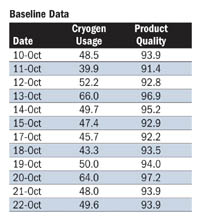
Baseline Data

Situation

Oliver is the production manager for a company that produces a variety of packaged food products for industrial food customers. One process that has been regularly over budget is the fast freezing of product. After an initial investigation, Oliver determined that the main contributor of budget overruns was the usage of cryogen in the freezing process. Further investigation revealed that cryogen usage was greater than had been anticipated for the past 18 months.

The first step Oliver took was to encourage the manager of the freezing process to cut back on the cryogen usage, but that effort led to an increase in product that was incorrectly frozen. Then Oliver decided to take advantage of the experience of a Six Sigma Master Black Belt (MBB) who was on call to the company. The MBB, Carolyn, met with Oliver. They decided to set up a team to study the cryogen usage with the goal of determining how best to minimize the usage and reduce costs without compromising product quality.
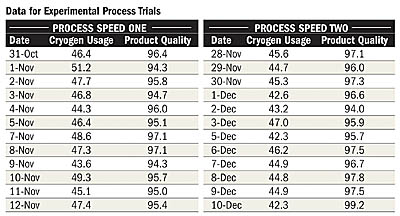
Data for Experimental Process Trials

Available Data

Carolyn advised the team to collect data on cryogen usage and product quality for several weeks in order to understand the current situation. Data for two weeks are summarized in the table, "Baseline Data." Cryogen usage is recorded in thousands of pounds. Product quality is recorded as percent of good pounds.

Once the team analyzed the baseline data, Carolyn encouraged them to do some experimenting with the process and measure cryogen usage and product quality. Because the process had run on a sporadic basis, they decided to run the process on a continuous basis at two different rates based on pounds of product per minute. Results of the trials are given in the table, "Data for Experimental Process Trials."

Questions

1. What do the baseline data indicate about cryogen usage and product quality?

2. Based on the analysis of the baseline data, what goals would the team want to achieve regarding cryogen usage?

3. How does the freezing process behave under the two trial conditions?

4. Do either of the trial conditions give improved results for cryogen usage without compromising product quality? Explain.

Answers to December Brain Teaser

After a recent improvement in the surface smoothness of vitamin gel capsules, Wilma, a process engineer, received complaints from the customer that the capsules were sticking to the chutes on the production line. An investigation of the filling machine did not reveal a cause of the sticking so Wilma and her team began to question the surface smoothness of the gel caps.

Q: Is there evidence in the data that the recent efforts to improve the gel cap smoothness did result in a change for surface smoothness?

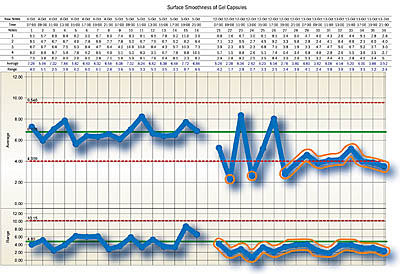
A: Based on an analysis of the data using an average and range process behavior chart, the data collected after the improvements show a definite decrease in surface smoothness after a period of oscillation in the average. Also, all of the ranges for the improved process are below the central line for the original gel capsules. This indicates that the variation in surface smoothness has decreased. See the chart, "Surface Smoothness of Gel Capsules." After recomputing the control limits for the improved capsules, the chart shows that the process becomes predictable at a lower average value with reduced variation.


Q: What statistical techniques can be used to determine if a difference exists in the smoothness of these two versions of gel capsules?

A: The process behavior chart used in the answer to the first question is one way to determine that a process change has occurred. This technique has the advantage that it is possible to determine if the process is predictable or not. Another technique that often is used is the two-sample t-test for population means. The disadvantages of this approach are the assumptions that underlie the test. These data are not random samples from a population, but periodic samples from an ongoing process. Also, as shown in the process behavior chart, the data for the improved process shows that process was unpredictable for the first several hours before it settled down. This lack of predictability leads to these data not passing the test of normality of the data, which is another assumption for the t-test.


Q: Is there evidence in the data to indicate that the new gel caps are too smooth?

A: The gel capsules have definitely become smoother, but any determination that they are "too smooth" would require an experiment.


Q: How can Wilma's team determine the optimal surface smoothness for the gel caps?

A: With a designed experiment, Wilma and her team can determine how smooth to make the capsules so that they will not stick in the filling chutes. Wilma may want to explore surface smoothness of the capsules at several levels, as well as several other factors in the experiment.

Share This Story

Looking for a reprint of this article?
From high-res PDFs to custom plaques, order your copy today!

Qm0620 clmn ask the expert author sophronia ward 0620

Dr. Sophronia Ward, a PhD statistician and continual improvement specialist, has extensive experience in manufacturing, service and health CARE. [email protected], www.pinnaclepartnersinc.com, or (865) 310-2973.

Recommended Content

JOIN TODAY
to unlock your recommendations.

Already have an account? Sign In

  • 2024 Quality Rookie of the Year Justin Wise 1440x750px banner with "Quality Rookie of the Year" logo inset

    Meet the 2024 Quality Rookie of the Year: Justin Wise

    Justin Wise is an exceptional individual who has been...
    Aerospace
    By: Michelle Bangert
  • Man with umbrella and coat stands outside while it rains at night looking at a building.

    Nondestructive Testing: Is there an ethics problem?

    I was a whistleblower who exposed fraudulent activities...
    NDT
    By: Dale Norwood
  • Unraveling Deflategate: Football stadium with closeup of football on field

    Unraveling the Tom Brady Deflategate

    The Deflategate scandal erupted following the 2014 AFC...
    Measurement
    By: Greg Cenker and Henry Zumbrun
Manage My Account
  • eMagazine Subscriptions
  • Newsletters
  • Online Registration
  • Subscription Customer Service
  • Manage My Preferences

More Videos

Sponsored Content

Sponsored Content is a special paid section where industry companies provide high quality, objective, non-commercial content around topics of interest to the Quality audience. All Sponsored Content is supplied by the advertising company and any opinions expressed in this article are those of the author and not necessarily reflect the views of Quality or its parent company, BNP Media. Interested in participating in our Sponsored Content section? Contact your local rep!

close
  • Key Takeaways for Quality Leaders
    Sponsored byComplianceQuest

    Key Takeaways for Quality Leaders from the 2026 Gartner Magic Quadrant™ for QMS

  • This image shows a person seated next to a Bobcat T66 compact track loader.
    Sponsored byPolyWorks by InnovMetric

    Supercharging Digital Gauging at Bobcat North America

  • Dorsey Calibration Lab photo by Tom LaBarbera Picture this Studios
    Sponsored byDorsey Metrology International

    Ensuring Product Quality in a Competitive Manufacturing Landscape

Popular Stories

a titanium diaphragm speaker driver

The One Thing Elon Gets Right Is Designed to Scare You

This image shows a person seated next to a Bobcat T66 compact track loader.

Supercharging Digital Gauging at Bobcat North America

Dorsey Calibration Lab photo by Tom LaBarbera Picture this Studios

Ensuring Product Quality in a Competitive Manufacturing Landscape

2026 Quality Professional of the Year!

Events

June 9, 2026

Future-Proof your Quality Processes with Advanced 3D Optical CMM Technology

Discover how to effortlessly capture complex data, leverage true multi-sensor automation, and ensure continuous operation without creating inspection delays.

June 22, 2026

Automate 2026

Automate is North America's largest robotics and automation event — and the best place to take your ideas from insight to impact.
 
Our show floor features the world’s leading automation solutions, from AI and robotics to motion control, vision systems, and more. Plus, our educational conference is second to none, led by the brightest minds in automation today.
 
Ready to transform the way you work? Take the next step at Automate.
View All Submit An Event

Products

Lean Manufacturing and Service Fundamentals, Applications, and Case Studies

Lean Manufacturing and Service Fundamentals, Applications, and Case Studies

See More Products
Quality Podcast Channel Custom Content

Related Articles

  • Brain Teasers: Can You Solve the Final Brain Teaser?

    See More
  • Brain Teasers: How Six Sigma Helps a Lean Project

    See More
  • Brain Teasers: Improve Productivity by 5%

    See More

Related Products

See More Products
  • Quality Brain Teasers: Real World Challenges to Build Your Manufacturing Skills (ebook)

  • Optimizing Factory Performance: Cost-Effective Ways to Achieve Significant and Sustainable Improvement

See More Products

Related Directories

  • EMUGE-FRANKEN USA

    EMUGE-FRANKEN USA has been the product technology and performance leader in their field for over 100 years. EMUGE-FRANKEN USA manufactures an extensive line of taps, drills, thread mills, end mills, toolholders, thread gages, clamping devices and other rotary cutting tools, over 40,000 items sold through distributors worldwide.
×

Stay in the know with Quality’s comprehensive coverage of
the manufacturing and metrology industries.

Newsletters | Website | eMagazine

JOIN TODAY!
  • RESOURCES
    • Advertise
    • Contact Us
    • Directories
    • Manufacturing Division
    • Store
    • Want More
  • SIGN UP TODAY
    • Create Account
    • eMagazine
    • Newsletters
    • Customer Service
    • Manage Preferences
  • SERVICES
    • Marketing Services
    • Market Research
    • Reprints
    • List Rental
    • Survey/Respondent Access
  • STAY CONNECTED
    • LinkedIn
    • Facebook
    • YouTube
    • X (Twitter)
  • PRIVACY
    • PRIVACY POLICY
    • TERMS & CONDITIONS
    • DO NOT SELL MY PERSONAL INFORMATION
    • PRIVACY REQUEST
    • ACCESSIBILITY

Copyright ©2026. All Rights Reserved BNP Media, Inc. and BNP Media II, LLC.

Design, CMS, Hosting & Web Development :: ePublishing