Aerospace Accelerometers
There are many design and selection considerations for aerospace accelerometers.
 Accelerometers used for shock and vibration measurement in extreme environments require special consideration during the design and manufacturing process. Specialized applications frequently require use of a single model of accelerometer, which must be capable of operating over significantly wider temperature ranges-for example, –65 C to 1,200 F-than conventional laboratory accelerometers, while at the same time providing high levels of accuracy, stability and reliability.
Typical applications for high-temperature aerospace accelerometers include measurement of vibration on gas turbine engines-both in-flight and in test cells, as well as rocket motors and thruster assemblies. The same accelerometers also may function in environments of nuclear radiation vibration monitoring in nuclear power plants and on space vehicles, for example. Materials and construction must therefore be optimized, not only to enhance high-temperature performance, but also to allow operation in the presence of gamma and neutron radiation without degradation.
Piezoelectric accelerometers are composed of some type of piezoelectric material inertially loaded by a mass. The resulting force produces an electrical charge proportional to the amount of acceleration imposed on the sensor.
 Material Selection
The design and performance of a sensor vary depending on the choice of piezoelectric material selected for the application. Both natural and manmade materials have unique features and advantages. Natural crystals tend to provide the highest temperature ranges and lowest pyroelectric outputs. However, ferroelectric ceramics offer extended frequency ranges and smaller sizes for the equivalent charge output.
Single, natural crystals, such as quartz or tourmaline, are inherently piezoelectric. Most natural materials are single crystals grown in laboratories, rather than mined, resulting in higher, more consistent quality and enabling development of new, higher sensitivity variations.
Ferroelectric ceramic materials, on the other hand, are not inherently piezoelectric and require polarization before use. The polarization process involves applying a high voltage to the material to align polar regions within the ferroelectric ceramic element. This process is known as “poling.”
Ferroelectric ceramics typically exhibit about twice the sensitivity, or charge output per imposed unit force, obtained from most natural crystals, and around 10 times that of tourmaline, one of the more commonly used natural crystals. Lead zirconate titanate (PZT) is a ceramic material that is widely used in temperature environments as high as 550 F. Bismuth titanate-based ferroelectric material can be used to temperatures of 950 F. Various compounds may be added to alter sensor characteristics, but higher temperature ranges always come at the expense of sensitivity. A natural material (single crystal) can be employed in either shear or compression mode. In compression mode, the material creates an electric charge in the same direction as the applied force. In shear mode, the material creates a charge in a direction perpendicular to the applied force. Typically, shear mode configurations offer almost twice the sensitivity of compression mode configurations. This enables extensive design flexibility and performance optimization.
There are numerous temperature, bandwidth, mounting and other tradeoffs that must be considered in high-temperature accelerometer applications. One of these involves the pyroelectric output of the piezoelectric material used. Pyroelectric output is the charge output of the piezoelectric material created by temperature changes in the material environment. A design that utilizes ferroelectric ceramic material in compression mode will have a greater pyroelectric output than that of a piezoceramic shear design or one using a natural crystal.
This is because of two effects:
• In a compression mode accelerometer, piezoelectric material is directly coupled to the environment through the base of the sensor.
• The ferroelectric material is sensitive to uniform temperature changes on those surfaces perpendicular to the axis of polarization.
However, the pyroelectric output is a very low frequency phenomenon that is typically well below frequency ranges of interest, and can be avoided by the use of high-pass filtering within measurement system electronics.
Challenges
The maximum operating temperature of an accelerometer is, in the main, controlled by two design challenges. The first is a property of the piezoelectric material alone and is, for practical purposes, termed the “Curie” temperature in piezoceramics, or “twinning” temperature in natural materials. This is the temperature at which the material loses its piezoelectric properties.
The second design challenge is an accelerometer’s “source resistance,” also known as the insulation resistance, which significantly decreases with temperature. At low sensor insulation resistances, charge amplifiers and charge converters must be specifically designed to operate with sensors with low insulation resistance values.
Whenever a sensor is exposed to temperature change, key parameters such as sensitivity, source resistance and sensor capacitance also change. These changes should be predictable and repeatable. Manufacturers should test every high-temperature sensor at its maximum operating temperature in order to ensure consistency and quality.
Successful Measurements
Successful high-temperature acceleration measurements require more than just good sensor design. Cabling and electrical connections also are critical to the acquisition of good quality data in aerospace testing applications.
A loose connector, for example, is a factor that can result in the generation of a high-level, low-frequency signal, totally unrelated to the measurement. In fact, reliability of all connectors degrades at temperatures over 900 F. Accelerometers designed for temperatures of up to 1,200 F are therefore fitted with integral cables, which also are mechanically isolated from the seismic system to avoid base and cable strain effects. The cables provided might use silicon dioxide insulation that is non-hygroscopic and exhibits excellent high-temperature electrical characteristics. Careful selection of cable material and use of a protective over braid facilitates ease of handling, and allows bend forming during installation while maintaining cable integrity.
When accelerometers are used for shock and vibration measurements in nuclear radiation environments, transient and steady state radiation effects can be significant and the tolerable radiation dose before degradation of accelerometer performance must be understood. Adverse reactions to radiation include a reduction of piezoelectric material output and deterioration of various materials that are intolerant to radiation, such as Teflon. Generally, higher temperature crystals are more resistant to radiation effects. All crystal and component materials used for their high temperature accelerometers should be tested for Gamma and Neutron radiation exposure.
High temperature accelerometers use both natural crystals and ferroelectric ceramics. For products designed to operate at up to 900 F, ferroelectric crystals are typically used. Accelerometers used between 900 and 1,200 F employ natural crystals. High-temperature sensors are hermetically sealed and tested to ensure that they are able to survive sustained harsh environments, with a long mean time between failures.
High temperature accelerometer designs are driven mainly by the purpose for which they are used. In test and measurement applications, single-ended designs are used to minimize mass and size. The single-ended output consists of a signal and ground and often the size and weight constraints of the test environment necessitate the case of a sensor needing to be integral to the ground circuit.
Because of the wide array of test and measurement environments and associated conditions, high-temperature test and measurement accelerometers feature a variety of mounting and cable/connector configurations.
A general category of high- temperature accelerometer is intended for use in permanently mounted condition monitoring applications. This type of accelerometer is often referred to as a “bill of materials” sensor, because it is integrated into a customer’s own product line.
These accelerometers are almost exclusively custom designed for each application. Unlike their test and measurement counterparts, cases of these sensors are almost always electrically isolated from the measurement circuit, and the charge output of the sensor is differential. That is, instead of outputting a signal and ground, the sensor outputs a + signal and – signal. Both features drive toward larger, lower frequency accelerometers, but provide a lower noise signal for the long operating lives required of these sensors.
Whether used in nuclear power plants or on space vehicles, accelerometers must provide high levels of accuracy, stability and reliability. Therefore, these instruments used in extreme environments require special consideration during the design and manufacturing process.
Margie Mattingly is senior program manager, PCB Aerospace & Defense, a division of PCB Piezotronics Inc. (Depew, NY). For more information, call (716) 684-0001, e-mail [email protected] or visit www.pcb.com.
- Natural crystals tend to provide the highest temperature ranges and lowest pyroelectric outputs.
- However, ferroelectric ceramics offer extended frequency ranges and smaller sizes for the equivalent charge output
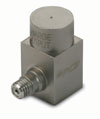
A high-temperature test and measurement aerospace accelerometer is shown here. Source: PCB
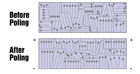
The polarization process involves applying a high voltage to the material to align polar regions within the ferroelectric ceramic element. This process is known as “poling.” Source: PCB
Typical applications for high-temperature aerospace accelerometers include measurement of vibration on gas turbine engines-both in-flight and in test cells, as well as rocket motors and thruster assemblies. The same accelerometers also may function in environments of nuclear radiation vibration monitoring in nuclear power plants and on space vehicles, for example. Materials and construction must therefore be optimized, not only to enhance high-temperature performance, but also to allow operation in the presence of gamma and neutron radiation without degradation.
Piezoelectric accelerometers are composed of some type of piezoelectric material inertially loaded by a mass. The resulting force produces an electrical charge proportional to the amount of acceleration imposed on the sensor.
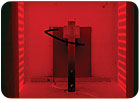
This shows a 1,200 F accelerometer under test. Note that under these conditions a functioning accelerometer is actually glowing. Source: PCB
The design and performance of a sensor vary depending on the choice of piezoelectric material selected for the application. Both natural and manmade materials have unique features and advantages. Natural crystals tend to provide the highest temperature ranges and lowest pyroelectric outputs. However, ferroelectric ceramics offer extended frequency ranges and smaller sizes for the equivalent charge output.
Single, natural crystals, such as quartz or tourmaline, are inherently piezoelectric. Most natural materials are single crystals grown in laboratories, rather than mined, resulting in higher, more consistent quality and enabling development of new, higher sensitivity variations.
Ferroelectric ceramic materials, on the other hand, are not inherently piezoelectric and require polarization before use. The polarization process involves applying a high voltage to the material to align polar regions within the ferroelectric ceramic element. This process is known as “poling.”
Ferroelectric ceramics typically exhibit about twice the sensitivity, or charge output per imposed unit force, obtained from most natural crystals, and around 10 times that of tourmaline, one of the more commonly used natural crystals. Lead zirconate titanate (PZT) is a ceramic material that is widely used in temperature environments as high as 550 F. Bismuth titanate-based ferroelectric material can be used to temperatures of 950 F. Various compounds may be added to alter sensor characteristics, but higher temperature ranges always come at the expense of sensitivity. A natural material (single crystal) can be employed in either shear or compression mode. In compression mode, the material creates an electric charge in the same direction as the applied force. In shear mode, the material creates a charge in a direction perpendicular to the applied force. Typically, shear mode configurations offer almost twice the sensitivity of compression mode configurations. This enables extensive design flexibility and performance optimization.
There are numerous temperature, bandwidth, mounting and other tradeoffs that must be considered in high-temperature accelerometer applications. One of these involves the pyroelectric output of the piezoelectric material used. Pyroelectric output is the charge output of the piezoelectric material created by temperature changes in the material environment. A design that utilizes ferroelectric ceramic material in compression mode will have a greater pyroelectric output than that of a piezoceramic shear design or one using a natural crystal.
This is because of two effects:
• In a compression mode accelerometer, piezoelectric material is directly coupled to the environment through the base of the sensor.
• The ferroelectric material is sensitive to uniform temperature changes on those surfaces perpendicular to the axis of polarization.
However, the pyroelectric output is a very low frequency phenomenon that is typically well below frequency ranges of interest, and can be avoided by the use of high-pass filtering within measurement system electronics.
Challenges
The maximum operating temperature of an accelerometer is, in the main, controlled by two design challenges. The first is a property of the piezoelectric material alone and is, for practical purposes, termed the “Curie” temperature in piezoceramics, or “twinning” temperature in natural materials. This is the temperature at which the material loses its piezoelectric properties.
The second design challenge is an accelerometer’s “source resistance,” also known as the insulation resistance, which significantly decreases with temperature. At low sensor insulation resistances, charge amplifiers and charge converters must be specifically designed to operate with sensors with low insulation resistance values.
Whenever a sensor is exposed to temperature change, key parameters such as sensitivity, source resistance and sensor capacitance also change. These changes should be predictable and repeatable. Manufacturers should test every high-temperature sensor at its maximum operating temperature in order to ensure consistency and quality.
Successful Measurements
Successful high-temperature acceleration measurements require more than just good sensor design. Cabling and electrical connections also are critical to the acquisition of good quality data in aerospace testing applications.
A loose connector, for example, is a factor that can result in the generation of a high-level, low-frequency signal, totally unrelated to the measurement. In fact, reliability of all connectors degrades at temperatures over 900 F. Accelerometers designed for temperatures of up to 1,200 F are therefore fitted with integral cables, which also are mechanically isolated from the seismic system to avoid base and cable strain effects. The cables provided might use silicon dioxide insulation that is non-hygroscopic and exhibits excellent high-temperature electrical characteristics. Careful selection of cable material and use of a protective over braid facilitates ease of handling, and allows bend forming during installation while maintaining cable integrity.
When accelerometers are used for shock and vibration measurements in nuclear radiation environments, transient and steady state radiation effects can be significant and the tolerable radiation dose before degradation of accelerometer performance must be understood. Adverse reactions to radiation include a reduction of piezoelectric material output and deterioration of various materials that are intolerant to radiation, such as Teflon. Generally, higher temperature crystals are more resistant to radiation effects. All crystal and component materials used for their high temperature accelerometers should be tested for Gamma and Neutron radiation exposure.
High temperature accelerometers use both natural crystals and ferroelectric ceramics. For products designed to operate at up to 900 F, ferroelectric crystals are typically used. Accelerometers used between 900 and 1,200 F employ natural crystals. High-temperature sensors are hermetically sealed and tested to ensure that they are able to survive sustained harsh environments, with a long mean time between failures.
High temperature accelerometer designs are driven mainly by the purpose for which they are used. In test and measurement applications, single-ended designs are used to minimize mass and size. The single-ended output consists of a signal and ground and often the size and weight constraints of the test environment necessitate the case of a sensor needing to be integral to the ground circuit.
Because of the wide array of test and measurement environments and associated conditions, high-temperature test and measurement accelerometers feature a variety of mounting and cable/connector configurations.
A general category of high- temperature accelerometer is intended for use in permanently mounted condition monitoring applications. This type of accelerometer is often referred to as a “bill of materials” sensor, because it is integrated into a customer’s own product line.
These accelerometers are almost exclusively custom designed for each application. Unlike their test and measurement counterparts, cases of these sensors are almost always electrically isolated from the measurement circuit, and the charge output of the sensor is differential. That is, instead of outputting a signal and ground, the sensor outputs a + signal and – signal. Both features drive toward larger, lower frequency accelerometers, but provide a lower noise signal for the long operating lives required of these sensors.
Whether used in nuclear power plants or on space vehicles, accelerometers must provide high levels of accuracy, stability and reliability. Therefore, these instruments used in extreme environments require special consideration during the design and manufacturing process.
Margie Mattingly is senior program manager, PCB Aerospace & Defense, a division of PCB Piezotronics Inc. (Depew, NY). For more information, call (716) 684-0001, e-mail [email protected] or visit www.pcb.com.
Tech Tips
- The design and performance of a sensor vary depending on the choice of piezoelectric material selected for the application. Both natural and manmade materials have unique features and advantages.- Natural crystals tend to provide the highest temperature ranges and lowest pyroelectric outputs.
- However, ferroelectric ceramics offer extended frequency ranges and smaller sizes for the equivalent charge output
Looking for a reprint of this article?
From high-res PDFs to custom plaques, order your copy today!