Scratch Test
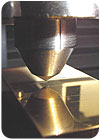
The diamond stylus
typically has a Rockwell C geometry with an angle of 120 degrees and a
spherical tip radius of 200 microns. Source: CSM Instruments
The new ASTM standard for scratch adhesion testing, ASTM C1624, covers the determination of the adhesion strength and failure modes of hard, thin ceramic coatings on metal or ceramic substrates. Scratch testers can be used for industrial quality control as well as scientific research. They should allow both lightly skilled operators and more experienced personnel to use the instrument to characterize the mechanical properties of Physical Vapor Deposition (PVD) or Chemical Vapor Deposition (CVD) coatings.
Scratch Testing
In scratch testing, a diamond stylus of defined geometry is drawn across the surface of a coated sample at a constant speed with a defined normal force over a defined distance. The normal force can be constant, progressively increasing or incrementally increasing. The diamond stylus typically has a Rockwell C geometry with an angle of 120 degrees and a spherical tip radius of 200 microns. Different tip radii can be used to change the contact pressure.During the test the tangential force, the penetration depth and the acoustic emission signals are recorded as secondary test data along with the normal force. After the completion of the scratch test, the scratch track is microscopically analyzed for specific, well-defined damage such as cracking, deformation, buckling, spallation or delamination of the coating. The load, which corresponds to the failure event, is denoted as the critical load, Lc, and is related to the practical adhesion strength and the damage resistance of the given coating or substrate system.
The critical load depends on the test parameters such as stylus parameters and geometry, loading rate and scratch speed, as well as on the properties of the coated sample such as coating thickness, surface roughness and microstructure, damage mechanism, hardness, modulus of elasticity and fracture strength.
In constant load (CL) scratch testing, the normal force is maintained at a constant level while scratching the sample. By increasing the load for each subsequent scratch, a scratch map can be generated to determine the critical load corresponding to a specified damage. In progressive load (PL) scratch testing, the stylus is drawn along the sample while the normal force is linearly increased to a maximum pre-determined value. The critical load is recorded as the normal force at which the damage is first observed. Incremental load (IL) scratch testing consists of incrementally increasing constant load scratch segments and is useful if space is limited on the sample.
The tangential force (Ft) is the force that opposes the relative motion between the stylus and the sample. During the scratch test the tangential force, or frictional force, may change in amplitude as different types of damages occur with the increasing load. The Acoustic Emission (AE) sensor can detect any high frequency elastic waves produced in the coating or substrate system by brittle damage events like cracking, delamination, chipping and buckling.
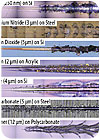
This shows a selection of typical progressive
load scratch tests on a range of different coating-substrate combinations in
common use. Each scratch path is labeled with the coating, its exact thickness
and the substrate material on which it is deposited. It is obvious how
different the failure modes are for these seven examples. Source: CSM Instruments
Instruments
Typical scratch test instruments are designed for ease of use in industrial quality control and production lines. Comprehensive scratch test software enables the operator to predefine the measurement protocol. The protocol is exported via a USB memory stick that is inserted in the front panel of the instrument and the test can be performed immediately. After the test is completed, the scratch track can be investigated with the optical microscope.With optional tangential force and acoustic emission sensors, the scratch tester also is a complete coating characterization station for research facilities. Scratch test protocols can be sent to different production plants to maintain an internal test standard within the company.
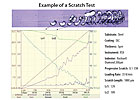
A typical scratch test example is shown here, along with the sample
information and the data set.
Source: CSM
Instruments
Instruments
With the pre-scan profiling, the surface roughness and topography are taken into account in order to get the true penetration depth (PD) during scratching. The post-scan profiling is used to obtain the residual depth (RD) data that is important for certain materials experiencing visco-elastic relaxation.
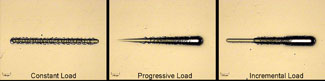
Three different scratch test modes are shown
here: constant load, progressive load and incremental load. Source: CSM Instruments
Test in action
A DLC coating on steel substrate is a typical scratch test example. (See pg. 17.) The thickness of the coating is 5 microns. A progressive load scratch test with a maximum load of 35 Newton was performed on the sample. The scratch length was 1 millimeter and the loading rate was 35 N/min. The first critical load (Lc1) is 12 Newton and corresponds to the point where the first damage is observed. This first damage has the shape of an interfacial shell-shaped spallation. Note that Lc1 corresponds to the first small jump on the acoustic emission signal as well as on the friction force curve.The second critical load (Lc2) is 18 Newton and it is the point where the damage becomes continuous and complete delamination of the coating starts. After this point, all of the acoustic emission, friction force and penetration depth signals become noisier. These critical points are shown on the scratch track with arrows.
With growing interest in scratch testing for industrial quality control and a new ASTM standard (see sidebar), scratch testers are proving to be a valuable tool for coating characterization. Such technology will enable coating companies to have better control over their deposition methods and build up a complete database of coating failure modes. In addition, scratch test information can be used to justify the adhesion of a coating to a prospective customer and offers a simple and quantitative method.
Sidebar: ASTM Standard
Due to the acceptance of the scratch test as the primary quantitative analysis method in coating production and a high demand for scratch test equipment, a new ASTM standard has been developed. The new ASTM standard for scratch testing is designated as ASTM C1624, “Standard Test Method for Adhesion Strength and Mechanical Failure Modes of Ceramic Coatings by Quantitative Single Point Scratch Testing.” This standard explains the principles of the scratch test in detail along with the limitations of the test, applicability to different coatings, terminology, test methodology, specimen requirements, apparatus requirements, calibration, test procedure, calculations, and repeatability and reproducibility requirements.A comprehensive bibliography and a scratch atlas describing and illustrating the common damage types are included in the standard. This standard provides a complete and accurate document for helping coating manufacturers develop an in-house quality control scratch test, which can be used regularly to screen coated components and evaluate their adhesion.
Looking for a reprint of this article?
From high-res PDFs to custom plaques, order your copy today!