Quality Magazine logo
search
cart
facebook twitter linkedin youtube
  • Sign In
  • Create Account
  • Sign Out
  • My Account
Quality Magazine logo
  • NEWS
  • PRODUCTS
    • FEATURED PRODUCTS
    • SUBMIT YOUR PRODUCT
  • CHANNELS
    • AUTOMATION
    • MANAGEMENT
    • MEASUREMENT
    • NDT
    • QUALITY 101
    • SOFTWARE
    • TEST & INSPECTION
    • VISION & SENSORS
  • MARKETS
    • AEROSPACE
    • AUTOMOTIVE
    • ENERGY
    • GREEN MANUFACTURING
    • MEDICAL
  • MEDIA
    • A WORD ON QUALITY PUZZLE
    • EBOOK
    • PODCASTS
    • VIDEOS
    • WEBINARS
  • EVENTS
    • EVENT CALENDAR
    • IMTS
  • DIRECTORIES
    • BUYERS GUIDE >
      • Supplier Insights
    • NDT SOURCEBOOK
    • VISION & SENSORS
    • TAKE A TOUR
  • INFOCENTERS
    • Digital Quality Management Systems
    • NEXT GENERATION SPC & QUALITY ANALYTICS
  • AWARDS
    • ROOKIE OF THE YEAR
    • PLANT OF THE YEAR
    • PROFESSIONAL OF THE YEAR
  • MORE
    • Expert Columns
    • NEWSLETTERS
    • QUALITY STORE
    • INDUSTRY LINKS
    • SPONSOR INSIGHTS
  • EMAG
    • eMAGAZINE
    • ARCHIVES
    • CONTACT
    • ADVERTISE
  • SIGN UP!
NDT

Back to Basics: Thermography 101

By Markus Tarin
June 8, 2010
The Airbus A350 has been designed with more than 50% composite materials. Source: Airbus
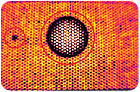


Honeycomb material with a lock-in result image shows circular delaminations, circled in red. Source: MoviTHERM

The first documented use of composite materials was most likely in ancient Egypt during the time of the Pharaohs. Workers were using straw and mud to make building materials. When talking about composite materials today, one usually refers to advanced materials used either in aerospace, military, and racing or automotive applications. Recently, one of the biggest boosts for using composite materials has been commercial aircraft manufacturers such as Boeing with the Dreamliner B-787 and Airbus with the A350.

In an attempt to make these super liners more fuel efficient, both companies have designed more than 50% of these aircrafts out of composite materials. With these large scale composite structures also comes a significant need for nondestructive material testing (NDT), both for manufacturing as well as in-service inspection.

Traditionally, this need has been fulfilled with ultrasound NDT. However, many parts for these aircraft are being manufactured with complex shapes and curvatures, making it difficult or impractical to use ultrasound sensors which need to be positioned true (orthogonal) to the surface of the material being inspected.


The orange spots on this lock-in image result image of a turbine blade show micro-cracks, some beneath the surface. Source: MoviTHERM

Thermal imaging is not as widespread as ultrasound inspection in the NDT world, although it has many advantages when it comes to large scale composite materials with complex shapes. Thermographic NDT techniques fall into the category of active thermography, due to use of an active heat excitation source. There are four subcategories of thermal or infrared (IR)-NDT: flash, transient, vibro-thermography and lock-in thermography.

Flash, sometimes also called pulse thermography, uses a very short pulse of energy, such as provided by a Xenon flash lamp, as the active excitation for the measurement. An infrared or thermal camera is then used to record an image sequence of the heat up and cool down period of the material.

When observing the thermal wave on the surface of the material during this period, defects such as impact damages, voids, foreign material inclusions, disbands and water inclusions manifest themselves with their varying thermo-physical properties compared to the intact or defect-free material. These thermo-physical differences create disturbances or interferences in the surface thermal wave, which the thermal camera records. These image sequences can contain up to multiple hundreds of thermal images. The analysis software then calculates a result image that based on the applied algorithm may be displayed as a phase angle image.

In a vibro-thermography system, induced ultrasound waves are used to create friction and therefore heat on crack surfaces inside or on the surface of the material. This friction heat can then be seen with the help of the thermal camera. Typical applications for such a vibro-thermography system are the inspection of ceramics and metals for cracks and micro-cracks.
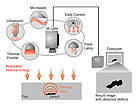
The principle measurement setup is shown here. Source: MoviTHERM

One of the more sophisticated thermal NDT methods available is lock-in thermography. A typical measurement setup for composite NDT using a lock-in thermography system usually involves halogen lamps for excitation.

The underlying principle is based on “locking in” the camera recordings on the known excitation frequency. The sample materials can thereby be excited continuously by using a sinusoidal waveform for modulation of the halogen lamp or lamps. This has the distinct advantage that the heat or thermal wave never decays to the point where the camera can no longer pick up the heat signature.

For instance, with flash or transient thermography a singe and finite heat pulse is used for excitation. The collection of useful thermal images ends at the latest, when the amplitude of the thermal wave approximates the noise floor of the camera detector. This in turn limits the maximum achievable penetration depth of the measurement. This is particularly critical in composite materials, which usually do not conduct heat as well.

Lock-in thermography uses Fast Fourier Transform (FFT) algorithms for calculation of the result image. The image data is evaluated on a pixel-by-pixel basis in the frequency domain and it only allows for signals to be evaluated that are an exact frequency match to that of the excitation source, thus eliminating undesirable thermal reflections.

In fact, since the frequency of noise of the measurement system is random, this method allows for an increase of the thermal sensitivity that reaches below the noise floor of the camera itself. This significantly improves the signal-to-noise (SNR) ratio of a lock-in thermography system, allowing for detection of tough-to-find defects, compared to IR-NDT methods. The typical thermal sensitivity of a cooled IR-camera is around 25 millikelvin (mK). A lock-in thermography system can extend that range down to the µK range, or by a factor of 100 to 1,000.

Other application examples for using lock-in thermography are thermal stress analysis for nondestructive evaluation of material strengths and shunt detection for photovoltaic (solar) cells and panels. NDT

Share This Story

Looking for a reprint of this article?
From high-res PDFs to custom plaques, order your copy today!

Markus Tarin is president and chief executive officer of MoviTHERM (Irvine, CA). For more information, call (949) 699-6600, e-mail [email protected] or visit www.movitherm.com.  

Recommended Content

JOIN TODAY
to unlock your recommendations.

Already have an account? Sign In

  • 2024 Quality Rookie of the Year Justin Wise 1440x750px banner with "Quality Rookie of the Year" logo inset

    Meet the 2024 Quality Rookie of the Year: Justin Wise

    Justin Wise is an exceptional individual who has been...
    Aerospace
    By: Michelle Bangert
  • Man with umbrella and coat stands outside while it rains at night looking at a building.

    Nondestructive Testing: Is there an ethics problem?

    I was a whistleblower who exposed fraudulent activities...
    NDT
    By: Dale Norwood
  • Unraveling Deflategate: Football stadium with closeup of football on field

    Unraveling the Tom Brady Deflategate

    The Deflategate scandal erupted following the 2014 AFC...
    Measurement
    By: Greg Cenker and Henry Zumbrun
Manage My Account
  • eMagazine Subscriptions
  • Newsletters
  • Online Registration
  • Subscription Customer Service
  • Manage My Preferences

More Videos

Sponsored Content

Sponsored Content is a special paid section where industry companies provide high quality, objective, non-commercial content around topics of interest to the Quality audience. All Sponsored Content is supplied by the advertising company and any opinions expressed in this article are those of the author and not necessarily reflect the views of Quality or its parent company, BNP Media. Interested in participating in our Sponsored Content section? Contact your local rep!

close
  • Key Takeaways for Quality Leaders
    Sponsored byComplianceQuest

    Key Takeaways for Quality Leaders from the 2026 Gartner Magic Quadrant™ for QMS

  • This image shows a person seated next to a Bobcat T66 compact track loader.
    Sponsored byPolyWorks by InnovMetric

    Supercharging Digital Gauging at Bobcat North America

  • Dorsey Calibration Lab photo by Tom LaBarbera Picture this Studios
    Sponsored byDorsey Metrology International

    Ensuring Product Quality in a Competitive Manufacturing Landscape

Popular Stories

a titanium diaphragm speaker driver

The One Thing Elon Gets Right Is Designed to Scare You

This image shows a person seated next to a Bobcat T66 compact track loader.

Supercharging Digital Gauging at Bobcat North America

Dorsey Calibration Lab photo by Tom LaBarbera Picture this Studios

Ensuring Product Quality in a Competitive Manufacturing Landscape

2026 Quality Professional of the Year!

Events

June 9, 2026

Future-Proof your Quality Processes with Advanced 3D Optical CMM Technology

Discover how to effortlessly capture complex data, leverage true multi-sensor automation, and ensure continuous operation without creating inspection delays.

June 22, 2026

Automate 2026

Automate is North America's largest robotics and automation event — and the best place to take your ideas from insight to impact.
 
Our show floor features the world’s leading automation solutions, from AI and robotics to motion control, vision systems, and more. Plus, our educational conference is second to none, led by the brightest minds in automation today.
 
Ready to transform the way you work? Take the next step at Automate.
View All Submit An Event

Products

Lean Manufacturing and Service Fundamentals, Applications, and Case Studies

Lean Manufacturing and Service Fundamentals, Applications, and Case Studies

See More Products
Quality Podcast Channel Custom Content

Related Articles

  • Back to Basics: Hardness Testing 101

    See More
  • Quality 101: Back to Basics with 3-D Optical Measurement

    See More
  • Back to Basics: Six Sigma

    Back to Basics: Six Sigma

    See More

Related Products

See More Products
  • louis hannigan.jpg

    The Non-Idiot's Guide to ISO 9001:2015: Understanding and Using the Quality Management System Standard to your benefit

  • Optimizing Factory Performance: Cost-Effective Ways to Achieve Significant and Sustainable Improvement

See More Products

Related Directories

  • Global Training Solutions Inc.

    Online training courses covering Infrared Thermography Training and Certification for Level 1, Level 2 and Level 3. Learn how to use an IR camera. In-depth content covers infrared equipment selection criteria, range and level settings, class demonstrations and more. Other content includes basic infrared theory, infrared electrical system inspections, infrared mechanical system inspections, infrared roof inspections, infrared building inspections, and how to implement an IR predictive maintenance program.
×

Stay in the know with Quality’s comprehensive coverage of
the manufacturing and metrology industries.

Newsletters | Website | eMagazine

JOIN TODAY!
  • RESOURCES
    • Advertise
    • Contact Us
    • Directories
    • Manufacturing Division
    • Store
    • Want More
  • SIGN UP TODAY
    • Create Account
    • eMagazine
    • Newsletters
    • Customer Service
    • Manage Preferences
  • SERVICES
    • Marketing Services
    • Market Research
    • Reprints
    • List Rental
    • Survey/Respondent Access
  • STAY CONNECTED
    • LinkedIn
    • Facebook
    • YouTube
    • X (Twitter)
  • PRIVACY
    • PRIVACY POLICY
    • TERMS & CONDITIONS
    • DO NOT SELL MY PERSONAL INFORMATION
    • PRIVACY REQUEST
    • ACCESSIBILITY

Copyright ©2026. All Rights Reserved BNP Media, Inc. and BNP Media II, LLC.

Design, CMS, Hosting & Web Development :: ePublishing