Get the Most Out of CT Software
Use the appropriate software for best results with computer tomography technology.

Industrial computer tomography (CT) is in the process of revolutionizing quality engineering. It provides an enormous amount of information and makes components transparent in the true sense of the word. To be able to use all possibilities provided by this technology, suitable software is indispensable.
Previously, most users of computer tomography scanners had to resort to using several software components, but technology has changed. Software is available today that allows voxel data processing, measurement analyses and materials testing tasks.
Originally, CT was an issue for medical applications and materials technology. As a result, the tasks encountered in these areas dominated developments. The pioneers of CT were mostly concerned with displaying the created data graphically in the first place. Only when better CT scanners and faster PCs made the technology usable for industrial applications did the wish arise to perform precise technical analyses. Computer tomography gradually turned into industrial computer tomography. For technological reasons, two fundamentally different, opposing data worlds exist today: voxel data (voxel = 3-D pixel) and CAD or surface data.
 Voxel data sets created by the tomography scanner are initially displayed only in different shades of gray. The software available today provides numerous tools for turning this data into a volumetric representation with a maximum of information content. Where differing gray values meet, the system recognizes surfaces and borders between materials.
A segmentation tool software module allows complex structures to be separated into their individual components. The way the 3-D picture is displayed can be redefined as required; for example, different elements can be highlighted in contrasting colors. The editing possibilities available are similar to those used for 2-D image processing. The segmentation tool also allows technical analyses, such as measurements and porosity analyses, to be performed in pre-defined regions of interest. Apart from that, no CT data set is perfect: If gray value transitions are flawed with many artifacts, fully automatic identification of material borders cannot always be guaranteed. The operator is therefore given the possibility to intervene manually using the segmentation tool.

Foundries that aim at producing castings with the lowest possible weight can be supported by a wall thickness analysis module. This can be used to examine the points at which a pre-defined wall thickness is not achieved. Areas where differing wall thicknesses have been detected are marked in contrasting colors and actual measurements are displayed.
For measurement analyses, a coordinate measurement module is at hand that is very close to an actual coordinate measuring machine. The software module is able to align a CT model with a CAD model. Operators who are familiar with CAD systems and using them for measurement tasks will find much that is similar-the methods are almost the same. The system recognizes component surfaces and determines distances or angles in relation to other surfaces.

Within the data processing world, conversions are generally problematic. They involve additional processing time, and all too often, data loss. When doing analyses within software, the operator is not affected by these problems, but, on the contrary, profits from a further time-saving advantage. By comparison, with software based on surface models, the segmentation functions usually allow a faster dissection of complex structures. This means that the analysis results of certain details or regions of interest are available more quickly.
A module for the reconstruction of CT slice images is available with software today. This module is targeted to producers of CT scanners and allows efficient reconstruction using modern high-end graphics boards. Typical data sets created with 1,000 by 1,000 pixels in 720 projection levels (angle settings) can be reconstructed within a few minutes.

Another determining factor is the material of the object. The higher the energy of the X-ray needed to penetrate the component, the lower the accuracy with which the X-rayed structures are imaged on the detector. Metal components, for example, require higher energies to be applied than plastic parts. Due to the finer focal spots, accuracies down to the micrometer range can be achieved with smaller plastic parts. However, by far the largest influence on measuring accuracy is exerted by the manipulation system-it is the basis for the calculation of voxel sizes. The greater the imprecision when determining the position of the component within the CT system, the more imprecise the measurements in the represented volumes will be.
With some software, the size of a voxel is not the end of accuracy. The intelligent algorithms of the system can even take fractions of a voxel (sub-voxel) into account for border identification. With a good data quality, a resolution of voxel/10, for sub-optimal data quality, a resolution of voxel/3 can be realistically expected.
The accuracy that can be achieved with measuring analyses cannot be stated in absolute values to a hundredth or thousandth of a millimeter as with a classical coordinate measurement machine. The accuracy always depends on the specific conditions of the scanning process. NDT
Industrial computer tomography (CT) is in the process of revolutionizing quality engineering. It provides an enormous amount of information and makes components transparent in the true sense of the word. To be able to use all possibilities provided by this technology, suitable software is indispensable.
Previously, most users of computer tomography scanners had to resort to using several software components, but technology has changed. Software is available today that allows voxel data processing, measurement analyses and materials testing tasks.
Originally, CT was an issue for medical applications and materials technology. As a result, the tasks encountered in these areas dominated developments. The pioneers of CT were mostly concerned with displaying the created data graphically in the first place. Only when better CT scanners and faster PCs made the technology usable for industrial applications did the wish arise to perform precise technical analyses. Computer tomography gradually turned into industrial computer tomography. For technological reasons, two fundamentally different, opposing data worlds exist today: voxel data (voxel = 3-D pixel) and CAD or surface data.
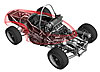
A CT scan of a car is seen with a wire frame of the cover on top of it. Since the car was scanned without the cover, the wire frame was added by the CAD model of the car. Source: Volume Graphics and Yxlon International
A segmentation tool software module allows complex structures to be separated into their individual components. The way the 3-D picture is displayed can be redefined as required; for example, different elements can be highlighted in contrasting colors. The editing possibilities available are similar to those used for 2-D image processing. The segmentation tool also allows technical analyses, such as measurements and porosity analyses, to be performed in pre-defined regions of interest. Apart from that, no CT data set is perfect: If gray value transitions are flawed with many artifacts, fully automatic identification of material borders cannot always be guaranteed. The operator is therefore given the possibility to intervene manually using the segmentation tool.
Precise Defect Analyses
A defect analysis/porosity module can be an essential tool for the inspection of aluminum alloy castings or plastic injection moldings. The software detects pores and cavities, providing the operator not only with a general statement of the quality of the part, but also with a detailed report about size and position of the defects. The segmentation tool can be used to define regions of interest within which defects are to be detected. In practice, the restriction to specific areas is usually more important than global information because it is mostly the problem areas that are of interest to the design engineer.Foundries that aim at producing castings with the lowest possible weight can be supported by a wall thickness analysis module. This can be used to examine the points at which a pre-defined wall thickness is not achieved. Areas where differing wall thicknesses have been detected are marked in contrasting colors and actual measurements are displayed.
For measurement analyses, a coordinate measurement module is at hand that is very close to an actual coordinate measuring machine. The software module is able to align a CT model with a CAD model. Operators who are familiar with CAD systems and using them for measurement tasks will find much that is similar-the methods are almost the same. The system recognizes component surfaces and determines distances or angles in relation to other surfaces.
Connecting Two Data Worlds
When using an actual/nominal comparison module, the universality of software comes into play. It forms a link between the world of voxels and the CAD world. The indirect comparison of voxel data with CAD data is made possible by an internal algorithm. But even though it is not necessary to convert voxel data into CAD data for analyses within the software, it is still possible, for example, in order to process the data further using other programs.Within the data processing world, conversions are generally problematic. They involve additional processing time, and all too often, data loss. When doing analyses within software, the operator is not affected by these problems, but, on the contrary, profits from a further time-saving advantage. By comparison, with software based on surface models, the segmentation functions usually allow a faster dissection of complex structures. This means that the analysis results of certain details or regions of interest are available more quickly.
A module for the reconstruction of CT slice images is available with software today. This module is targeted to producers of CT scanners and allows efficient reconstruction using modern high-end graphics boards. Typical data sets created with 1,000 by 1,000 pixels in 720 projection levels (angle settings) can be reconstructed within a few minutes.
How about Measuring Accuracy?
The measuring accuracy that can be achieved using CT technology depends largely on the quality of the hardware-for example, the X-ray tube, the detector resolution and the alignment of the system. Except for large-scale systems, industrial computer tomography now uses a standard resolution of 1,024 by 1,024 pixels. Because this is a constant value, both small plastic parts, such as connectors and mobile phone shells, and large castings such as cylinder heads or gearbox housings, are displayed with the same resolution. Relatively speaking, the resolution is lower for larger components. For measuring analyses, the consequence is that larger components give a lower accuracy.Another determining factor is the material of the object. The higher the energy of the X-ray needed to penetrate the component, the lower the accuracy with which the X-rayed structures are imaged on the detector. Metal components, for example, require higher energies to be applied than plastic parts. Due to the finer focal spots, accuracies down to the micrometer range can be achieved with smaller plastic parts. However, by far the largest influence on measuring accuracy is exerted by the manipulation system-it is the basis for the calculation of voxel sizes. The greater the imprecision when determining the position of the component within the CT system, the more imprecise the measurements in the represented volumes will be.
With some software, the size of a voxel is not the end of accuracy. The intelligent algorithms of the system can even take fractions of a voxel (sub-voxel) into account for border identification. With a good data quality, a resolution of voxel/10, for sub-optimal data quality, a resolution of voxel/3 can be realistically expected.
The accuracy that can be achieved with measuring analyses cannot be stated in absolute values to a hundredth or thousandth of a millimeter as with a classical coordinate measurement machine. The accuracy always depends on the specific conditions of the scanning process. NDT
Looking for a reprint of this article?
From high-res PDFs to custom plaques, order your copy today!