The History and Evolution of White Light Inspection Sources for Aerospace
In the last two years, a new light source has finally become commercially available that uses light emitting diodes (LEDs) as the white light source.
In the last 2 years, a new light source has finally become commercially available that uses light emitting diodes (LEDs) as the white light source. These LED light sources have been around for 20 years in very low power forms, which were not suitable, or bright enough, for inspection and task lighting. Now we have LED light sources using multi-die technology, creating small point sources of light as high as 20 watts. These multi-die light sources can be put together in a focused array of only a few inches in diameter to create up to 100 watt light source with a luminous efficacy of 130 lumens per watt, far surpassing older, incandescent light sources. The highest luminous efficacy occurs when you drive these LED lights with a constant dc voltage, instead of AC voltage.
Equally important to the luminous efficacy of LED light sources, these LED lamps can be dimmed using a pulse-width modulation (PWM) technique, where the peak current remains constant as the duty cycle varies. This type of PWM dimming technique is carried out by an electronic integrated circuit light engine, which drives the LEDs directly. Using this constant peak current method of intensity control allows full range dimming, while keeping the color temperature constant, and hence, the color rendition index remains high.
Also, it should be noted that the new LED white light source does not project any infra red heat energy, so these light sources are well suited for close up work with any type of task or sample illumination, and the constant color temperature dimming feature allows glare free view, with a white light source suitable for taking photos.
For all of these reasons, LED white light source is well-suited to applications in aerospace, including the visual inspection of small parts, such as those used in aircraft turbine engine assemblies. The variable dimming feature cuts surface glare, allowing better defect verification.
Optical vision inspection systems benefit from the high color rendition index, and constant color temperature, allowing for automated inspection techniques in the aerospace environment.
It was not until the 1960s that a newer, more-efficient and brighter light source, called the halogen lamp, became available. These lamps have a brightness of up to 6000 foot candles at close distances. The function of the halogen is to set up a reversible chemical reaction with the tungsten evaporating from the filament. In ordinary incandescent lamps, this tungsten is mostly deposited on the bulb. The halogen cycle keeps the bulb clean and the light output remains almost constant throughout life. At moderate temperatures the halogen reacts with the evaporating tungsten, the halide formed being moved around in the inert gas filling. At some time it will reach higher temperature regions, where it dissociates, releasing tungsten and freeing the halogen to repeat the process.
In order for the reaction to operate, the overall bulb temperature must be higher than in conventional incandescent lamps. The bulb must be made of quartz or a high-melting-point glass. The high temperature of these halogen bulbs is an occupational work hazard especially for close-up work, where a person would get burned by touching the bulb envelope, or even the lamp shade that houses the bulb. In addition, these lamps project forward a large amount of infra-red heat energy, forcing some users to insert an infra-red blocking filter on the front of the lamp. The luminous efficacy of these halogen bulbs is approximately 24 lumens per watt, which is double the earlier tungsten argon bulb.
It should be noted that the above examples of incandescent lamps can have their intensity controlled by varying the operating voltage to the bulb. The early intensity controls were made with multi-tap transformers, giving discrete steps of intensity, usually limited to less than 10 steps.
In the 1970s, a newer form of intensity control came out with the invention of the triac, which allowed the user to continuously vary the voltage and thus the intensity of the lamp. The main drawback of using variable voltage dimming is that as you dim the lamp , the color temperature changes, which causes the white light source to turn into a warmer orange color light source, which is not good if you are taking photos and lessens the color rendering index of the light source. j
Scientific Instruments is one of the few companies today making LED white light sources for inspection task lamps, utilizing state of the art light engines with dc power source for maximum luminous efficacy, and universal input voltage for worldwide compatibility, along with full range PWM dimming adjustment for glare free viewing. This new LEDLITE can be viewed by visiting www.sciinst.com .
LED light sources using multi-die technology create small point sources of light as high as 20 watts.
These LED lamps can be dimmed using a pulse-width modulation (PWM) technique, where the peak current remains constant as the duty cycle varies.
The new LED white light source does not project any infra red heat energy, so these light sources are well suited for close up work with any type of task or sample illumination, and the constant color temperature dimming feature allows glare free view, with a white light source suitable for taking photos.
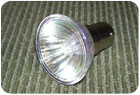
Halogen bulb
In the last 2 years, a new light source has finally become commercially available that uses light emitting diodes (LEDs) as the white light source. These LED light sources have been around for 20 years in very low power forms, which were not suitable, or bright enough, for inspection and task lighting. Now we have LED light sources using multi-die technology, creating small point sources of light as high as 20 watts. These multi-die light sources can be put together in a focused array of only a few inches in diameter to create up to 100 watt light source with a luminous efficacy of 130 lumens per watt, far surpassing older, incandescent light sources. The highest luminous efficacy occurs when you drive these LED lights with a constant dc voltage, instead of AC voltage.
Equally important to the luminous efficacy of LED light sources, these LED lamps can be dimmed using a pulse-width modulation (PWM) technique, where the peak current remains constant as the duty cycle varies. This type of PWM dimming technique is carried out by an electronic integrated circuit light engine, which drives the LEDs directly. Using this constant peak current method of intensity control allows full range dimming, while keeping the color temperature constant, and hence, the color rendition index remains high.
Also, it should be noted that the new LED white light source does not project any infra red heat energy, so these light sources are well suited for close up work with any type of task or sample illumination, and the constant color temperature dimming feature allows glare free view, with a white light source suitable for taking photos.
For all of these reasons, LED white light source is well-suited to applications in aerospace, including the visual inspection of small parts, such as those used in aircraft turbine engine assemblies. The variable dimming feature cuts surface glare, allowing better defect verification.
Optical vision inspection systems benefit from the high color rendition index, and constant color temperature, allowing for automated inspection techniques in the aerospace environment.
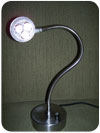
LED lite
History
In the early 1900s, bench-type task lights were powered by standard tungsten argon 12v or 120v bulbs. The brightness of these bulbs, even at close distances, was limited to approximately 1000 foot candles. The life of the bulb was approximately 1000 hours. These bulbs project infra-red heat, to some extent, making them frequently unsuitable for very-close-up work, or for biologic sample analysis under microscope or stereoscope. The luminous efficacy of these bulbs is approximately 12 lumens per watt.It was not until the 1960s that a newer, more-efficient and brighter light source, called the halogen lamp, became available. These lamps have a brightness of up to 6000 foot candles at close distances. The function of the halogen is to set up a reversible chemical reaction with the tungsten evaporating from the filament. In ordinary incandescent lamps, this tungsten is mostly deposited on the bulb. The halogen cycle keeps the bulb clean and the light output remains almost constant throughout life. At moderate temperatures the halogen reacts with the evaporating tungsten, the halide formed being moved around in the inert gas filling. At some time it will reach higher temperature regions, where it dissociates, releasing tungsten and freeing the halogen to repeat the process.
In order for the reaction to operate, the overall bulb temperature must be higher than in conventional incandescent lamps. The bulb must be made of quartz or a high-melting-point glass. The high temperature of these halogen bulbs is an occupational work hazard especially for close-up work, where a person would get burned by touching the bulb envelope, or even the lamp shade that houses the bulb. In addition, these lamps project forward a large amount of infra-red heat energy, forcing some users to insert an infra-red blocking filter on the front of the lamp. The luminous efficacy of these halogen bulbs is approximately 24 lumens per watt, which is double the earlier tungsten argon bulb.
It should be noted that the above examples of incandescent lamps can have their intensity controlled by varying the operating voltage to the bulb. The early intensity controls were made with multi-tap transformers, giving discrete steps of intensity, usually limited to less than 10 steps.
In the 1970s, a newer form of intensity control came out with the invention of the triac, which allowed the user to continuously vary the voltage and thus the intensity of the lamp. The main drawback of using variable voltage dimming is that as you dim the lamp , the color temperature changes, which causes the white light source to turn into a warmer orange color light source, which is not good if you are taking photos and lessens the color rendering index of the light source. j
Scientific Instruments is one of the few companies today making LED white light sources for inspection task lamps, utilizing state of the art light engines with dc power source for maximum luminous efficacy, and universal input voltage for worldwide compatibility, along with full range PWM dimming adjustment for glare free viewing. This new LEDLITE can be viewed by visiting www.sciinst.com .
Tech Tips
Looking for a reprint of this article?
From high-res PDFs to custom plaques, order your copy today!