The Photoelectric Solution
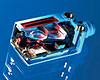
A photoelectric sensor is made up of lighting, lensing and electronics. This shows a cross section of a sensor. Source: Sick Inc.
Despite the popularity of vision sensors, the simple combination of photoelectric sensors can still be a preferred sensing solution for vision. With smaller sensors, more powerful sensor ASIC technology and low-cost PLCs, this combination is a viable solution for many inspection tasks.
First, what is a photoelectric sensor? In the simplest terms, it is made up of lighting, lensing and electronics. The technology goes beyond those simple terms, however.
Lighting
Most modern photoelectric sensors use LED technology for the “light” part of the equation. Depending on the application, the most common LEDs are either red (typically 630 to 660 nanometers) or infrared (850 to 880 nanometers). There also are common applications using green (about 525 nanometers) or ultraviolet (about 370 nanometers). The construction of the LED can include a simple protective dome over the diode or can be a more sophisticated lens that provides a pinpoint of light. The light provided by the LED ultimately will be used to determine whether a photoelectric sensor switches state, how much of the light is received or where along the receiver light is received by the sensor.Lensing
The combination of the LED-with or without its own lens-and the sensor’s lensing create the light spot. The type of lens on a sensor can provide a variety of behaviors for the sensor. While some photoelectric sensors use polished glass lenses, these are generally only found on older legacy products. The vast majority of today’s lenses are molded plastic. The construction or appearance of the lenses will vary: internal lensing with an external lens cover, molded lenses with a flat front or molded lenses external to the sensor (convex). Also, some sensors will have the sender and receiver lens next to each other, while some are separated and others are a single lens. This single lens is an auto-collimated system-the sender and receiver are on the same axis.Much like the LED selection, the type and arrangement of the lenses ultimately depends on the designated application for that sensor. As mentioned, the LED and lensing will determine the characteristics of the light spot. For example, a sensor used to detect very small parts would be designed with a pinpoint LED and lensing that provides a sharp-focused spot at a short range; meanwhile, a sensor intended to be easily aligned and used in a break-the-beam application with a reflector would be designed with a floodlight LED and wider-angle lensing.

This is a sensor detection application. Photoelectric sensors are a cost-effective alternative to vision. Source: Sick Inc.
Electronics
As important as the lighting and lensing are, probably more important are the electronics inside today’s sensors. Most photoelectric sensors use application-specific integrated circuit (ASIC) technology. Simply put, these ASICs are the smarts that make the sensors work. Today’s ASICs have replaced yesterday’s discrete components. The space-saving design has enabled photoelectric sensors to get dramatically smaller in the last decade. Also, the reduction of components required contributes to better shock and vibration resistance, as well as better stability in temperature extremes. The biggest advantage to these ASICs is the creation of the processing algorithms. State-of-the-art ASIC design provides such technological advances as improved ambient light immunity, increased protection from many forms of EMC or other “industrial noise,” including electrostatic discharge (ESD), cell phones and crosstalk from other sensors.Sensing Modes
When the lighting, lensing and electronics are finally combined, work can begin designing sensors for modern applications, including simple inspection tasks. Three primary sensing modes are through-beam, retroreflective and diffuse. Through-beam sensing is the most basic: light only goes one way, from the sender to the receiver. While this is basic and not dependent on color or reflectivity of the objects, costs are inherently higher because two housings have to be purchased, mounted and maintained. Retroreflective, also called reflex, is probably the most common mode and generally the least expensive: the sensor contains sender and receiver, and is aligned to a reflector or reflective tape. The most diverse mode is diffuse: light is reflected off the target object. Some of the most common diffuse sensing types are background suppression, foreground suppression, energetic, V-optic, convergent or divergent. These different sensing types are created by the combination of the lighting and lensing. The performance is often determined by the ASIC used.Alternative to Vision
Using photoelectric sensors for inspection is nothing new. For years, OEMs and integrators have combined sensors with programming in their controls to check for missing parts in automotive assembly or detect an incorrectly threaded cap on a bottling line. This solution often can provide reasonably priced high-speed error proofing. The downside is the number of sensors required, which depends on the specific application, as well as the time and expertise required for the controls programming.When the only vision solutions were vision systems, the cost to implement these solutions led to more attention focused on using combinations of photoelectric sensors. These sensor solutions were less expensive and definitely worth the effort. More recently, however, industry has seen the introduction of the vision sensor. Specifically designed to fill the application gap between photoelectric sensors and a vision system, these vision sensors generally offer basic software to program the sensor for an inspection application. Vision sensors have been the latest hot wave in automation.
But, while these vision sensors are definitely a step down in implementation costs when compared to vision systems, they are still often more expensive than implementing a collection of photoelectric sensors for the same application. It comes down to preference. The vision sensor is often a viable choice. But the photoelectric sensor option is absolutely not going away. Photoelectric sensors remain a cost-effective alternative to vision.
Wayne Meyer is product manager, industrial sensors, at Sick Inc. (Minneapolis). For more information, call (800) 325-7425, e-mail [email protected] or visit www.sickusa.com.
Looking for a reprint of this article?
From high-res PDFs to custom plaques, order your copy today!