Software & Analysis
Are Your Documents Under Control?
Document control must not be isolated.
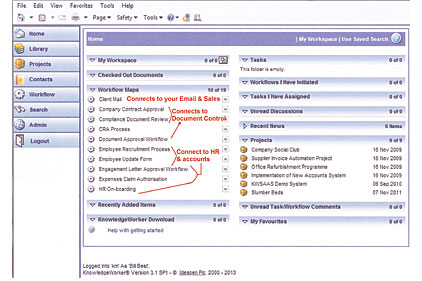 This is a single web interface to multiple systems with controlled and uncontrolled/managed documents alongside projects and accounts. |
In the mid 1980s my company got its first PC for accounting and a database of client/case records. It was a revolution! At that time companies had document management systems that involved extensive rows of filing cabinets and, if they were lucky, a more than competent filing clerk. What little control there was over these documents involved being responsible for the key of the one locked filing cabinet.
In 1990 I was introduced to quality management and the UK standard BS5750; ISO 9001 followed shortly afterwards. For the most part business managers wanted the certificate on the wall to aid sales, PR and because their customers “required” it. I got asked by directors of many small and medium-sized enterprises what a certificate would cost and did it come with a “quality” frame? All too often they were not interested in quality management as a means of improving the prospects and profitability of their business. Quality managers tasked with getting their companies approved to ISO 9001 often had an uphill task trying to persuade their senior managers that controlling selected documents was a reasonable requirement that would provide benefits to the company.
Generally, sufficient power to control some documents and monitor procedures and processes was given to the quality manager who squeezed in such responsibilities around his “real” job. In practice this usually meant storing “controlled” documents in a locked cabinet in the quality manager’s office, to which selective access could be gained with his or her permission. It also meant tiresome hours gathering information from disparate IT systems to produce any form of quality management information.
While this was not by any means the case in every company it was certainly pretty common in small and medium-sized enterprises. The initial software produced at the time in DOS did little more than provide an indexing system and historical record of document changes. We classified it as document control, but that was certainly a misuse of the word “control.”
The key thing about document control and quality management records in general is that they were entirely separate from the business management systems. Accounting and financial records were pretty much computerized by this time, while sales and marketing were using basic databases to assist them. ERP systems were coming to the forefront yet the quality management team continued, in most companies, using a quill pen or a hand-me-down PC from an accounting or sales system upgrade. Little or no software was provided.
Updated standards improved their relevance to business while greater commercial intelligence of quality managers, growing use of IT in the private lives of company staff, and an acknowledgement that the quality manager did have a role to play beyond retaining the certificate on the wall resulted in quality departments getting their own specialist software for controlling their documents and managing quality data. The improvements in quality management and information have not arrived without cost however. Disparate systems were put in place to solve differing issues for different departments, creating silos of information. The IT departments have found it hard to keep up with the changing software world.
According to the Forrester Research report “Trends 2011: ERP Customers Demand Better Flexibility, Cost Transparency, And Mobility,” by Paul D. Hamerman, from January 11, 2011, “approximately half of ERP customers are currently on releases that are two versions behind the current release,” which may be four years old or more. This results in duplication of data, multiple sources or locations for data and documents, and difficulty in taking advantage of new technological opportunities. All of this produces a very high risk of error. I have only come across a handful of companies that have done a real cross functional FMEA on their own business management IT software systems. Have you?
The opportunities to mitigate business risks, reduce harmful effects and greatly increase efficiency—and profits—have never been greater, however it does require commitment by all departments to understand the needs. IT departments have tended to have the idea that document control is a simple task of securing their storage in a restricted area of the server or web site whereas all quality professionals know it involves a little more than that. One of the difficulties in achieving a fully integrated complete business management system incorporating all of the quality management needs is that no single software company has all the answers. Nevertheless it is becoming easier to integrate systems from different companies to provide a complete management system. It is also important to realize that just solving the document management and control issue without integration of the rest of the business functions is probably going to cause more problems than it solves.
So given that we are now in a more technologically advanced situation, what do we need to consider in determining a way forward? The most important considerations are:
-
Who are the suppliers of data input?
-
Who are the clients for the system output?
-
What is it that they want/need and
-
How do they interact with the system?
The answer to the first two is “everyone” and that includes your suppliers and customers. They may not enter data directly now but this will become increasingly common. The answer to 3 is potentially “everything,” however whereas supplier/customer needs are very limited, staff needs are wider and specific to each individual. It is important to fully understand what is required by your customers and suppliers as well as staff on the shop floor; Why the documents are required, what are they used for and how can we improve the way they are used.
The simple answer to question 4, how do they interact with the system? is “in a simple, quick and easy to use manner.” Enhancing the ease of interaction between the person and document/data is a critical requirement of any system upgrade or replacement. There is always a compromise between security and being easy to use, however the latest security systems and software does reduce the need for compromise. When anyone needs access to documents they should be able, at a single interface screen, to see the existence of controlled and managed documents alongside each other with little or no differentiation. Equally they should be able to see a list of documents in an ERP or content management system which will deliver to them the relevant documents whether controlled or not. Clearly the system has to ensure that if it is a controlled or restricted document the user has the rights to see it.
When viewing a document a user should have a simple and quick common interface to register a change request if an error is spotted or an update is required. This does not mean that they need to make the change, just that they need to notify owners of the document that review is required. This should be possible from any software, not just the document control quality management system.
Products like SharePoint and Oracle WebCentre are excellent at document management, however, their control features are very much dependent on the quality of the programmers that configure it, and of course will those programmers be available in the event of an upgrade requirement? Other products like KnowledgeWorker are a relatively new form of content management system, which do not restrict themselves to web sites. They are pretty much preconfigured to overlay your existing systems as well as providing document management/process management facilities. This means that you can access and interact with the data from accounting, ERP and your quality management system all from one interface. These products, and there are several around, are becoming more platform independent which means that handheld devices can also be used.
Having a common interface allows, for example, the entry of a nonconformance or a complaint that will automatically connect to the quality management system, and trigger the process through to resolution including updates to documents, procedures, processes, training requirements, accounts and the like before delivering these back through the common interface to all interested users. Managers see real time data dashboards enabling them to quickly identify trends both good and bad.
Despite everything that I have said here, there is one thing that is a given: paper is not redundant. There are many circumstances when the printed copy will still be required and this leaves us with one major risk which does need to be addressed. How do you know that the piece of paper you’ve got is the correct piece of paper? I am sure that the solution to this is just around the corner.
|
TECH TIPS
|
Looking for a reprint of this article?
From high-res PDFs to custom plaques, order your copy today!