Measurement
New Technology Improves Photogrammetry
Mid-nineteenth century measurement technique now benefits from optics and scanners.
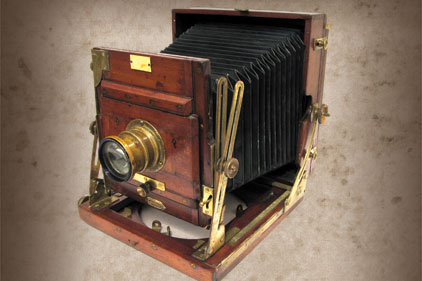
Source: stock xchng, guguxpress |
Photogrammetry determines the geometric properties of an object from photographic images.
According to Ben Dawson, director of strategic development at Teledyne DALSA, photogrammetry has two definitions. One definition is for what it is and the other for where it is used. It uses one or more images or photographs to determine the shape of an object. The second definition, he said, “In my mind it is used for measuring large objects–buildings in a remote sensing say, satellite image, aircraft wings, interiors of buildings for architecture or engineering, etc.”
Point Cloud
Photogrammetry has a history of measuring 3-D—width, height and depth, distance or range. The 3-D measurements are represented in the computer as a point cloud.
“Measuring the length of shadows in a single photograph can be used. Perhaps you have seen this on NCIS,” said Dawson. “It can be used to approximate objects heights. This doesn’t give you a full point cloud.”
A point cloud is a set of data points in some coordinate system in a three dimensional coordinate system, these points are often referred to as X, Y, Z and represented as the external surface of an object. Because of 3-D scanning point clouds can be used in a variety of ways in the manufacturing process. This includes 3-D CAD models for manufactured parts, metrology, quality inspection, and a myriad of visualization, animation, rendering and mass customization applications.
In addition to measuring a shadow, photometric stereo, stereophotogrammetry and laser are among the ways third dimension measurements can be taken.
Photometric stereo
Photometric stereo or shape from shading is the term used in machine vision is when two or more images taken with different illumination to estimate the object’s 3-D shape.
“For example, you have a picture taken from an airplane in the morning and a picture taken the same way and at the same spot in the afternoon. The differences in shading and shadows can be used approximate object heights,” said Dawson.
Stereophotogrammetry
Stereophotogrammetry or stereo-vision and in machine vision uses geometry and takes two or more images from angles of view, said Dawson. “By finding the corresponding position of object points in the two or more images, you can figure the height at that point on the object,” said Dawson.
This does what the eyes and brain do naturally when one looks at anything. A related method is called structured light. This is when corresponding object points are found by an illumination pattern rather than the reflectance from the object’s surface.
Laser
Laser has varied applications that can also be used to gather 3-D measurements. This includes time of flight or LIDAR which sends out a pulse of light and times how long it takes for the pulse to travel to the object. This method is usually used for long distances.
“If you have ever been clocked by a police laser gun, this measured speed a form of LIDAR,” said Dawson.
Lasers can modulate the light beam and measure the phase difference of the returned beam. This is used for moderate distance measures, perhaps up to a few hundred meters.
“The new Kinect from Microsoft looks like it uses this method,” said Dawson. This allows it to differentiate from the hands operating it from the couch in which they are sitting.
Photogrammetry applications are uses many disciplines. These cameras have revolutionized the quality control industry. Cameras allow the optic and projective geometry elements to merge. Teledyne DALSA’s BOA Smart Cameras are an evolution of cameras and quality control. Smart, small, quick and easy are among its many attributes that make it the product of choice for many quality applications. They are ease of use, price and small in size and weight.
Since time equates money in the manufacturing industry, the BOA’s ease of set up only taking minutes using a graphical interface and terms familiar to a manufacturing or quality professional. “For example, the interface shows familiar caliper tools, rather than the details of edge detection. We put significant effort into the human factors design of the BOA, to make the user interface simple, intuitive and attractive,” said Dawson.
Price is a factor when determining equipment used in any manufacturing setting. According to Dawson, the BOA is an all-in-one product. “Just add lighting, lens and connect it to the factory Ethernet. The BOA offers good performance and an attractive price, when compared with component-based vision systems,” he said.
Small and light weight makes this camera compatible for if a vision system is retrofitted into a small space or the smart camera is placed on the end of a robot arm.
The BOA is typically used for a spot of vision.
“Take for example, dimensioning a part as it is made. Electrical connector components, are stamped out of metal like copper and the BOA measures critical dimensions of these parts as they are made in real time. This allows the stamping process to be quickly stopped if bad product is being made and also can monitor how the stamping tools are wearing by the slow changes in component dimensions,” said Dawson
Common tasks for the BOA are dimensioning and metrology of calipers and hole diameters. It also detects defects and flaws such as scratches, dirt or cracks. By positioning it on a robot arm it facilitates in visual control and guidance.
Photogrammetry does not tell the whole story according to Daniel Brown, product manager.
“Photogrammetry alone is used to gives reference points when only specific points of low density are required,” said Daniel Brown, product manager at Creaform. “When it is use with 3-D scanning the procedures complement each other. However, when it is used with 3-D scanning the procedures complement each other.”
Where photogrammetry stops, 3-D scanning adds another dimension
The MaxSHOT 3D optical coordination system from Creaform takes photogrammetry to another level. Introduced to the market in May of this year, it gives the speed and accuracy of photogrammetry with a wide range of applications including quality control.
According to Creaform, it is portable, reliable and very easy to use. The MaxSHOT 3D combines a photogrammetric video camera with the VXshot processing software. This results in speed and accuracy. The easy positioning model that allows novices to use it with ease and accuracy based on a series of photos. The data acquisition process guides users through each step. The software informs the user if additional pictures are needed for accuracy. With a few coded targets either on the object to be measured or in its environment and take several blocks of convergent photos and launch the bundle adjustment process. This allows reflectors replaced on the object in 3D and the scale bars for model scaling.
After the calculations are complete, the Creaform 3D scanner or optical CMM automatically uses the high accuracy positioning model generated in VXelements to determine its position in the measurement volume.
The BOA and the MaxShot 3D are incorporating photogrammetric technology with TeledyneDALSA and Creaform merging photogrammetric technology with scanning capabilities that make for more accurate, reliable and portable devices.
Looking for a reprint of this article?
From high-res PDFs to custom plaques, order your copy today!


