Quality Magazine logo
search
cart
facebook twitter linkedin youtube
  • Sign In
  • Create Account
  • Sign Out
  • My Account
Quality Magazine logo
  • NEWS
  • PRODUCTS
    • FEATURED PRODUCTS
    • SUBMIT YOUR PRODUCT
  • CHANNELS
    • AUTOMATION
    • MANAGEMENT
    • MEASUREMENT
    • NDT
    • QUALITY 101
    • SOFTWARE
    • TEST & INSPECTION
    • VISION & SENSORS
  • MARKETS
    • AEROSPACE
    • AUTOMOTIVE
    • ENERGY
    • GREEN MANUFACTURING
    • MEDICAL
  • MEDIA
    • A WORD ON QUALITY PUZZLE
    • EBOOK
    • PODCASTS
    • VIDEOS
    • WEBINARS
  • EVENTS
    • EVENT CALENDAR
    • IMTS
  • DIRECTORIES
    • BUYERS GUIDE >
      • Supplier Insights
    • NDT SOURCEBOOK
    • VISION & SENSORS
    • TAKE A TOUR
  • INFOCENTERS
    • Digital Quality Management Systems
    • NEXT GENERATION SPC & QUALITY ANALYTICS
  • AWARDS
    • ROOKIE OF THE YEAR
    • PLANT OF THE YEAR
    • PROFESSIONAL OF THE YEAR
  • MORE
    • Expert Columns
    • NEWSLETTERS
    • QUALITY STORE
    • INDUSTRY LINKS
    • SPONSOR INSIGHTS
  • EMAG
    • eMAGAZINE
    • ARCHIVES
    • CONTACT
    • ADVERTISE
  • SIGN UP!

Quality Test & Inspection: Photogrammetry Provides Picture Perfect Accuracy

October 1, 2005
Photogrammetry captures high-precision measurements in the most formidable places.


The pairing of two seemingly disparate processes-photography and measurement-could only result in something interesting, something completely out of the ordinary. Since the introduction of the box camera in 1888, the endless possibilities of a device so portable, so adaptable to any setting has enabled the world to embrace the art of capturing images like no other pastime.

Fast forward to 2005. The digital photography revolution is progressing in leaps and bounds. Stir industrial metrology into the mix, and a portable coordinate measurement technology has emerged-photogrammetry. No cords. No cables. Just the operator, a camera and the object to be measured.

Photogrammetry is a 3-D coordinate measuring technique that uses photographs as the fundamental medium for metrology. The technology began to thrive in the early 1970s when civil engineers and surveyors began using photogrammetry for measuring and creating large 3-D topological mapping systems. With the success of photogrammetric technology in this discipline, soon industrial engineers were looking to reap those benefits in their respective industries.

Breakthroughs in both math and science evolved this sector of metrology into what is known as close-range photogrammetry. The combination of an ultra-mobile photogrammetric camera and the high-precision measurement capabilities of a coordinate measuring machine (CMM) sets this technology apart in a field all its own. Photogrammetry is used extensively for industrial applications such as in-place measurement, tooling inspection and adjustment, test-retest measurement, deformation studies, part inspection and tamoana (disassembly and reassembly) studies. Engineers and quality professionals working in aerospace, shipbuilding, automotive, antenna and satellites, space hardware and power generation have found photogrammetry to be the one portable measurement technology that is not hindered by harsh conditions, populated production lines or formidable plant settings.


Triangulation is the fundamental principle used by photogrammetry. By taking photographs from at least two different locations, lines of sight can be developed from each camera to points on the object. These lines of sight, sometimes called rays because of their optical nature, are mathematically intersected to produce 3-dimensional coordinates of the points of interest. Source: Geodetic Systems Inc.

Photogrammetry principles

Triangulation is the fundamental principle used by photogrammetry. By taking photographs from at least two different locations, lines of sight can be developed from each camera to points on the object. These lines of sight, sometimes called rays because of their optical nature, are mathematically intersected to produce 3-D coordinates of the points of interest.

A projector-like device casts thousands of dots on the measurement surface. Designed with large objects in mind, this system generates fast, accurate, dense, noncontact measurements on large surfaces such as molds, master models, panels, antennas and other components. Source: Geodetic Systems Inc.

Measuring industrial objects with photogrammetry usually consists of the following steps:

• Planning the measurement

• Targeting the object

• Taking pictures

• Measuring pictures

• Processing pictures to obtain 3-D coordinate data

• Analyzing the results

This list is a merely a general guide as every measurement project is unique. Sometimes the content and even the order of these steps may be modified.

There are many ways to capture points of interest on an object. Targeting is just one method used in close-range photogrammetry. The photogrammetry system measures special targets made of a thin 0.1 millimeter-thick, flat, grayish colored retro-reflective material, which efficiently returns light to the light source.

A single camera system is used for an aerospace measurement application. Source: Geodetic Systems Inc.

The photogrammetric camera does not measure the object directly, but measures the center of the retro-reflective target. By placing the target on or in a known relationship to the point of interest, the point can be measured. In some circumstances, it may be difficult to target the point to be measured directly. Fortunately, many different types of retro-reflective targets have been developed to solve this issue.

Once an object is targeted, the camera's flash illuminates the targets and makes exposure of the targets independent of the ambient light level. This means the object can be photographed in bright light or total darkness, and the target exposure will be the same. Therefore, the target and object exposure are largely independent as target exposure is provided by the strobe, and object exposure is provided by the ambient light. The camera automatically sets the shutter speed and flash power setting based on lighting conditions in the environment.

While targeting has been the mainstay in photogrammetry, new developments are giving the quality control professional new alternatives to capture points of interest. For example, a stroboscopic light projector, casts thousands of dots upon a surface and measures them in less than one minute. Source: Geodetic Systems Inc.

While targeting has been the mainstay in photogrammetry, new developments are giving the quality control professional new alternatives to capture points of interest. For example, one company has developed a stroboscopic light projector that casts thousands of dots on a surface and measures them in less than one minute. Designed with large objects in mind, this new system generates fast, accurate, dense, noncontact measurements on large surfaces such as molds, master models, panels and antennas.


Picture perfect accuracy

How many photographs are needed for an accurate measurement? As photogrammetry measures by triangulation, in theory only two photographs are required for a measurement. However, a minimum of four to six photographs is recommended because this range allows the operator to self-calibrate the camera.
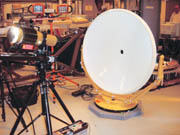
Photogrammetry is ideal for measuring all sizes of antenna, in a shop environment or outdoors in a remote location. Source: Geodetic Systems Inc.

Photogrammetry is precise and provides accuracies comparable to those achieved by other large volume, high-accuracy coordinate measurement systems. Typical accuracies are 25 to 50 microns, or 0.001 to 0.002 inch, on a 3-meter object.

Photogrammetric accuracy depends on several interdependent factors:

• Camera resolution

• Size of the measured object

• Number of photographs taken

• Geometric layout of the camera stations, or camera locations, relative to the object and to each other.


Photogrammetry and metrology

In the field of metrology, photogrammetry has the ability to measure and inspect large objects in busy industrial settings where environmental factors like vibration, movement and extreme temperatures often are found. A photogrammetric camera can gather 3-D data with laboratory quality and accuracy without laboratory conditions as required by other metrology instruments. Precise measurements can be captured while the camera operator is standing on an unstable floor, or from a lift or scaffolding on the plant floor. Photogrammetry also is immune to harsh conditions in outdoor environments such as shipyards and remote space antenna fields.

Inspection of large assemblies, such as aircraft, automobiles and space hardware, in a production environment can be a difficult task. A shop floor or assembly line presents many obstacles for quality control personnel. Workers, tools, equipment, cabling channels and other obstructions can impede the line of sight. Because of the portability of a camera, operators can shoot field measurements with minimal downtime to others working concurrently on an assembly of an aircraft, automobile or other large assembled objects.

This software automatically inspects digital pictures and produces three-dimensional data. The data can be aligned into any coordinate system, used for surface inspection operations, compared to previous measurements or examined further with analysis, visualization and statistical tools. The operator can view points, camera stations, intersection angles, surfaces, XYZ coordinate information and analysis results. Source: Geodetic Systems Inc.

Photogrammetry transforms the plant floor into a place where metrology adapts to the production line in practical way. This interaction revolves around working people and productivity. With the least amount of impact to others working in the same environment, the QC department can use a photogrammetric camera to gather critical coordinate data, perform analysis, breakdown the assessment and make adjustments all within the confines of a work day. Q


Gary Johanning is vice president of Geodetic Systems Inc. (Melborne, FL). For more information, call (321) 724-6831, e-mail [email protected] or visit www.geodetic.com.


Tech tips

• Photogrammetry is a 3-D coordinate measuring technique that uses photographs as the fundamental medium for metrology.

• Photogrammetry is one example of portable measurement technology that is not hindered by harsh conditions, populated production lines or formidable plant settings.

• Triangulation is the fundamental principle used by photogrammetry.

• The photogrammetric camera does not measure the object directly, but measures the center of the retro-reflective target. By placing the target on or in a known relationship to the point of interest, the point can be measured.

Share This Story

Looking for a reprint of this article?
From high-res PDFs to custom plaques, order your copy today!

Recommended Content

JOIN TODAY
to unlock your recommendations.

Already have an account? Sign In

  • 2024 Quality Rookie of the Year Justin Wise 1440x750px banner with "Quality Rookie of the Year" logo inset

    Meet the 2024 Quality Rookie of the Year: Justin Wise

    Justin Wise is an exceptional individual who has been...
    Aerospace
    By: Michelle Bangert
  • Man with umbrella and coat stands outside while it rains at night looking at a building.

    Nondestructive Testing: Is there an ethics problem?

    I was a whistleblower who exposed fraudulent activities...
    NDT
    By: Dale Norwood
  • Unraveling Deflategate: Football stadium with closeup of football on field

    Unraveling the Tom Brady Deflategate

    The Deflategate scandal erupted following the 2014 AFC...
    Measurement
    By: Greg Cenker and Henry Zumbrun
Manage My Account
  • eMagazine Subscriptions
  • Newsletters
  • Online Registration
  • Subscription Customer Service
  • Manage My Preferences

More Videos

Sponsored Content

Sponsored Content is a special paid section where industry companies provide high quality, objective, non-commercial content around topics of interest to the Quality audience. All Sponsored Content is supplied by the advertising company and any opinions expressed in this article are those of the author and not necessarily reflect the views of Quality or its parent company, BNP Media. Interested in participating in our Sponsored Content section? Contact your local rep!

close
  • Key Takeaways for Quality Leaders
    Sponsored byComplianceQuest

    Key Takeaways for Quality Leaders from the 2026 Gartner Magic Quadrant™ for QMS

  • This image shows a person seated next to a Bobcat T66 compact track loader.
    Sponsored byPolyWorks by InnovMetric

    Supercharging Digital Gauging at Bobcat North America

  • Dorsey Calibration Lab photo by Tom LaBarbera Picture this Studios
    Sponsored byDorsey Metrology International

    Ensuring Product Quality in a Competitive Manufacturing Landscape

Popular Stories

a titanium diaphragm speaker driver

The One Thing Elon Gets Right Is Designed to Scare You

This image shows a person seated next to a Bobcat T66 compact track loader.

Supercharging Digital Gauging at Bobcat North America

Dorsey Calibration Lab photo by Tom LaBarbera Picture this Studios

Ensuring Product Quality in a Competitive Manufacturing Landscape

2026 Quality Professional of the Year!

Events

June 9, 2026

Future-Proof your Quality Processes with Advanced 3D Optical CMM Technology

Discover how to effortlessly capture complex data, leverage true multi-sensor automation, and ensure continuous operation without creating inspection delays.

June 22, 2026

Automate 2026

Automate is North America's largest robotics and automation event — and the best place to take your ideas from insight to impact.
 
Our show floor features the world’s leading automation solutions, from AI and robotics to motion control, vision systems, and more. Plus, our educational conference is second to none, led by the brightest minds in automation today.
 
Ready to transform the way you work? Take the next step at Automate.
View All Submit An Event

Products

Lean Manufacturing and Service Fundamentals, Applications, and Case Studies

Lean Manufacturing and Service Fundamentals, Applications, and Case Studies

See More Products
Quality Podcast Channel Custom Content

Related Articles

  • Quality Innovations: Picture Perfect

    See More
  • Quality Test & inspection: See the Forest and the Trees

    See More
  • Quality Test & Inspection: Sensor-Driven Error Proofing

    See More

Related Products

See More Products
  • Quality Audits for Improved Performance, Third Edition

  • Quality Improvement Through Planned Experimentation 3/E

  • Juran Institute's Six Sigma Breakthrough and Beyond Quality Performance Breakthrough Methods

See More Products

Events

View AllSubmit An Event
  • May 20, 2026

    Break the Bottleneck: Bringing Lab-Grade Accuracy to the Shop Floor

    On Demand Are you struggling to deliver high-quality products faster in the face of growing complexity and a shrinking pool of skilled workers?
View AllSubmit An Event
×

Stay in the know with Quality’s comprehensive coverage of
the manufacturing and metrology industries.

Newsletters | Website | eMagazine

JOIN TODAY!
  • RESOURCES
    • Advertise
    • Contact Us
    • Directories
    • Manufacturing Division
    • Store
    • Want More
  • SIGN UP TODAY
    • Create Account
    • eMagazine
    • Newsletters
    • Customer Service
    • Manage Preferences
  • SERVICES
    • Marketing Services
    • Market Research
    • Reprints
    • List Rental
    • Survey/Respondent Access
  • STAY CONNECTED
    • LinkedIn
    • Facebook
    • YouTube
    • X (Twitter)
  • PRIVACY
    • PRIVACY POLICY
    • TERMS & CONDITIONS
    • DO NOT SELL MY PERSONAL INFORMATION
    • PRIVACY REQUEST
    • ACCESSIBILITY

Copyright ©2026. All Rights Reserved BNP Media, Inc. and BNP Media II, LLC.

Design, CMS, Hosting & Web Development :: ePublishing