
ComplianceQuest is the #1 AI-powered Quality, Risk, and Compliance (QRC) platform that connects product, manufacturing, people, and partner quality in a single system. Built on Salesforce, the platform delivers end-to-end visibility, AI-driven intelligence, and enterprise-scale execution, enabling organizations to prevent risk, ensure compliance by design, and turn quality into a driver of growth.


Key Takeaways for Quality Leaders from the 2026 Gartner Magic Quadrant™ for QMS
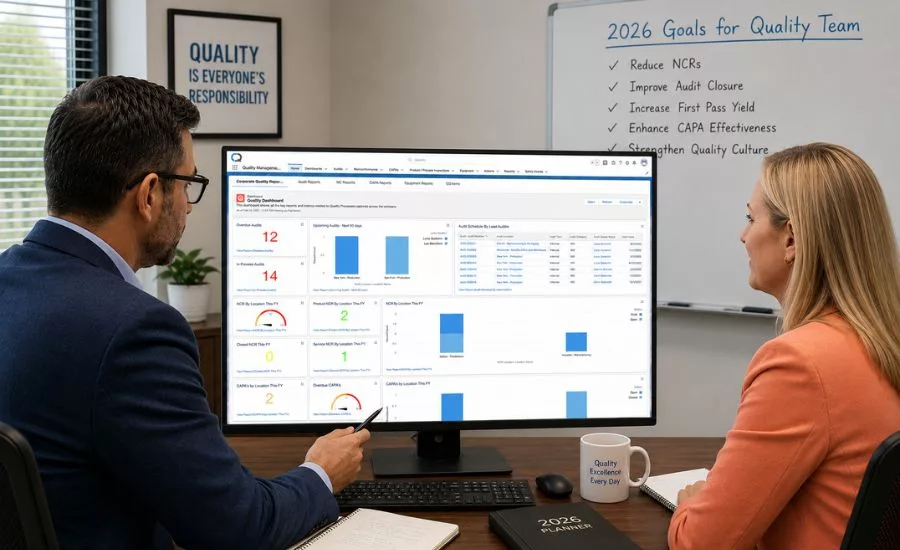
Quality leaders don’t need more noise. They need clarity.
The QMS market has become crowded, feature-heavy, and increasingly difficult to evaluate. Many platforms look similar at a distance, but the real differences only emerge during implementation, integration, and day-to-day execution.
We believe the 2026 Gartner® Magic Quadrant™ for Quality Management System Software reflects this reality. It highlights how vendors are evolving, but more importantly, it signals how buyer expectations are changing.
Here are a few key shifts shaping QMS decisions in 2026:
- Quality is now a board-level priority — driven by risk, cost, and supply chain impact
- Cloud is the default baseline — differentiation comes from time-to-value and scalability
- AI claims are under scrutiny — buyers expect measurable workflow impact, not features.
- Integration is critical — disconnected systems create delays, blind spots, and reactive quality management.
- Usability directly impacts compliance outcomes — adoption drives data integrity and audit readiness.
These shifts point to a larger change:
QMS is no longer about documentation. It is about execution.
ComplianceQuest has been named a Leader, and positioned highest on Ability to Execute
ComplianceQuest was named a Leader in the 2026 Gartner® Magic Quadrant™ for Quality Management System Software and is positioned highest on the Ability to Execute axis.
We want to answer a more practical question:
What does “Ability to Execute” need to look like in today’s quality environment?
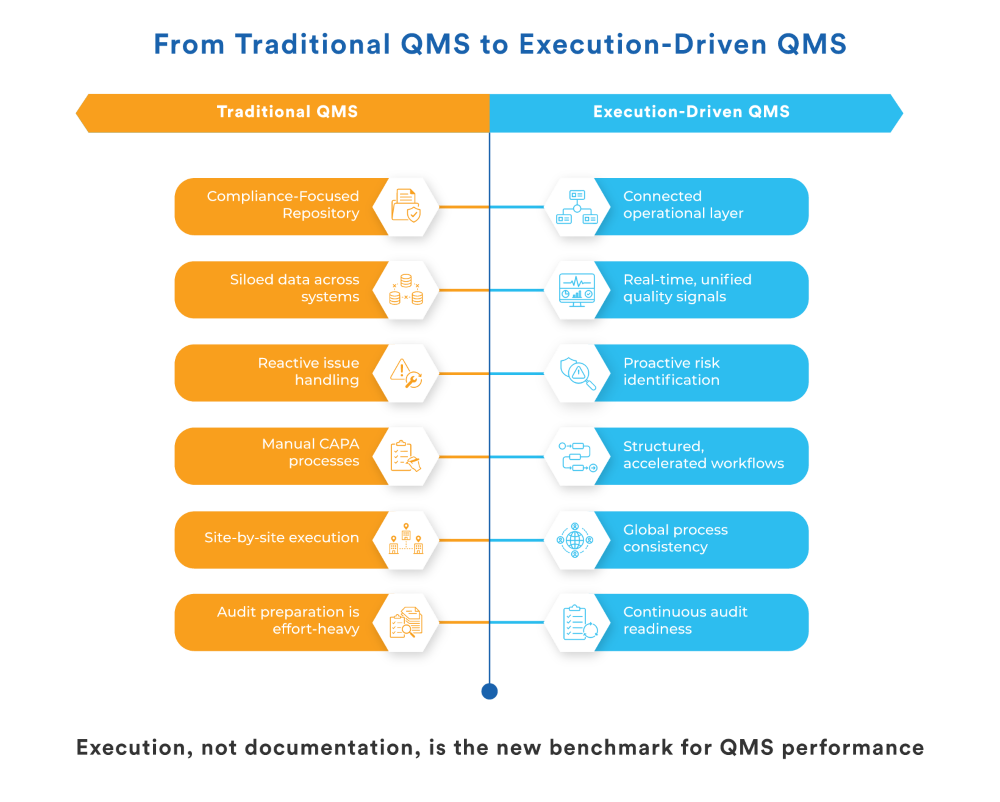
Why the QMS market is changing (and why Quality Leaders feel it first)
Gartner describes quality leaders facing challenges evaluating QMS software because of market saturation, industry-specific feature sets, and broad platforms that can overlook core quality needs.
At the same time, the market is accelerating. Gartner projects the global QMS software shortlist will surpass $10B in 2025, a 26% increase over 2024.
From what we see, it’s a signal that organizations are investing because quality failures are more expensive, more visible, and harder to contain in complex supply chains.
What “Ability to Execute” means for Quality Teams in 2026
Gartner evaluates vendors on Ability to Execute using criteria such as Product/Service, Sales Execution/Pricing, Marketing Execution, Customer Experience, and Operations.
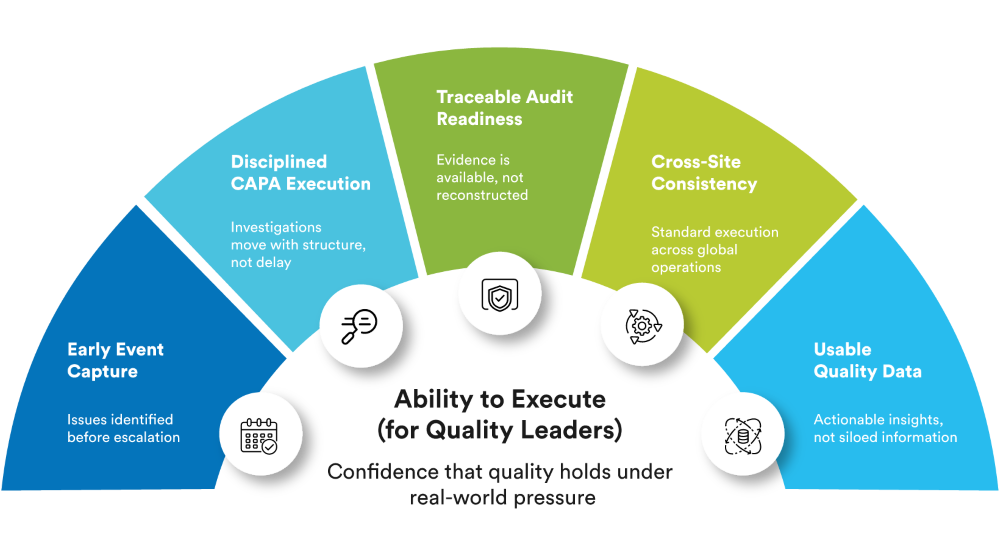
But from a Quality Leader perspective, the day-to-day meaning is sharper.
To us, the Ability to Execute is the confidence that:
- Quality events are captured early, not discovered late
- Investigations and CAPAs move with discipline, not drift
- Audit evidence is traceable, not reconstructed
- Global sites operate consistently, without constant policing
- Quality data is usable, not trapped in silos or spreadsheets
And that “confidence” has become a leadership requirement, not a quality-team aspiration.
Our perspective: Why we believe ComplianceQuest’s positioning reflects how execution is being redefined.
We are sharing what we believe matters most for execution today, based on how we’ve built and evolved ComplianceQuest.
1) Execution today is enterprise execution, not quality-team execution
In many organizations, quality is still treated as a departmental system. But quality outcomes are shaped upstream and downstream: engineering changes, supplier performance, manufacturing deviations, training completion, and complaint trends all interact.
Our belief: A modern QMS must operate as a connected operational layer, not a standalone compliance repository.
That’s why “execution” should be measured in how well quality workflows hold together across:
- Sites and regions
- Functions and handoffs
- Suppliers and partners
- Changing regulatory expectations
2) Cloud is no longer the differentiator, time-to-value and stability are
Gartner notes that SaaS deployments account for ~85% of implementations, while on-premises is ~7% (hosted ~4%, other ~5%). Cloud is the default expectation now.
Our belief: The differentiator is whether cloud delivery reduces friction in the places quality leaders feel it most:
- Standardizing global processes without excessive overhead
- Sustaining continuous improvement without disruptive upgrades
- Scaling without creating IT dependency bottlenecks
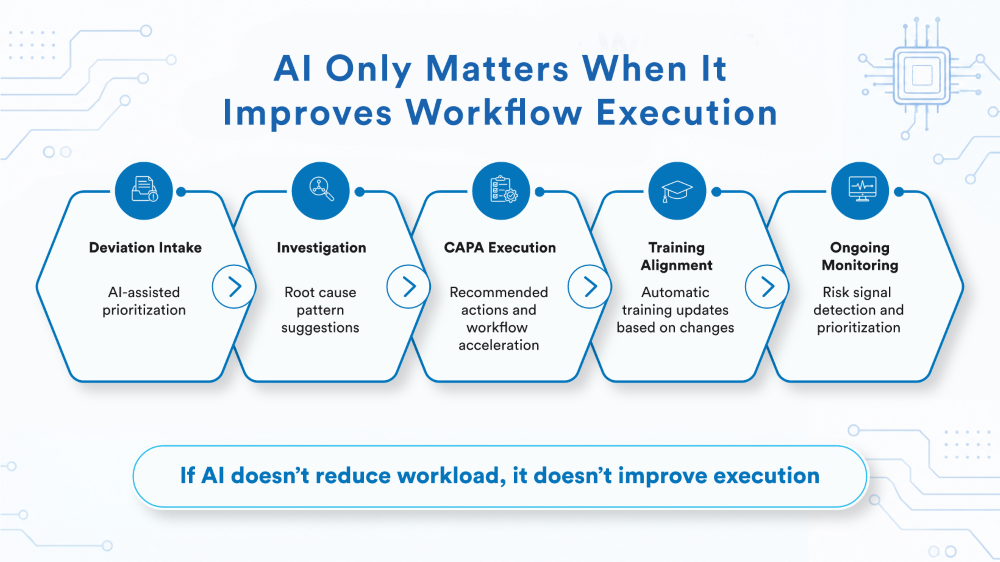
3) AI is only credible when it is measurable in quality workflows
Gartner advises buyers to scrutinize AI and automation claims, including asking for live demos, examples in use, and metrics that demonstrate value.
We agree with that stance.
Our belief: AI should be judged by whether it reduces cycle time and manual load in workflows like:
- Triage and investigation support
- Root-cause consistency
- Training readiness alignment after change
- Risk signal detection and prioritization
If AI does not change the daily workload for the teams doing the work, it is not “execution.” It is decoration.
4) Integration is a quality risk issue, not a technical checkbox
Gartner emphasizes verifying integration strength with enterprise systems such as ERP, MES, CRM, PLM to enable comprehensive data visibility and process alignment.
This is one of the most practical “execution” tests a Quality Leader can apply.
Our belief: Disconnected systems create blind spots, and blind spots show up as:
- Repeated deviations without systemic correction
- Late discovery of supplier-driven issues
- Audit evidence gaps that require manual reconstruction
- Reactive firefighting because signals arrive too late
A QMS should help quality leaders connect the signals, not chase them.
5) Usability is not a design preference, it’s a compliance outcome
Gartner highlights that intuitive user experience is a critical differentiator: Customers prioritize intuitive interfaces, mobile access, and robust self-service features.
Our belief: Adoption is one of the strongest predictors of audit readiness and data integrity.
If the system is hard to use, people will avoid it, delay entries, or invent workarounds. That creates downstream risk that quality leaders inherit.
How Quality Leaders should use the Magic Quadrant
We encourage quality leaders to use analyst frameworks as a starting point, not a finish line.
To us, the Gartner guidance to buyers is pragmatic:
- Scrutinize AI and automation claims with demos and proof points
- Verify integration strength with core enterprise systems
- Leverage customer references to validate real-world deployment outcomes
- Review roadmaps against short and long-term needs
If you’re leading a QMS evaluation in 2026, here is a VP‑level way to pressure-test vendors quickly:
The VP Quality “Execution Reality Check”
Ask each vendor to demonstrate live how their platform handles:
- A deviation that becomes a CAPA with cross-site impact
- A change that requires training updates and traceability
- A supplier issue that must be linked to incoming inspection + risk
- Audit evidence generation without manual compilation
The goal is not to admire features. It’s to see whether execution holds under complexity.
Where Quality Execution is Headed
We are proud that ComplianceQuest has been named a Leader in the 2026 Gartner Magic Quadrant for QMS software and positioned highest on the Ability to Execute axis.
We also believe the real value of that positioning is what it signals about where the market is going:
Toward QMS platforms that help quality leaders run execution with confidence: across sites, across systems, and across rising expectations.
Access the 2026 Gartner® Magic Quadrant™ for QMS Software
See how leading platforms are evaluated, and what to prioritize in your QMS strategy.
Gartner Objectivity Disclaimer
Gartner does not endorse any company, vendor, product, or service depicted in its publications, and does not advise technology users to select only those vendors with the highest ratings or other designation. Gartner publications consist of the opinions of Gartner’s business and technology insights organization and should not be construed as statements of fact. Gartner disclaims all warranties, expressed or implied, with respect to this publication, including any warranties of merchantability or fitness for a particular purpose.
Gartner, Magic Quadrant for Quality Management System Software, By Hope Warrilow, Kate Wagner, 20 January 2026
GARTNER is a trademark of Gartner, Inc. and/or its affiliates. Magic Quadrant is a registered trademark of Gartner, Inc. and/or its affiliates and is used herein with permission. All rights reserved.
Looking for a reprint of this article?
From high-res PDFs to custom plaques, order your copy today!


