Management
What ISO 9001:2015 Really Means to an Organization
ISO 9001:2015 is one of the most widely used quality management standards in the world, yet it is often misunderstood.
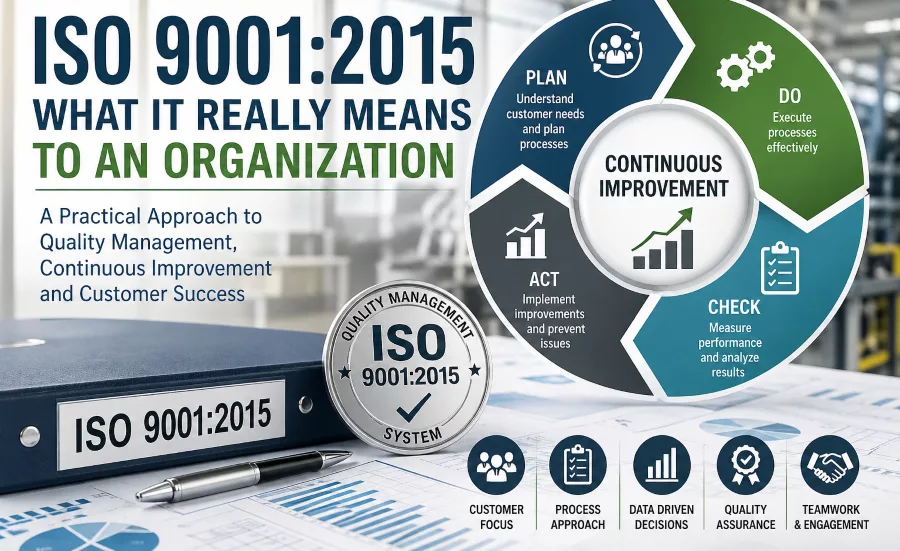
ISO 9001:2015 is often misunderstood. It is not a complicated system designed to slow an organization down, and it is certainly not something to fear. At its core, ISO 9001:2015 is simply a structured, common-sense approach to managing a business more effectively.
It is not a separate system layered on top of what you already do. Instead, it is a framework that standardizes and organizes the processes you already have in place. It ensures that everyone in the organization understands what is being done, how it is being done, and who is responsible for doing it.
ISO 9001:2015 Is a Management System
ISO 9001:2015 is a management system—no different in principle from the management systems organizations have always used. The difference is that ISO provides a consistent, internationally recognized format.
The purpose of this system is simple: to ensure that processes are defined, measurable, and capable of being analyzed. When a problem occurs, the organization must be able to examine the standard process and determine why it failed. Without a defined process, meaningful analysis is not possible.
ISO 9001:2015 provides the structure required to define processes, measure performance, analyze results, and take corrective and preventative action.
The Importance of Standardization and Data
A successful organization must rely on accurate, consistent information. Without standardized tools to collect and analyze data, decisions are often based on assumptions rather than facts.
ISO 9001:2015 ensures that performance data is collected consistently, reported clearly, and analyzed effectively. This allows management to react to customer needs quickly and prepare for future requirements. Organizations that operate without this structure often struggle with inefficiencies, poor communication, and inconsistent results.
The Cost of Quality vs. the Cost of Non-Quality
There is a common misconception that quality is expensive. In reality, the cost of non-quality is far greater.
Studies have shown that non-quality costs can represent up to 25% of sales, while quality-related costs may represent only 5% of sales. When processes are not controlled, errors, rework, customer complaints, and inefficiencies increase significantly. On the other hand, a well-managed quality system can improve profitability and even increase overall margins.
Quality is not expensive—the consequences of poor quality are.
ISO 9001:2015 Keeps the Organization “Ready”
To remain competitive, an organization must always be in a position to respond to customer needs. This means understanding performance on a day-to-day basis and being able to identify issues before they escalate.
ISO 9001:2015 provides the tools required to maintain this “ready” position. It ensures that performance is continuously monitored, problems are identified early, and corrective actions are implemented quickly.
Rather than reacting to issues after they occur, the organization becomes proactive.
Processes and Procedures: Not New, Just Defined
One of the biggest misconceptions about ISO 9001:2015 is that it introduces entirely new processes. In reality, most organizations are already performing the required activities.
The difference is that these processes are often not documented, not consistently followed, and not clearly understood by all employees.
ISO 9001:2015 organizes and documents what already exists. It creates a common understanding across the organization and ensures consistency in execution.
The real challenge is not creating new processes—it is aligning everyone’s perception of how those processes work and how they interrelate.
The Real Change: Attitude
The most significant change introduced by ISO 9001:2015 is not procedural—it is cultural.
It requires a shift in attitude from individual problem-solving to a team-based approach, from reactive thinking to proactive planning, from informal practices to standardized processes, and from short-term fixes to long-term improvement.
When everyone in the organization understands the objectives and works toward them together, the system becomes effective.
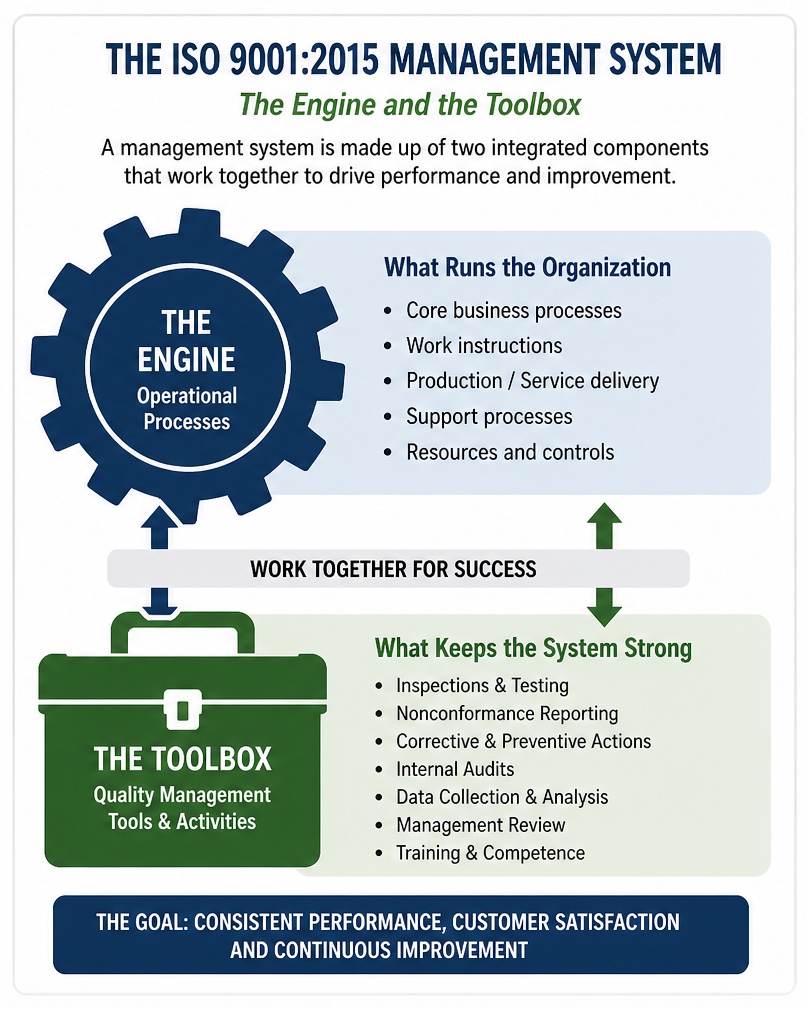
Source: TQMS, created with assistance from ChatGPT
Integration of the Management System
A management system is a collection of tools that work together to ensure the organization meets customer requirements, regulatory requirements, and safety and environmental standards.
ISO 9001:2015 can be viewed as two integrated components.
The “engine” represents the operational processes—the activities required to run the business, including work instructions, production processes, and service delivery.
The “toolbox” includes the quality-related tools used to maintain and improve the system, such as inspections, internal audits, nonconformance reporting, and corrective actions.
Without the toolbox, the engine will eventually fail. Both must work together for the system to succeed.
Defining Responsibilities and Objectives
A key part of ISO 9001:2015 is clearly defining responsibilities and measurable objectives.
Rather than focusing on tasks alone, roles should be defined based on outcomes. For example, instead of simply describing a warehouse role as operating equipment, the focus should be on accuracy, compliance, and communication.
When responsibilities are defined in terms of measurable performance, employees better understand their contribution to the organization’s success.
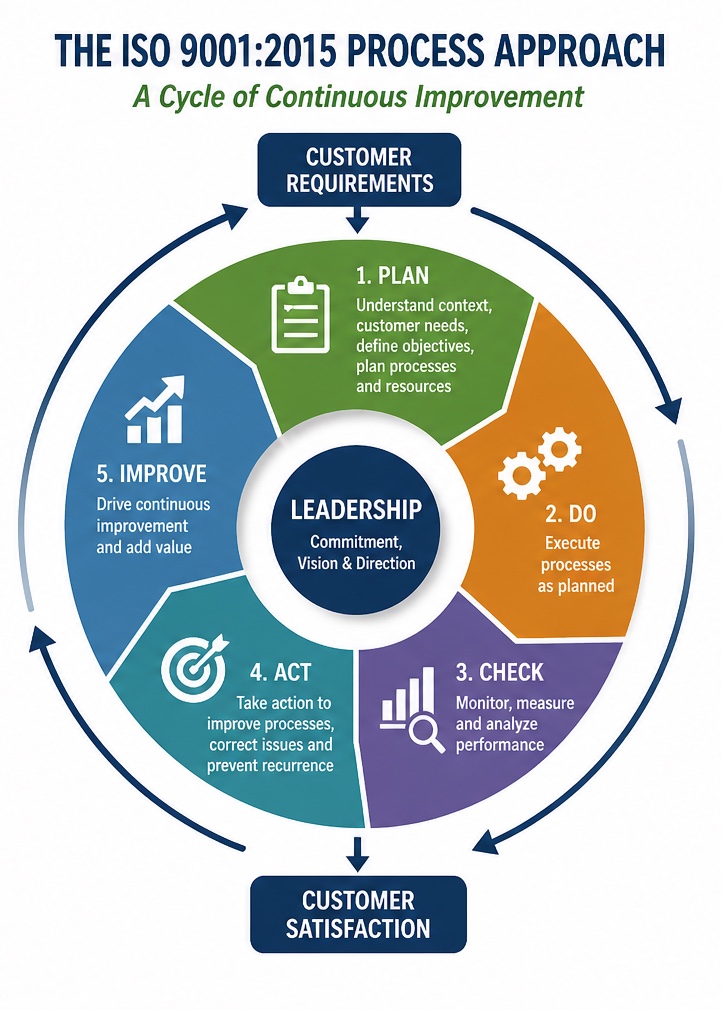
Source: TQMS, created with assistance from ChatGPT
The Process Approach
ISO 9001:2015 is built around a process approach that links all activities within the organization.
The cycle begins with understanding customer requirements, planning processes and resources, executing the work, measuring performance, analyzing results, and implementing improvements.
This cycle repeats continuously, driving ongoing improvement and ensuring consistent service delivery.
Measurement, Analysis, and Improvement
Measurement is at the heart of the management system. Organizations must collect data on inspections, process performance, customer feedback, internal audits, and operational metrics such as delivery and accuracy.
This data is then reported and analyzed to identify trends, issues, and opportunities for improvement.
Corrective action is a structured method used to identify root causes, implement solutions, and prevent recurrence. Over time, this leads to improved performance and reduced costs.
Training and Communication
A successful management system depends on trained and informed employees.
Organizations must identify required skills, provide appropriate training, evaluate training effectiveness, and maintain training records.
Equally important is communication. Management must ensure that objectives are clearly understood, expectations are communicated, and feedback flows throughout the organization.
Without proper training and communication, even the best-designed system will fail.
Leadership and Organizational Structure
Leadership plays a critical role in the success of ISO 9001:2015.
Without strong leadership, planning becomes ineffective, employees become reactive, and objectives are unclear.
Management must provide direction, establish objectives, and ensure that all employees are aligned.
At the same time, the organization must remain flexible. While roles and responsibilities should be clearly defined, employees must be prepared to respond to customer needs while still following standard processes.
Driving Consistency Across the Organization
An organization functions as a system of interconnected parts. If one area fails, the entire system is affected.
Success requires clear definition of all functions, consistent execution of processes, and participation from all employees and stakeholders.
When everyone understands their role and follows the same processes, the organization can achieve consistent, high-quality results.
Conclusion: Hitting the Target Every Time
ISO 9001:2015 provides a practical roadmap for managing an organization effectively. It is not about compliance for the sake of certification—it is about improving performance.
To succeed, an organization must implement a structured management system, train employees and management, establish measurable performance indicators, monitor and analyze processes, and focus on continual improvement.
When these elements are in place, the organization can consistently meet customer expectations, reduce costs, and improve overall performance.
The result is simple: do the job right the first time—and do it every time.
Looking for a reprint of this article?
From high-res PDFs to custom plaques, order your copy today!