Quality 101: XRF 101
Avoid costly process failures by utilizing XRF analysis
When processes fail unexpectedly, companies face irrecoverable loss of revenue and profit, not to mention the potential for irreparable damage to their brand. Failures are multivariate: they can be found in individual parts, entire machines, or within a process. Therefore, it can be difficult to determine the true cost of a failure because there are direct and indirect consequences related to each and every aspect of the failure. In addition to the immediate repair costs of the equipment there is lost production time, where products cannot be manufactured and revenue is lost. The company’s losses become compounded when considering that overheads are accruing while no revenue is being realized and at a time when emergency hires such as consultants or contractors may need to be brought in at elevated rates.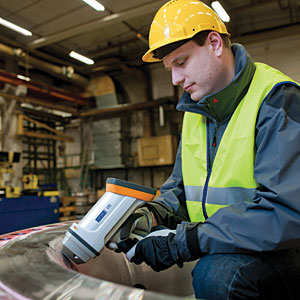
Profits can be quickly eroded and a great deal of time that would otherwise be value-added is spent minimizing losses, writing incident reports, and designing process changes to prevent future failures and potential risks. As the direct result of a failure, products may need to be scrapped or require rework, inventory may need to be replaced, spills will require clean-up, loss of containment may need to be investigated to determine any environmental impact, shut-down and start-up costs can be incurred, and there are those additional complications associated with not being able to fulfill contractual agreements with customers.
To mitigate against potential losses companies continuously test processes, equipment, essential components and incoming materials in order to predict failures or avoid them altogether. X-ray fluorescence (XRF) is a well-proven, simple-to-use technique which can easily and cost-effectively be incorporated as part of an overall quality assurance program to detect and correct potential problems before they become serious issues.
Use of XRF Analysis to Minimize Risks
The X-ray fluorescence technique is a trusted, nondestructive and widely used analytical technique that is often implemented by quality control departments to monitor the production of solids, liquids, powders and pellets. XRF is capable of analyzing a wide range of elements from high percentage concentration levels down to the parts per million level, and it requires little or no sample preparation. Whether it is an XRF instrument found in a laboratory or a portable device, there are numerous ways in which XRF can be used to reduce the risk of unexpected process failures.
Continuous Monitoring of Process Equipment with XRF Analysis
Mechanical failure of machinery is commonly the result of stress or fracture of moving parts. Process equipment such as engines, motors and gearboxes require lubricating oils with specific additives to reduce friction, remove heat and maintain the proper spacing between each moving part. As equipment starts to break down, small metal particulates break off of the components and are distributed throughout the oil. Benchtop XRF analysis of the used lubricating oils can easily be monitored as part of a quality assurance program to assist in determining when to schedule maintenance of machines and when it is simply time to replace the used oil. By analyzing the elements in the particulates found within the used oil and by measuring the ratio in which they are present, it is possible with XRF to identify the type of metal that is eroding, thereby indicating which component within the machinery is failing. Additionally, contamination by dirt, water and other fluids may alter the condition of the used oil. By monitoring key elements in the oil with XRF over time, a working history of the machinery can be generated to determine when the oil is no longer optimal and should be replaced.
Chemical Facility Inspections with XRF
In chemical or petroleum facilities inspections are performed to monitor the equipment that carries high temperature and pressure steam that is used to supply heat to process fluids and equipment including: pipes, heat exchangers, distillation columns and pressure vessels. This steam travels rapidly through piping which eventually causes breakdowns of the system’s mechanical parts. Plant engineers design the process to control the flow rate, endure the extreme conditions brought on by the steam and to ensure that there are no energy releases. In addition, part of their role requires that the equipment is not overdesigned to avoid elevated cost. However, since all equipment eventually fails as a result of corrosion, erosion, or mechanical and chemical interactions, a significant amount of maintenance and effort is spent monitoring and replacing parts of this equipment as they begin to break down. Some components such as carbon steel piping can be monitored with XRF to predict when they will fail as a result of accelerated corrosion. Steel piping that carries high temperature and pressure steam undergoes flow accelerated corrosion (FAC), where a metal oxide layer that forms a barrier along the pipe dissolves in the turbulent flow of steam. Portable XRF units can measure the amount of the key metals needed to form the protective barrier; when this amount falls below a certain level, there is a corresponding increase in corrosion rate. As part of a routine inspection program with XRF, the pipe is removed from service prior to reaching this level, thus reducing the risk of a catastrophic release.
Electronics Component Testing with XRF
Nondestructive testing using XRF can help electronics manufacturers who buy components like integrated circuits, capacitors, resistors and solder from hundreds or thousands of suppliers to produce and assemble quality products that contain thousands of individual parts. Every facility has trusted, and sometimes suppliers that are not-so-trusted, which presents a unique challenge—namely how do quality and supply chain managers ensure that suppliers are in fact supplying materials consistent with the ordered specifications? Many suppliers keep good manufacturing records and are diligent with their quality programs. Some suppliers don’t perform adequate quality control or due diligence, others deliberately ignore good practices and are deceptive or ship counterfeit parts that look correct to the naked eye but contain incorrect or mislabeled materials, or the correct materials but in the wrong amount. In any case, unknowingly assembling a finished good with improper components may lead to high failure rates. As a manufacturer it is your responsibility for the final product or assembly that you manufacture, and ensuring quality control should be your top priority.
By incorporating a microspot XRF instrument into your program to test incoming materials, you can screen for compliance to meet local, state, federal and international regulations and standards such as Restriction of Hazardous Substances (RoHS). XRF equipment can easily test the composition of solder bars or determine the plating thickness of terminations and leads or contacts prior to adding them into your process. In the end, the use of XRF ultimately saves significant time and money compared to solely relying on in-process testing or final outgoing quality control, where instead of scrapping or reworking batches of products, the raw materials are rejected before they enter into your production process.
With an ever-increasing expectation of an improved quality manufacturing environment, product sustainability, increased safety and profitable corporate growth, a critical and essential step is to reduce the risk of unexpected process failures and improve process efficiencies. Today’s most successful manufacturers look for a competitive advantage by analyzing and collecting data during production operations to help continuously improve product development and process performance. This can be achieved by incorporating XRF into your quality or maintenance program to monitor process equipment, essential components and incoming materials. Implementing a robust control strategy as part of preventive maintenance program with XRF analyzers is both a cost-effective and highly efficient way to avoid interruptions to production and protect against unnecessary revenue loss.
Matt Kreiner is the business development manager of Oxford Instruments. For more information, call (978) 369-9933, email [email protected] or visit www.oxford-instruments.com/xrf
Looking for a reprint of this article?
From high-res PDFs to custom plaques, order your copy today!


.webp?height=200&t=1621530074&width=200 "Handheld XRF analyzer")