Improving Automation
We've come a long way, but we still have a long way to go.
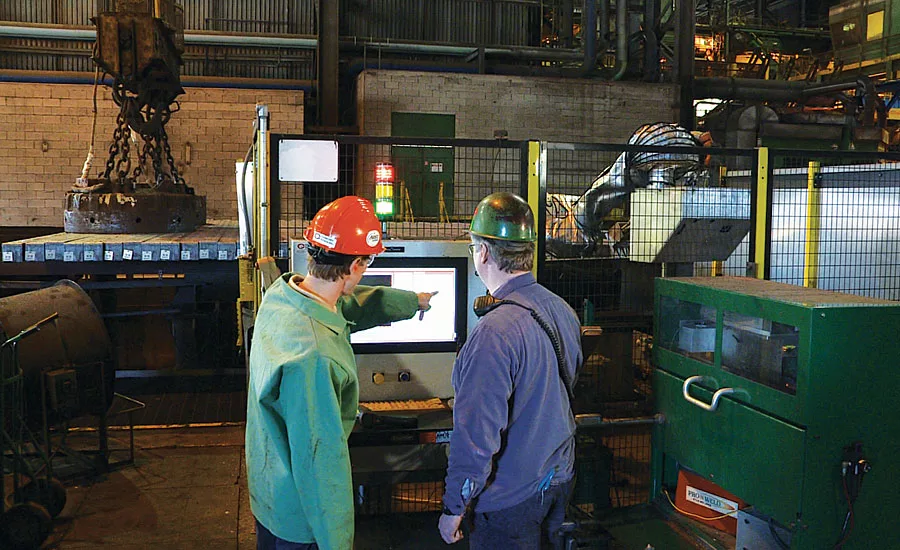
Automation engineers at work. Source: Concept Systems Inc.
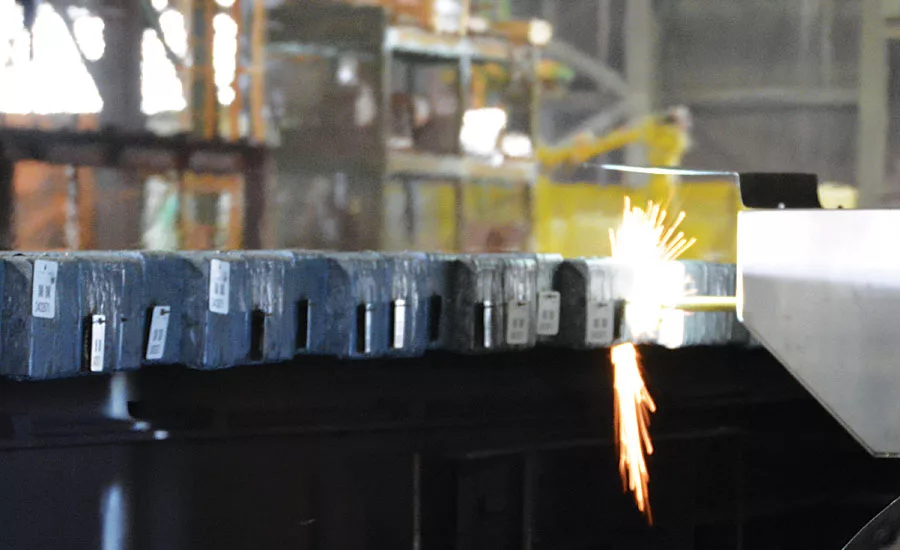
BilletID, a robotic tagging system that eliminates the risk of losing track of billets in the manufacturing process, is automated into action. Source: Concept Systems Inc.
Automation may seem like a relatively modern concept, with its buzzworthy contribution to the Industrial Internet of Things (IIoT) and already monumental importance to the future of global enterprise. However, the technological birth of automation as we know it today dates
back centuries.
The first recorded use of automation control was a feedback control mechanism used to tent the sails of windmills, patented by English inventor Edmund Lee in 1775. Automation came to America in the late 18th century with the centrifugal governor, invented by Scottish mechanical engineer James Watt in 1788 to help regulate the admission of steam into the cylinders of his steam engine. American inventor and engineer Oliver Evans later used the centrifugal governor to adjust the gaps between millstones in his automatic flour mill, making this the first completely automated industrial process in history.
The innovations snowballed from there, culminating in a present-day automation boom. In 2016, automated mining, retail, security systems, highway systems, waste management systems, homes, offices, and industrial plants are no longer pipe dreams, but exciting realities with lush opportunities for growth.
For a more detailed assessment of automation’s leaps and bounds over the past few years, Qualityasked two automation insiders for their takes: John Neeley, product manager of mobility solutions at Fluke Corp.; and Michael Lindley, vice president of business development and marketing at Concept Systems Inc.
What recent strides has your company made toward improving automation, and how do these strides fit into the broader automation landscape?
John Neeley: With respect to Fluke, we are a manufacturer of safe, rugged, and easy-to-use tools; so, measurement tools that maintenance technicians use to maintain a facility or a factory. How we fit into recent strides in automation, or the broader automation landscape, is that we are automating the knowledge management system around those tools.
You have to measure things in order to make automated decisions, to make them reliable, and to run a maintenance program. You have to measure the equipment. There hadn’t previously been a knowledge management system that automatically takes the measurements from the field and organizes it all by asset and equipment, until now. Fluke Connect is that. It automatically takes the measurements from the field and transmits them wirelessly to the Cloud so that the system of software and wireless tools enables the team to build and sustain maintenance programs. It automates their knowledge management.
It used to be that people would have to take a measurement, write it down in a notebook, and relay it verbally to somebody else. Fluke Connect changes that by automatically recording data from tools and putting that data into the Cloud.
Michael Lindley: Over the last three years, we have seen a sharp uptick in the number of companies investing in industrial robots. To support this growing demand, Concept Systems made a number of key investments in 2015 to meet the needs of our customers. First, we expanded our internal robotic training program to ensure that our engineers are all well-versed in specifying the robot, work cell simulation software, programming, and integration. Second, in 2015 Concept Systems started a mechanical division to support the expansion of our robotic offerings. Often we find the robot is a small portion of the overall work cell, and the mechanical design and components represent the most complex aspects. By managing the mechanical aspects internally, we are able to provide full turnkey systems to our clients.
Last, as with all manufacturing, safety is a key concern. More companies companies are making proactive investments to keep their employees and equipment safe. Concept Systems has always taken safety seriously; and to meet the expanding needs of our clients and leverage new technologies, in 2015 we obtained the Rockwell Automation Safety Certification and added TUV certified engineers on staff.
What changes are happening in the automation space right now that you find particularly exciting and groundbreaking?
Lindley:
Proliferation of robotics.The plant floor of tomorrow will look nothing like it does now. Robots continue to come down in price, while the cost of labor continues to increase. Robotic technology allows for more flexible work cells that can interact with people in ways not possible just a few years ago. Sensing technologies, integrated with robots and other processes, allow for more intelligent, flexible manufacturing. Many more customers, especially mid-market manufacturers, will use robotics and automation to stay competitive.
Manufacturing on demand.We will continue to see more customized, personalized manufacturing, with short turn-around times and small batches. This type of manufacturing demands intelligent and highly flexible work centers that can produce a variety of parts quickly and cost-effectively, with little setup time. Customers will require automation to do this effectively.
Everything is networked.Big Data, the Internet of Things, whatever you want to call it: everything on the plant floor, from the photocell to the ERP system, will be networked and share information. The goal is to make better, faster, and smarter business decisions and optimize manufacturing resources. Customers will be demanding manufacturing intelligence solutions to give them more relevant data faster.
What are the biggest obstacles to progressing automation?
Lindley: The average age of industrial equipment in the U.S. has risen in the last 10 years to the oldest point since 1938. In the future, companies will invest heavily in new automation solutions that leverage the latest in control, vision, and robotic technology. Companies that have not yet automated their production environments and those with outdated automation technologies will take advantage of advances in robots and vision to drive down production costs and increase profits. Automated robotic painting made smart with 3-D vision technology is a good example of how a manual process can be eliminated, leading to an increase in production volume.
There’s a growing skills gap. On the plant floor, senior people with extensive process knowledge are retiring. The people taking their places do not have the same set of skills and experience. And, as the pace of technology accelerates, manufacturers will find it increasingly difficult to identify, hire, and retain talent. Customers will require automation suppliers to provide full solutions and also provide ongoing service and support for those solutions.
We need more training programs for students. In Oregon, the Multiple-Engineering Cooperative offers university students real-life experiences in an engineering environment before graduation. It’s a powerful business/education partnership that provides internships for students, as well as recommendations for curriculum enhancements that create continual improvement. Over the past year, more than 600 engineers were placed with Oregon businesses.
How are automation updates satisfying an aging workforce while also enabling younger people to integrate successfully into the workplace?
Neeley: At first we thought it might have something to do with age as well…but really, it’s much more about attitudes toward technology. Because of the changes in communication technology, most notably the ubiquitous adoption of smartphones, people have become used to exchanging data that just wasn’t possible 10 years ago. People are used to seeing pictures and rich media like video. What we’re finding is teams that are progressive in their adoption of technologies or better practices, whatever their initiative, like [the changes].
For Fluke’s knowledge management system, we started off by setting the bar with consumer applications. It has to be incredibly intuitive. With respect to a knowledge management system of measurements and work orders, we’ve taken our cue from consumer apps, such as newsfeeds that you see on social networks, so that people can comment on measurements and the assets they maintain, or comment in a newsfeed on work orders. So we’re finding that adoption and understanding is pretty quick, as it is a natural extension of a tool that people already use. Naturally as we get into more complicated systems, or rather more functional systems like automated alarming, we do include our own material so that managers or more sophisticated reliability engineers can set up what they want.
Which automation applications do you think we will come to rely upon most in the future and why?
Lindley: The lowest lying fruit, offering the largest gains, is real-time data analytics. With automated systems, all the data is sitting there on the plant floor. With network capabilities, processing speeds, and open-architecture software, customers can capture that data and present it in a meaningful way, so operational personnel can use it to make decisions. The sky really is the limit on what’s possible with real-time data analytics. The key is defining what is needed and zeroing in on what I call a minimal viable product. What key piece of information do you need, on a real-time basis, to improve your operational decisions?
The power of analytics will be used to drive manufacturing improvement. By automatically collecting, aggregating, analyzing, and presenting actionable information, manufacturing teams will have data to use to build smarter manufacturing into their processes. They won’t have to take time to crunch the data.
Another technology that offers tremendous value is robotics. Not robotics in the traditional pick-and-place sense, but rather robotics with added senses: vision-guided robots, forced-controlled robots, or high-precision robots. The applications for robots with added senses have a wide range: flexible infeed systems, machine tending, painting, and material removal, to name a few. Adding senses to robots gives them the ability to adapt to their environment.
Safety is truly one of the hidden gems of the technology boom, as it provides greater reliability and increased productivity. Historically, the most common way to safeguard workers in and around equipment was to provide physical barriers, which must be removed to access the equipment. Precious manufacturing time is lost while workers remove and replace guarding and ensure the proper interlocks are in place. Many interlock systems also require significant maintenance.
Today, technologies exist that do not require physical barriers, yet provide the same, if not a better, level of safety. Many modernized devices are now equipped with integrated, sophisticated safety systems, like light curtains, laser scanners, area (3-D) scanners, collaborative robots, and more. Modern safety technology presents the opportunity for significant productivity gains without sacrificing reliability. It is a matter of opening up the processing line and providing better access and equipment visibility. V&S
Leah Pickett is an associate editor at Quality. She can be reached at [email protected].
Looking for a reprint of this article?
From high-res PDFs to custom plaques, order your copy today!