The Rise of Total Product Life Cycle
And the need for product lifecycle management (PLM) automation.
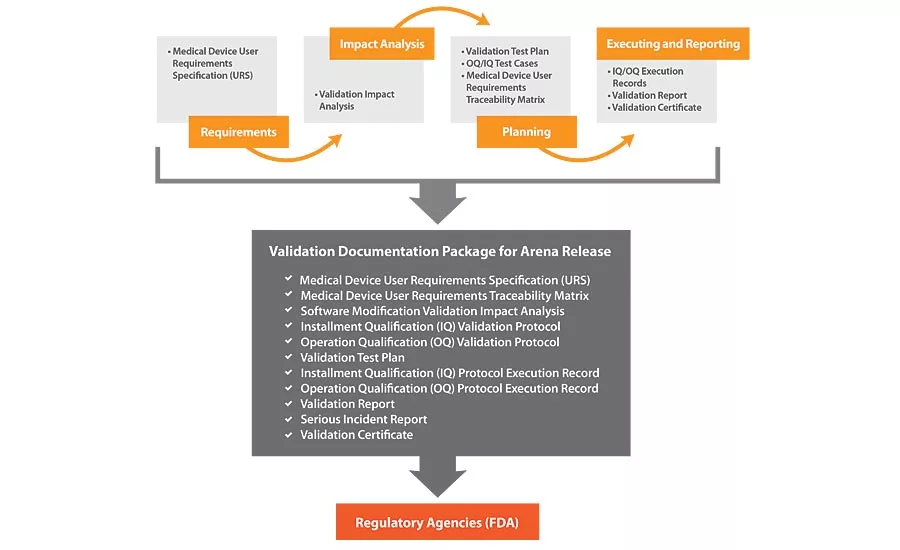
Product lifecycle management (PLM) formalizes all the processes required by FDA including design control, document control and change control processes. Source: Arena Solutions
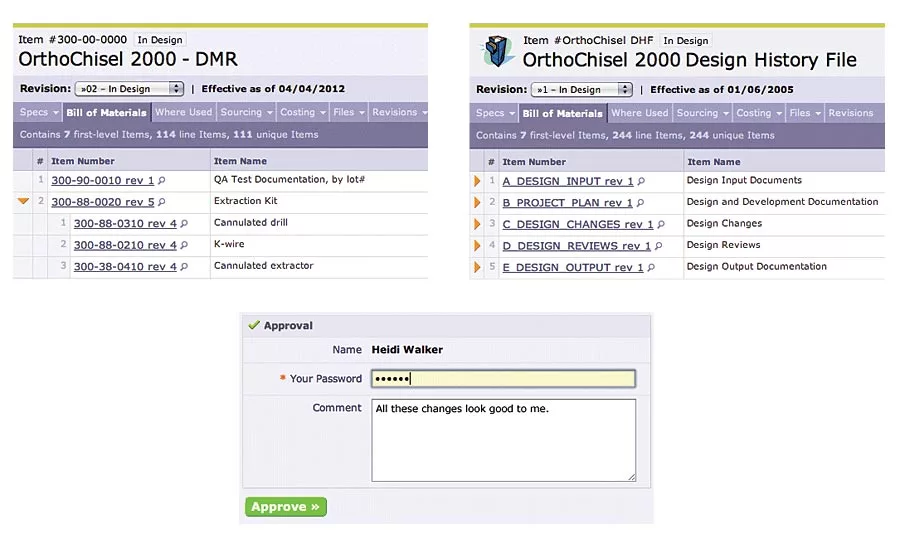
Most medical device companies have a complex approval matrix defining who must sign documents. Source: Arena Solutions
In the medical device industry, success requires bringing innovative products to market faster than the competition. But to accomplish this feat, medical device companies must put in place proactive strategies to ensure timely compliance with the regulatory requirements in global markets. Since the Food and Drug Administration (FDA) and other regulatory bodies have embraced the concept of total product life cycle (TPLC) management, medical device companies would be well served to follow it to shepherd a product from concept to completion.
TPLC enables device companies to manage the process from the concept and design of a product’s lifecycle through commercialization and ongoing safety monitoring, as it encourages collaboration and facilitates cooperation. But achieving both a successful design and regulatory compliance with TPLC is virtually impossible using traditional manual processes—such as spreadsheets—because static, manual processes do not provide an environment that enables the timely interaction essential to TPLC.
Manual processes inhibit good product design and quality because they lack integration. Moreover, each department within a medical device company often has its own distinct system, and even worse, they often work in functional silos. A TPLC approach focuses on sharing information throughout the entire lifecycle of the product. In TPLC, product development follows a logical progression and incorporates the required interactions between all stakeholders. A successfully implemented program not only leads to the development of a high-quality medical device, it fosters a culture of innovation and ensures the device will be effective and designed with the patient in mind.
Moreover, the electronic tracking of product development required by TPLC is not easily accomplished with paper-based waterfall or stage-gate systems. As such, the FDA has encouraged device manufacturers to move away from the traditional waterfall model to TPLC, primarily because the FDA insists that the stages of product development must not just overlap, but must also be connected.
PLM as a TPLC Tool
Medical device companies face many challenges in product development: Not only must all processes be documented, but these processes must be followed and all outputs must be documented per the design control processes (e.g., DHF, DMR, etc.). Product lifecycle management (PLM) formalizes all the processes required by FDA including design control, document control and change control processes.
Collaboration is the backbone of PLM. With PLM, and especially with a cloud-based system, which can be accessed from anywhere at any time—collaboration is seamless. And if that product-centric PLM backbone is part of a single solution that includes ALM and QMS to keep all cross-functional stakeholders informed both upstream and downstream, all the better. Cloud PLM provides a centralized system of electronic records so that everyone has access to the same version of any document and everyone sees the latest revisions. It enables device companies to move through product lifecycle phases faster than with traditional processes as it reduces the chance for mistakes that result from human error during manual data entry. Additionally, it prevents version control issues, which can be made even worse if all layers of the global supply chain are not kept up-to-date with the latest engineering change order.
Additionally, PLM streamlines audits and compliance. With it, design history file documents provide a centralized repository of electronic records so that all parties are working from the latest version. Records that are searchable, traceable and linked make it easy to locate and present files to the FDA and other regulatory bodies as soon as they are requested.
PLM makes it easy to demonstrate that standard operating procedures are being followed because it specifies the steps and procedures that make up each design phase as it enables seamless access to a centralized system. All stakeholders view and update the same documents, such that approval can be accomplished in a timely manner.
Another benefit to PLM is the ability to integrate supplier information in such a way that they too, are part of the process. For example, medical device companies are able to rank suppliers based on cost, product availability and other factors. With such information in the system, device companies can determine how fast a supplier can provide a prototype, and this provides for control over vendor costs and production times.
Cloud-Specific Benefits
Older methods of PLM enable companies to move their paper-based systems to on-premise solutions with an installed client configuration. Even if it is not in the cloud, the solution can provide benefits; however, cloud-based systems provide yet another level of accessibility, affordability and ease of use. If a company is operating in the cloud, users need only a Web browser to conduct business, thereby removing global barriers to collaborate.
The ease of cloud PLM is that organizations don’t have to install, configure or maintain anything on in-house servers. Nor do they need a department of IT technologists to maintain and operate it ad infinitum. The cloud enables users to simply go to a specific URL, enter a username and password and access the centralized system of electronic records for the company. There are also cost-effective benefits with cloud PLM: a medical device OEM does not have to allow for IT support or invest in extensive infrastructure. Essentially, it is the classic lease vs. buy scenario. And if it’s a multi-tenant SaaS solution where a single instance of software is employed, this then affords the user maximum scalability. With this approach, new users can easily be added (or subtracted) by simply assigning the new user a username and password. This modality also applies to the addition of new modules, any security patches, upgrade or bug-fixes. The cloud-based PLM supplier simply pushes these to the purchaser with no interaction required on the user’s part.
Because the system is in the cloud, medical device companies can implement it quickly and are assured of having the most up-to-date version of the software. As the PLM software is updated with new features, it becomes available to the entire customer base instantly, meaning all the users are working with the latest version. To ease the validation burden on device manufacturers and help them ensure compliance with applicable regulations such as 21 CFR Part 11, or 21 CFR Part 820, some PLM providers include maintenance services in which each release is first validated in-house, against a well-defined set of intended uses, for each release. Customers are then provided with documentation to confirm that updates to the software have, in fact, been validated. It takes the lion’s share of software compliance work off the customer’s shoulders, so it can focus on what it does best: creating products.
Getting sign-offs from all required parties on an engineering change order is a difficult process when conducted manually, and even worse when suppliers’ suppliers are either not informed, or left out of the loop altogether. The cloud simplifies matters. In the cloud, 10 cross-functional stakeholders who need to sign off on a change can be at 10 different locations worldwide, yet the ECO process is seamless. Cloud PLM provides automatic notification to those who can approve the change via electronic signature. Getting physical signatures—even if all signers work in the same building—can be a time-consuming task. Most medical device companies have a complex approval matrix defining who must sign documents, a process that takes a great deal of time to complete with paper-based systems. PLM reduces the chance of human error.
Getting an innovative, cost-effective product to market quickly requires collaborative interaction of all key stakeholders throughout the product design cycle. Being first to market can be the difference between being a market leader or simply an also-ran. As TPLC takes hold, medical device companies must embrace these new PLM platforms to compete. It reduces costs associated with late-stage redesign, it reduces regulatory delays associated with inefficient document control and it improves communication among team members. The FDA already expects this higher level of product development, and soon may demand it.
Looking for a reprint of this article?
From high-res PDFs to custom plaques, order your copy today!