Quality Magazine logo
search
cart
facebook twitter linkedin youtube
  • Sign In
  • Create Account
  • Sign Out
  • My Account
Quality Magazine logo
  • NEWS
  • PRODUCTS
    • FEATURED PRODUCTS
    • SUBMIT YOUR PRODUCT
  • CHANNELS
    • AUTOMATION
    • MANAGEMENT
    • MEASUREMENT
    • NDT
    • QUALITY 101
    • SOFTWARE
    • TEST & INSPECTION
    • VISION & SENSORS
  • MARKETS
    • AEROSPACE
    • AUTOMOTIVE
    • ENERGY
    • GREEN MANUFACTURING
    • MEDICAL
  • MEDIA
    • A WORD ON QUALITY PUZZLE
    • EBOOKS
    • PODCASTS
    • VIDEOS
    • WEBINARS
  • EVENTS
    • EVENT CALENDAR
    • IMTS
  • DIRECTORIES
    • BUYERS GUIDE >
      • Supplier Insights
    • NDT SOURCEBOOK
    • VISION & SENSORS
    • TAKE A TOUR
  • INFOCENTERS
    • Digital Quality Management Systems
    • NEXT GENERATION SPC & QUALITY ANALYTICS
  • AWARDS
    • ROOKIE OF THE YEAR
    • PLANT OF THE YEAR
    • PROFESSIONAL OF THE YEAR
  • MORE
    • Expert Columns
    • NEWSLETTERS
    • QUALITY STORE
    • INDUSTRY LINKS
    • SPONSOR INSIGHTS
  • EMAG
    • eMAGAZINE
    • ARCHIVES
    • CONTACT
    • ADVERTISE
  • SIGN UP!
Test & Inspection

Thread Basics: Go / No-Go Acceptance

It can be beneficial for manufacturing companies to offer thread specific training to both machinists and quality personnel.
By Philip Gronback
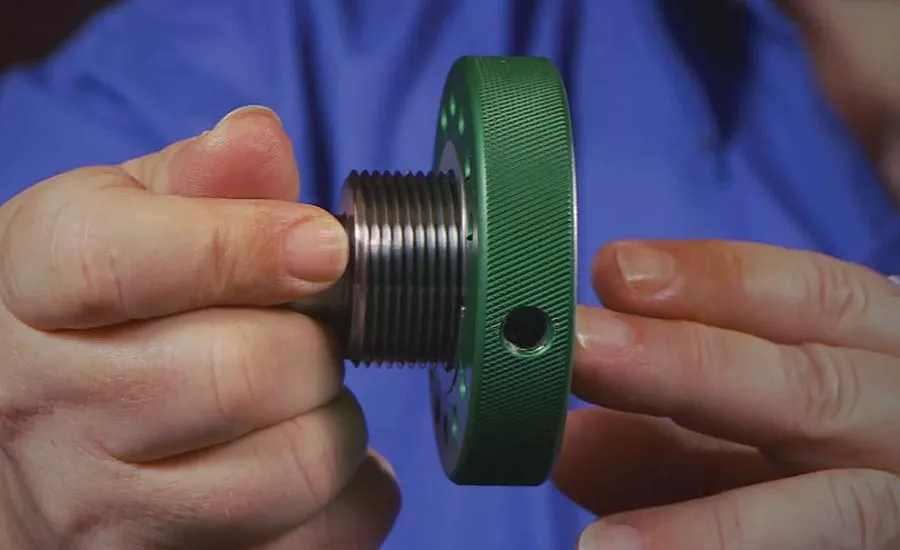
Thread ring and plug engagement.
January 1, 2018

The basic concept of a thread plug is to provide a quick inspection for machinists and quality inspectors to verify that the threads are within the accepted tolerance so that it interacts with the mating part correctly. This verification would be performed by threading the Go thread gage to the full depth of the feature without restriction, followed by the non-acceptance of the No-Go plug gage.

What may be a surprise to many is that there are cases when a threaded hole accepts the No-Go thread gage but not the Go gage. To fully understand how this is possible you must understand the difference between a Go and No-Go thread gage and how each of them interacts with the threaded feature.

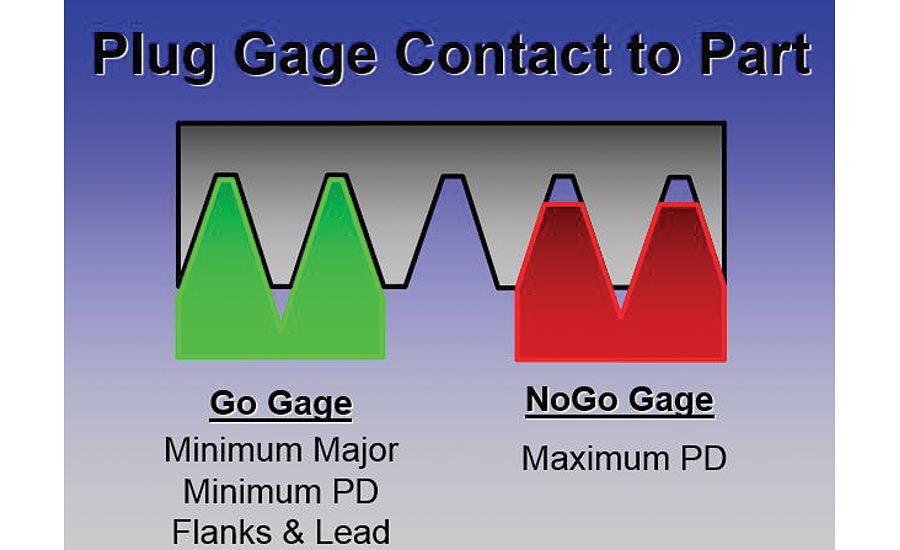
Let’s start with the Go member of any thread gage. This side of the plug gage is tasked with measuring the minimum major diameter, the minimum pitch diameter and the flanks and leads of the thread form. Like the No-Go side, the Go never checks the minor diameter of the thread feature. This check is performed by another means such as a pin gage or dial bore gage. 

The No-Go side of the thread gage performs a check on only the pitch diameter, verifying that it does not exceed the maximum condition. In this case the major diameter is not being checked. For this reason, if measured, the user will find that the OD of a No-Go thread gage is smaller than the OD of a Go thread gage. The reason behind this is because the No-Go plug is not tasked with checking the deepest points of the thread. This is verified by the Go gage only.

If the hole accepts the No-Go gage but not the Go gage, this is generally because the tips of the cutting tool have been worn or chipped causing the depth to be too shallow. In this case, the machinist will usually assume the thread feature needs to be opened more and make an adjustment to cut the thread larger. However, if the tip of the thread cutting tool has worn, compensating the cutter will lead to overcutting the thread pitch diameter. And since the No-Go thread gage only verifies the thread pitch diameter, it is possible to have a condition where the part accepts the No-Go but not the Go.
thread basics

For this reason, it is very important to check the hole with the No-Go gage and the Go gage every time an adjustment is made to cutter compensation. It should never be assumed that compensation be continually made until the Go thread gage is accepted, as this side of the gage is checking more features of the thread than the No-Go thread gage.
thread basics

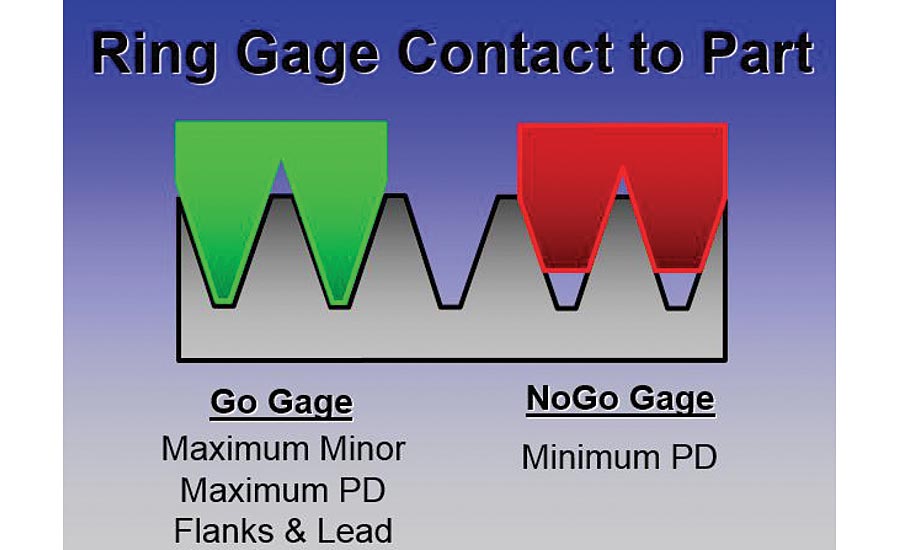
With the same principles as thread plugs, thread ring gages also work in the same fashion. The only difference here is that a Go thread ring is measuring the maximum minor diameter instead of the minimum major diameter. The major diameter is not measured with either the Go or No-Go ring. That is measured with a separate gage such as an OD micrometer. Like the No-Go thread plug, the No-Go thread ring is only verifying that the pitch diameter is within allowable limits. 

Again, the scenario of the part accepting the No-Go but not the Go gage is also possible with thread ring gages just as in the case of the thread plugs. 

It is important to mention that thread gage fits are called out in two ways. For the Go side the fit is defined as “free and easy.” Although this can be interpreted differently depending on the user, the rule of thumb is that the gage should go in or over without obstruction. In the case of a thread ring this means that the gage should spin on without force. If your gage takes a measure of force to check the feature, this will cause the gage to wear out prematurely. 

In the case of the No-Go thread gage, the most common misconception is that it should not enter or travel over the thread feature at all. In other words, it should “Not Go” at all. This is one of the largest areas of debate between machinists and quality inspectors.

According to the national thread standards, the no go can be allowed up to but not exceeding three full threads for standard gages or two full threads for metric thread gages prior to feeling a definite drag. In theory, you could travel the length of the thread with a metric No-Go thread gage providing you feel a drag after the second full turn. 

There are exceptions to the rules for No-Go thread gages such as part materials. If the part being manufactured is of ductile material, or softer than the gage being used, there may not be any allowance for the gage to engage at all. This is also the case with short thread spans. If your thread length is only three or four threads long, you would not want to use the two turns or three turn allowance. 

In the end, the thread standards allow the user to have a certain number of turns as a maximum condition for No-Go gage unless the product dictates you should reduce that because of the thread length or material.

Due to the nature of threads and the amount of geometry involved in creating them correctly, it can be beneficial to manufacturing companies to offer thread specific training to both machinists and quality personnel. 

All your employees having the same understanding of what makes a proper thread can save your company the headaches and costs associated with bad parts.

KEYWORDS: gages thread inspection

Share This Story

Looking for a reprint of this article?
From high-res PDFs to custom plaques, order your copy today!

Philip Gronback is the national sales and marketing director at Glastonbury Southern Gage. For more information, call (860) 537-7340 x 103, email [email protected] or visit www.gsgage.com.

Recommended Content

JOIN TODAY
to unlock your recommendations.

Already have an account? Sign In

  • 2024 Quality Rookie of the Year Justin Wise 1440x750px banner with "Quality Rookie of the Year" logo inset

    Meet the 2024 Quality Rookie of the Year: Justin Wise

    Justin Wise is an exceptional individual who has been...
    Aerospace
    By: Michelle Bangert
  • Man with umbrella and coat stands outside while it rains at night looking at a building.

    Nondestructive Testing: Is there an ethics problem?

    I was a whistleblower who exposed fraudulent activities...
    NDT
    By: Dale Norwood
  • Unraveling Deflategate: Football stadium with closeup of football on field

    Unraveling the Tom Brady Deflategate

    The Deflategate scandal erupted following the 2014 AFC...
    Measurement
    By: Greg Cenker and Henry Zumbrun
Manage My Account
  • eMagazine Subscriptions
  • Newsletters
  • Online Registration
  • Subscription Customer Service
  • Manage My Preferences

More Videos

Sponsored Content

Sponsored Content is a special paid section where industry companies provide high quality, objective, non-commercial content around topics of interest to the Quality audience. All Sponsored Content is supplied by the advertising company and any opinions expressed in this article are those of the author and not necessarily reflect the views of Quality or its parent company, BNP Media. Interested in participating in our Sponsored Content section? Contact your local rep!

close
  • Key Takeaways for Quality Leaders
    Sponsored byComplianceQuest

    Key Takeaways for Quality Leaders from the 2026 Gartner Magic Quadrant™ for QMS

  • This image shows a person seated next to a Bobcat T66 compact track loader.
    Sponsored byPolyWorks by InnovMetric

    Supercharging Digital Gauging at Bobcat North America

  • Dorsey Calibration Lab photo by Tom LaBarbera Picture this Studios
    Sponsored byDorsey Metrology International

    Ensuring Product Quality in a Competitive Manufacturing Landscape

Popular Stories

iStock-1352825159-jpg.jpg

U.S. Should Substantially Boost Support for Manufacturing USA Program, Issue National Industrial Manufacturing Strategy, Says New Report

a factory floor during what appears to be a training session or a daily briefing

The Root Cause of Defects We Rarely Name or Address

Dorsey Calibration Lab photo by Tom LaBarbera Picture this Studios

Ensuring Product Quality in a Competitive Manufacturing Landscape

2026 Quality Professional of the Year!

Events

June 22, 2026

Automate 2026

Automate is North America's largest robotics and automation event — and the best place to take your ideas from insight to impact.
 
Our show floor features the world’s leading automation solutions, from AI and robotics to motion control, vision systems, and more. Plus, our educational conference is second to none, led by the brightest minds in automation today.
 
Ready to transform the way you work? Take the next step at Automate.
July 14, 2026

Quality Leaders Forum: Better Communication, Better Quality Data

The Quality Leaders Forum is a quarterly, editor-moderated fireside chat series hosted by Quality Magazine, featuring candid conversations with senior manufacturing and operations executives shaping enterprise-level quality.

View All Submit An Event

Products

Lean Manufacturing and Service Fundamentals, Applications, and Case Studies

Lean Manufacturing and Service Fundamentals, Applications, and Case Studies

See More Products
Rookie of the Year Custom Content

Related Articles

  • DEPT101_FT

    The Infamous No-Go Gage

    See More
  • Manufacturing Excellence: Acceptance or Excellence

    See More
  • Other Dimensions: Thread Gages or Thread Comparators?

    See More

Related Products

See More Products
  • H1470.jpg

    The Certified Quality Improvement Associate Handbook, Third Edition

See More Products

Related Directories

  • VISION fOr VISION

    VISION fOr VISION specializes in the development of software for machine vision applications. We implement standard and custom vision algorithms, tune them for best performance, adapt them to your platforms, and assemble complete solutions that suit your needs.
×

Stay in the know with Quality’s comprehensive coverage of
the manufacturing and metrology industries.

Newsletters | Website | eMagazine

JOIN TODAY!
  • RESOURCES
    • Advertise
    • Contact Us
    • Directories
    • Manufacturing Division
    • Store
    • Want More
  • SIGN UP TODAY
    • Create Account
    • eMagazine
    • Newsletters
    • Customer Service
    • Manage Preferences
  • SERVICES
    • Marketing Services
    • Market Research
    • Reprints
    • List Rental
    • Survey/Respondent Access
  • STAY CONNECTED
    • LinkedIn
    • Facebook
    • YouTube
    • X (Twitter)
  • PRIVACY
    • PRIVACY POLICY
    • TERMS & CONDITIONS
    • DO NOT SELL MY PERSONAL INFORMATION
    • PRIVACY REQUEST
    • ACCESSIBILITY

Copyright ©2026. All Rights Reserved BNP Media, Inc. and BNP Media II, LLC.

Design, CMS, Hosting & Web Development :: ePublishing