Test & Inspection
A Guide to Mechanical Testing of Paper and Plastic Packaging Materials
A simple tensile test can be used as a quality control measure to ensure the materials meet internal criteria, or for comparison purposes.

In the year since the COVID-19 pandemic began upending our lives, one change among many was the huge uptick in the global consumption of paper and plastic products. Ecommerce saw rapid expansion in 2020 as restaurants shifted to a takeout model and consumers opted to shop online from the safety of their homes instead of visiting a crowded store. For those who did venture out, many stores rolled back the use of reusable bags to avoid cross-contamination. The result of these trends is an increased demand for single-use paper and plastic packaging. While the appetite for these products is not new, it has been accelerated under the strains of a pandemic. To keep up, manufacturers of plastic and paper packaging materials consistently invest in universal testing machines to perform mechanical evaluations of their materials and ensure they withstand the demands of real-world use.
Packaging Testing
When we think about all the ways paper and plastic get used and abused – walking home with a heavy paper bag of groceries, a plastic fork poking a bag of takeout food, a plastic package containing clothes being tossed onto a mail truck for delivery – it is clear why these materials need to undergo complete physical evaluation. There is also always the risk that sheets of paper and plastic will fail during the packaging process before even reaching the consumer. Knowledge of a material’s properties and functional performance is essential to ensuring that the product it protects successfully makes it from manufacturer to consumer without damage.
Test procedures across the packaging industry are typically established by several international organizations. The Technical Association of the Pulp and Paper Industry (TAPPI) is the primary group that creates and updates standards for the paper industry. The American Society of Test and Measurement (ASTM) and the International Standards Organization (ISO) are the trusted organizations for setting industry best practices for testing plastic films and sheeting commonly used in packaging.
The next sections discuss a few of the most common paper and plastic tests performed to TAPPI, ISO, and ASTM standards. These standards encompass a high-level overview, but many more standardized and manufacturer-developed methods exist for evaluating specific applications.
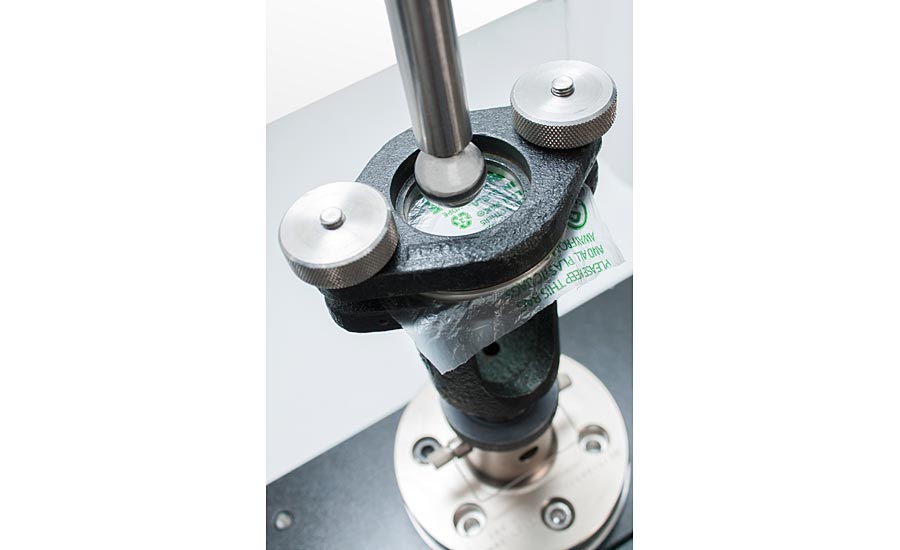
Pictured is an example of a plastic bag puncture test performed on an Instron dual column test system. Source: Instron
Puncture Test
Packaging is commonly subjected to lacerations or punctures during transport, or once in the hands of the consumer. ASTM F1306 is a standard widely used to test the penetration resistance of thin flexible barrier materials. Testing is performed with an upper probe mounted to the machine’s load cell that is then slowly moved down onto the clamped specimen until failure occurs. This standard can be modified to simulate specific end-use applications, or the recommended conditions can be followed closely to compare material performance.
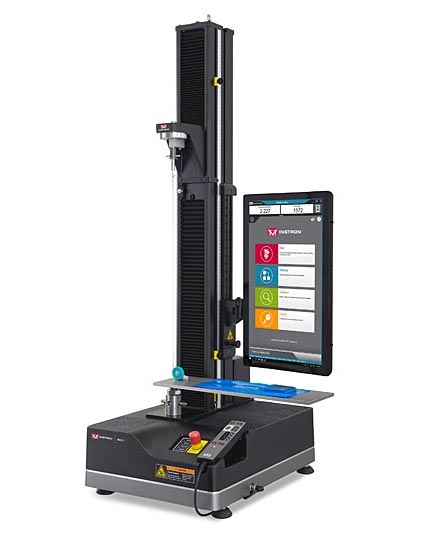
As the crosshead of the machine moves upward, the sled is pulled across the substrate. The frictional force, divided by the weight of the sled, is used to calculate the static and kinetic coefficients of friction for the material. Source: Instron
Coefficient Of Friction Test
ASTM D1894 and ISO 8295 are the predominant standards used for determining the coefficient of friction for thin films or plastic packaging materials. Testing is performed to establish both the static and kinetic friction values for the material when sliding over itself or other materials. As the machine crosshead acts in tension, a weighted sled is dragged across the material being tested to determine the coefficient of friction. These tests are typically performed for the purpose of quality control in film production.
Peel Test
T-peel tests, like ASTM D1876, are commonly used to evaluate the adhesive bonds that hold together the edges or seals of a plastic or paper package. In a T-peel test, the two free ends of the specimen are each clamped and pulled in tension. This testing helps manufacturers ensure that these seals will not burst during transit, likely ruining the product they contain.
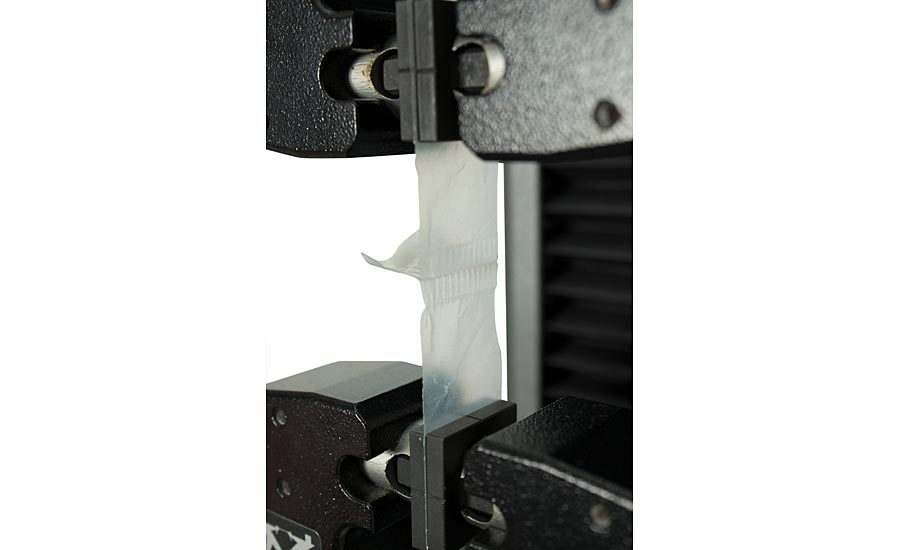
When performing a T-peel test, the primary calculations of interest are the maximum force and the average peel strength, calculated per width of the seal. Source: Instron
Tensile Test
A tensile test, or tension test, is the most basic and fundamental type of mechanical testing. As the test machine’s crosshead moves up, a pulling load is applied to the material, and the system measures the material’s response. From this data, the material’s strength and elongation can be determined.
Popular standards used for tensile testing are ASTM D882 and ISO 527-3 for plastic sheeting and films, or TAPPI T494 for paper and paperboard. Additionally, TAPPI T456 is also commonly used to standardize specimen conditioning for wet tensile strength testing of paper and paperboard. Results are then compared to those from dry testing to determine a percent strength reduction. For both paper and plastic, a simple tensile test can be used as a quality control measure to ensure the materials meet internal criteria, or for comparison purposes.
Tensile Testing Recommendations
The most common specimen geometry used for testing thin films or plastic or paper sheeting is a rectangular strip of consistent width as opposed to a dumbbell or dog bone shape. Testing rectangular strips of material presents several challenges, primarily that the absence of a reduced section increases the stress concentration at the point where the jaws grip the specimen. The recommended gripping solutions for these types of tests are aimed at reducing these stress concentrations and enabling specimen breaks in the center of the gage length. For many applications, a jaw break may indicate an early specimen failure and lead to results that do not fully represent the properties of the material. However, ASTM D882 states that if results from jaw breaks are comparable to those for specimen failure in the middle of the gage length, the results are acceptable. This is a good rule of thumb across all of these tests.
For the testing of paper and plastic strips, pneumatic side action grips with line contact jaw faces are widely used. These faces contain a single flat face and a single face with a semi-circular surface. The single line of contact produces a smaller contact area and helps prevent the material from thinning and slipping out of the grips during testing. However, the single contact line can create a high stress concentration, and all these standards acknowledge that depending on the material these may not be the optimal solution, in which case smooth faces should be used. Pneumatic side action grips are best here, as they provide a consistent clamping pressure throughout testing as thin films or plastics tend to thin as they elongate.
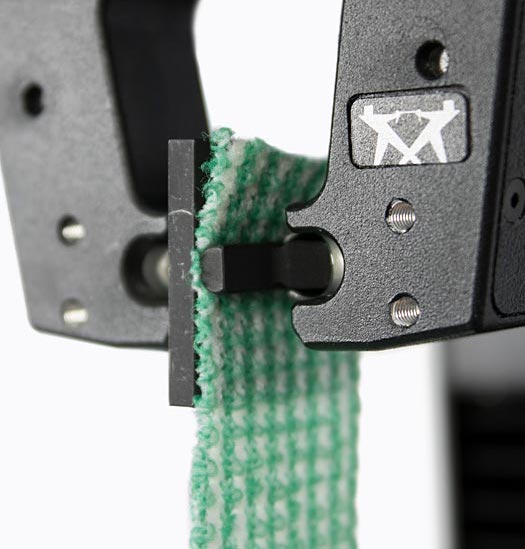
Line contact jaw faces, shown here clamping a textile specimen, are widely used for testing paper or plastic strips of packaging material. Source: Instron

This instrument uses red polarizing light, so the camera lens perceives the specimen and marks as either white, black, or grey. The higher the contrast between the marks and the specimen, the easier it is for the extensometer to track strain. Source: Instron
Finally, ASTM D882 does not require an extensometer; it allows for crosshead displacement to be used to measure strain. On the other hand, ISO 527-3 requires a class 1 extensometer to fully adhere to the standard. However, both standards do mention the need for an extensometry solution that does not stress the specimen or cause the specimen to bear the weight of the extensometer. TAPPI T494 does not require an extensometer, but manufacturers may choose to use one to obtain the most accurate strain data. Again, the weight of an extensometer on a paper specimen should be avoided, so an optical extensometer is the best solution across the board here. Optical extensometers use an internal camera to identify and track marks applied to the specimen to calculate strain. They are typically integrated with the system software so that results are accessible and can be viewed easily. Video extensometry eliminates any external weight applied to the specimen and ensures that the strain measured only represents the change in length of the specimen itself.
Conclusion
As the trend of single use paper and plastic packaging products continues to expand, a universal testing machine is a worthwhile investment for manufacturers to evaluate raw material properties and functional performance of their products. Especially as more sustainable recycled materials are developed that can replace some single-use plastics and papers, completely understanding their properties and how they compare to other materials is essential to ensure quality in the field. Mechanical testing of packaging materials is critical to ensuring that they hold up to the demands of real-world use, and that the products they protect reach the end user undamaged.
Meredith Bernstein is an applications engineer at Instron. For more information, email [email protected] or call (781) 575-5000.
Looking for a reprint of this article?
From high-res PDFs to custom plaques, order your copy today!