Have you ever heard the expression “that is not the way we do things here!” Paradigm paralysis is one of the most prevalent—and least recognized—barriers to innovation in modern industry.
TRIZ, or Theory of Inventive Problem Solving, is a methodology developed by Genrich Altshuller in the mid-20th century to creatively solve engineering and technical problems. It posits that innovation follows predictable patterns, utilizing tools derived from the study of patents.
Luc Burgard, a leader in pharmaceutical manufacturing with experience in biotechnology and automotive sectors, highlights the importance of data analytics in strategic decision-making and shares insights on building specialized teams using Minitab.
Offering a major advantage over conventional ultrasonic testing, PAUT provides 2D image representations of flaws in a weld as opposed to a mere A-scan signal that could be challenging to interpret.
How can we make products that need critical material/dimensional performance and are also of a size that becomes very difficult to rapidly and economically produce?
The manufacturing industry has seen major upheaval over the past few years. From supply chain disruption to worker shortages, keeping the pipeline filled with quality products – free of defects – has been no easy challenge. Because of these issues, the promise of Industry 4.0, or smart manufacturing, has never been more important.
While COVID dampened demand early on, the skills gap and labor shortage that has plagued the industry for more than a decade is still in full swing. As new NDT methods advance, quality professionals require new training, and technicians transitioning from film techniques to non-film techniques need hands-on experience.
Inspection plays a critical role during all phases of product development and implementation, making UT methods an enabling technology for new AM applications.
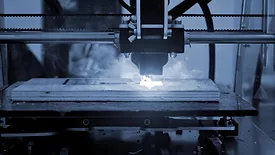
Although additive manufacturing (AM) already plays a significant role in product design and prototyping, advancing the methodology for industrial applications depends on reliable inspection technology, particularly for safety-critical parts and structures.
Today’s modern quality software technologies use advanced, yet simple, analysis tools to provide actionable information at a higher level, than older technology allowed for.