The Portable Leeb Test Turns 35
As the portable Leeb hardness test celebrates its 35th anniversary, Leeb is the most widely used portable hardness testing method.

As seen in this application, Leeb testers are often used on huge parts. Source: Proceq
As the portable Leeb hardness test celebrates its 35th anniversary, Leeb is the most widely used portable hardness testing method. It has become one of the top four hardness tests alongside the traditional methods of Rockwell, Brinell and Vickers.
Hardness testing is one of the oldest and probably the most commonly applied quantitative inspection method for metallic materials. One reason for this is that hardness itself is a useful material parameter. Another is that there are more or less direct correspondences between hardness and other important material properties that are much more difficult to measure directly, such as tensile strength, yield strength or fatigue behavior. Finally, unexpected hardness values also may indicate undesired changes of microstructure, for instance, close to welds.

Variants of Leeb testers provide great flexibility. In the field of macro hardness testing, the Leeb method is now third after Rockwell C and Brinell. Source: Proceq
Traditional Hardness Tests
The property hardness of a metallic material is vaguely defined as the resistance of a material to permanent deformation. This means that hardness is not a physical quantity in the strictest sense, but rather the outcome of a well-defined deformation process. At the beginning of the 20th century, several practical methods were designed to quantify metal hardness, the most popular being Rockwell, Brinell and Vickers. In all of these, hard test tips are pressed into the material under defined loads, and deformation parameters are measured, such as the indentation depth or the diameter of the indentation mark. Usually, a simple formula correlates these deformation parameters with a hardness unit, such as HRC, HBW10/3000 and HV30.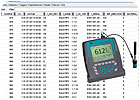
Automated data recording and even remote controlled hardness tests enhance
efficiency and minimize the risk of human errors. Source: Proceq
Invention of Leeb Hardness
In 1975, Dietmar Leeb and Dr. Marco Brandestini invented an alternative hardness test method and hardness tester. An impact body of mass m with a hard-ball tip is accelerated by a spring toward the material surface and hits the material at velocity vI, corresponding to the kinetic energy ½mvI². The impact body bounces back with velocity vR, which is lower than vI due to the loss of kinetic energy used for the plastic deformation of the material (½mvR² = ½mvI² - Wpl, where Wpl is the plastic deformation work). The harder the material, the smaller the loss of kinetic energy and the greater the velocity ratio vR/vI. The velocities of the impact body shortly before (vI) and shortly after impact (vR) are measured inductively. The scaled ratio HL = 1000 · vR/vI produces the Leeb hardness number.Benefits of Leeb Tests
The Leeb method has become popular over the years. In the field of macro hardness testing, it is now third after Rockwell C and Brinell.The most important reason behind the spread of Leeb is the size of the Rockwell, Brinell and Vickers benchtop machines. Specimens need to be taken to the traditional benchtop testers, whereas Leeb testers are small, portable instruments that can be used directly on the work piece on the factory floor or outdoors.
With traditional hardness testers, the objects under test must be small and plane. In practice, samples must often be cut off from work pieces. In contrast, Leeb testers can measure hardness on large objects with complicated geometries and curved surfaces. Also, modern Leeb testers permit measurements not only vertically downwards, but in any direction. This adaptability means that Leeb hardness testing remains virtually nondestructive, while a Rockwell or Brinell test requires scrapping the object after the test.
Material-Specific Solutions
Repeatability and accuracy of the genuine Leeb testers is comparable to high-end benchtop testers. For example, the high repeatability can easily be observed when measuring in a small area on a test block that has homogeneous hardness. The highest accuracy is found when the hardness is reported in the original Leeb scales, HL.Major users such as those in the steel-making and the automotive industries use the HL units more and more frequently to eliminate the additional uncertainty that can arise when converting to other scales. The measurement uncertainty of genuine HL results can be calculated much more easily and is much smaller than for converted hardness numbers.
However, conversion functions from HL to other scales become handy when customers specify the work piece hardness, for example, in Rockwell’s HRC scale. Some Leeb testers offer a large number of such conversions. Each conversion function is applicable to a group of materials that exhibit similar physical parameters, such as a similar Young’s modulus and creep behavior. Provided the material group is selected correctly, conversion errors will not normally exceed ±2 HRX for Rockwell scales, and ±10% for Brinell hardness number (HB) and Vickers pyramid number (HV). (HRX in this case stands for Rockwell hardness scales in general, where X is the wildcard. This means that in general, for all 30 Rockwell scales, the maximum error for conversion is 2.) In most cases, the conversion error is significantly lower.
If higher accuracy is required, or if the alloy under test is not covered by one of the built-in conversions, high-end testers provide a variety of methods to generate material-specific conversions.
Probes Provide Flexibility
Several types of impact devices suit specific fields of application.The D probe often is seen as the general-purpose impact device and thus most widely used. Its impact body carries a tungsten carbide ball with a 3-millimeter diameter that hits the surface with an impact energy of 11.5 millijoules (mJ). The D probe works best when the surface roughness is Ra ≤ 2 microns (N7). The DC and DL devices are essentially identical, but have shorter and longer nozzles, respectively, so that confined spaces can be accessed, such as in narrow vessels or bore holes. The S and the E devices are equipped with especially hard tips for testing on extremely hard surfaces, such as rolls.
The applicability of the Leeb devices is limited by the dynamic measuring principle, which requires the sample to have a minimum mass and thickness. For D, DC, DL, S and E devices, specimen dimensions ideally exceed 5 kilograms and 25 millimeters. However, they can be tested down to 0.1 kilogram and a few millimeters when special precautions are taken.
In addition, the C probe is available, with an impact energy 3 mJ. Work pieces down to 1.5 kilograms and 10-millimeter thickness can be tested easily, while lighter samples and sheets down to 1-millimeter thickness are measurable with precautions. For the C probe, data scatter increases once Ra ≥ 0.4 micron.
In contrast to the C device, the G impact device applies an impact energy of 90 mJ with a test tip of 5 millimeters in diameter. It is designed for rougher (Ra ≤ 7 microns, N9) and more inhomogeneous surfaces as found on cast steel parts. Parts should ideally have greater than 15 kilograms and greater than 70-millimeter thickness.
Standardized Hardness Test
Since 1975, this test method also has been standardized in international bodies under the name Leeb/Equotip hardness test, and guidelines for users are available.As with traditional hardness test methods, standards require verification of the instruments on test blocks. Before each working shift, the instrument should be checked on a test block with hardness not far from the hardness of the work piece. If desired, block and instrument calibrations are available traceable to the German national institute.
Thirty-five years after its introduction, Leeb has become one of the top hardness tests. The instruments and test methods are still popular, as customers seek to increase testing efficiency and reach new applications. Q
Tech tips
- Hardness testing is one of the oldest and probably the most commonly applied quantitative inspection method for metallic materials.
- The property hardness of a metallic material is vaguely defined as the resistance of a material to permanent deformation.
- In addition, unexpected hardness values may indicate undesired changes of microstructure, for instance, close to welds.
Looking for a reprint of this article?
From high-res PDFs to custom plaques, order your copy today!