Case Studies: Automated Latch Effort Inspection
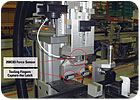
Pneumatic
actuators present the load cell tooling fingers to the latch. The latch is then
cycled a few times to “break-in” the components. Source: PCB Piezotronics Inc.
Eastern Automation Systems (Farmingdale, NJ) designs and builds custom assembly and inspection machines. The machines range from simple manual tools to fully automated assembly lines. Eastern places a large emphasis on quality by integrating inspection tasks directly into the assembly process. All machine motion is controlled with endpoint sensors, and all components assembled are 100% inspected in-process for presence, color, orientation and function.
A large part of the machine control software is dedicated to validating all inputs of each cycle of the assembly process, which ensures robust machine operation for many cycles within an industrial environment. A recent automated assembly line for a plastic over-molded, spring steel, automotive glove box latch was designed with a latch effort inspection station that required measuring small forces in-process. However, the machine and operators can cause high overloads as part of normal machine use. Thus the customer required a force sensor that was durable enough for the environment, yet sensitive enough for the required measurement.
Inspection Station
The inspection station is one of 12 placed around a carousel-style, asynchronous assembly machine. The assembly must pass several inspection criteria including an automatic pull test to measure the human effort required to pull up on the latch, just as one would encounter when they open up the glove box in an automobile. In order to perform this inspection, a strain gage load cell with an analog output is typically used.
Pneumatic actuators present the load cell tooling fingers to the latch. The latch is then cycled a few times to “break-in” the components. On the last pull cycle, the analog reading of the load cell input is sampled, compared to controls limits and stored in the system’s controller.
The customer stated the following inspection criteria: an inspection rate of one inspection every 3.5 seconds; inspection load range of 8 to 25 Newtons, with ±1 resolution (latch handle style dependent); control parameters of lower limit, upper limit, scale (calibration) factor, quantity bad in a row to stop machine.
How to Measure?
An ideal sensor choice was a 45 Newton, 2 millivolts per volt (mV/V) strain gage load cell. However, in normal machine use, an intermittent condition occurred that generated high-impact loads perpendicular to the measuring axis of load cell. This impact force exceeded the 150% safe overload range of the load cell and resulted in failure.
The most common failure mode of a strain gage load cell is the application of force beyond the yield point of the strain gage flexure (safe overload range). A typical 2.225 kilonewtons strain gage load cell has an overload limit of 3.3 kilonewtons, equivalent to 150%. Overloading the load cell usually causes permanent damage to the flexure, which results in a zero shift, nonlinearity or complete failure.
Quartz piezoelectric force sensors are typically an order of magnitude stiffer than strain gage load cells of an equivalent full-scale capacity. A quartz piezoelectric force sensor reacts to stress, resulting in a miniscule strain, to produce its charge output. They have stiffness on the order of 1.05 to 23 kilonewtons per micron (kN/µm), which means there is virtually no deflection during measurement. Most have a compressive strength of 4.351 x 10⁴ psi, which allows massive overloading without the risk of crushing the sensor. Even when the sensor is overloaded beyond its stated capacity, they suffer no ill effects, zero-shift, fatigue or linearity change. For example, PCB Piezotronics Inc.’s (PCB, Depew, NY) model 208C03, with a capacity of 2.2 kilonewtons and a diameter of 16 millimeters, the maximum compression of 22 kilonewtons is equivalent to 1,000% over-range protection. Additionally, the sensors are designed for harsh industrial environments with hermetically sealed, stainless steel housings.
“The main reason that we use PCB is for their excellent technical support,” says Scott Bellows, president of Eastern Automation Systems. “The sensors were easy to use and interface with, robust and industrialized, accurate and repeatable.”
For the customer’s latch effort application, a 2.2 kilonewton quartz piezoelectric force sensor was therefore used in order not to damage the force sensor. Why not simply select a 2.2 kilonewton strain gage load cell? It is not the best solution for the application because of the low output sensitivity of a strain gage load cell. A strain gage load cell typically has a 2 mV/V sensitivity, and with a 10 Volt DC power supply, the full scale strain gage output would only be 20 millivolts. While the quartz piezoelectric technology allowed use of a sensor with a much higher capacity, hence a much higher tolerance for breakage, it also featured ICP sensor output. This type of output is a 5-volt signal directly from the sensor. The high voltage output of the ICP force sensor provides a significant benefit in terms of signal to noise ratio, especially since the application required a low force capacity-25 Newton-compared to the rated capacity, 2.2 kilonewtons.
Using the ICP sensor circuit, which is built inside the sensor, there is excellent measurement resolution. The 2.2 kilonewton force sensor that was required to survive the impacts had a broadband resolution of 0.022 Newton.
Calibration on the Machine
Another issue common to in-process monitoring applications is the complexity of a calibration routine. A calibration on the machine was simply not possible because of mechanical constraints of the tooling.
The quartz ICP quartz force sensor does not require the use of a dead-weight style calibration and a lengthy setup routine. Instead a master latch was used. This master latch was calibrated with a separate tension-measuring device. The master latch was then used to check the machine measurement and scale the ICP force sensor input in the machine controller.
A common sensor characteristic that makes most machine builders shy away from piezoelectric sensors is zero drift. Drift is a long-term zero-shift phenomenon encountered with traditional charge output piezoelectric force sensors. These older style piezoelectric force sensors require remote charge amplifiers, which are the source of the drift.
The ICP voltage output force sensor actually eliminates issues associated with this drift through AC coupling. Low frequency response for ICP force sensors acts like a highpass filter and may be tailored to a specific value to accommodate most high-speed in-process inspection machines. This AC coupled signal not only eliminates the drift issue, but it also allows for control simplification. Charge amplifiers require reset and control signals from the machine controller. Thus, since extra relays, wiring and programming are not required, the machine control becomes less confusing.
During machine runoff at the customer’s site, several sets of data were taken with the master latch and then both good and bad parts to verify the measuring system performance. Additionally, a comparison between the 45 Newtons and 2.2 kilonewtons ICP sensors was performed to verify that the higher capacity sensor would prove useful.
Using the master latch in the inspection station, the standard deviation for the 2.2 kilonewtons sensor was ±0.03 Newton, which was within the machine’s required resolution of ± 1.
The customer was able to use a sensor that survived the harsh industrial environment and provided the required resolution to ensure 100% in-process latch inspection.
PCB Piezotronics Inc., Force/Torque Division
(888) 684-0004
www.pcb.com
Reply 13
Benefits
- Eastern places a large emphasis on quality by integrating inspection tasks directly into the assembly process.
- All machine motion is controlled with endpoint sensors, and all components assembled are 100% inspected in process for presence, color, orientation and function.
- The sensor survived the harsh industrial environment and provided the required resolution to ensure 100% in-process latch inspection.
Looking for a reprint of this article?
From high-res PDFs to custom plaques, order your copy today!