Quality Innovations: Force Gage Fits the Bill
As
Mark-10’s (Copiague, NY) Series 5 force gage begins shipping this year, it is
the result of feedback from customers around the world.
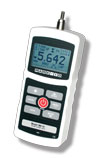
As Mark-10’s (Copiague, NY) Series 5 force gage begins shipping this year, it is the result of feedback from customers around the world.
The company wanted to introduce a new force gage that would offer sophisticated capabilities and ease of use, but at an affordable price. They had been discussing ideas on and off for years, and began working on it in earnest two years ago, according to sales and marketing manager Mark Fridman. As a result, the gage brings together many existing technologies into one package that previously had not been available in a force gage.
The sampling rate of 7,000 hertz produces accurate peak measurements, and the gage’s large backlit LCD-unique for the industry-makes it easier to read those measurements.
The reversible housing separates into two halves, which are joined together by gold-plated spring pins. This reversibility allows the load cell shaft to be pointing up or down, for handheld or test stand use. The menu navigation was designed so that an operator can use the gage without the user’s guide. However, the simplicity does not come at the expense of the instrument’s capability.
This $995 force gage competes against other force gages on the market, as well as more expensive materials testers and force testers that often are underutilized in the field, Fridman says. With respect to other force gages available in the marketplace, the Series 5 is one of the first to offer USB output, has the fastest peak capture rate in the industry and offers a number of features for its price bracket, says Fridman.
“These are pre-existing technologies,” Fridman says. “We didn’t invent USB, but we put that into a force gage. There are not too many others out there with USB built in.”
Still, force gages cannot be used for all applications, and do not take the place of a materials tester, which often is required for sophisticated testing of materials and components, Fridman points out. “A force gage’s functions, though sufficient for numerous applications,” he says, “do not take the place of a material tester, which offers high-resolution deflection indication as well as sophisticated software calculations and data management.”
But for applications up to 500 pounds with more basic production testing, “this is definitely fits the bill,” Fridman says.
Series 5 force gages can be used to assess the quality of a material, component or assembly across a range of industries. Typical applications include the testing of packaging materials, medical devices, automotive components, springs and wire assemblies.
Onboard data memory, go/no go indicators with outputs, statistical calculations and data outputs make this gage a useful tool in achieving quality control and analysis objectives.
Digital force gages are not the only way to measure force. Mechanical force gages are still readily available, and may be used as well; however, the functions are limited to observing the current force and peak force on an analog dial, Fridman says. A load cell with indicator also may be used for some applications, but this setup can be more expensive and difficult to set up.
Initial feedback from customers has been good, Fridman says, and they particularly like the look of the display with the large, visible numbers. Some sophisticated gages may show a lot of information but the main number, the current force reading, remains tiny. Though the display numbers are large, the gage itself is compact.
In creating the new force gage, the company wanted to keep what worked from their legacy gages-the overall dimensions, mounting pattern and ease of use-and add more features. The new Series 5 gage mounts the same way as previous gages, but offers a new platform, microprocessor and PC.
For more information, contact:
Mark-10 Corp.
11 Dixon Ave., Copiague, NY 11726
(888) MARK-TEN
[email protected]
www.mark-10.com
The
Series 5 force gage can be used to assess the quality of a material, component
or assembly across a range of industries. Source: Mark-10
As Mark-10’s (Copiague, NY) Series 5 force gage begins shipping this year, it is the result of feedback from customers around the world.
The company wanted to introduce a new force gage that would offer sophisticated capabilities and ease of use, but at an affordable price. They had been discussing ideas on and off for years, and began working on it in earnest two years ago, according to sales and marketing manager Mark Fridman. As a result, the gage brings together many existing technologies into one package that previously had not been available in a force gage.
The sampling rate of 7,000 hertz produces accurate peak measurements, and the gage’s large backlit LCD-unique for the industry-makes it easier to read those measurements.
The reversible housing separates into two halves, which are joined together by gold-plated spring pins. This reversibility allows the load cell shaft to be pointing up or down, for handheld or test stand use. The menu navigation was designed so that an operator can use the gage without the user’s guide. However, the simplicity does not come at the expense of the instrument’s capability.
This $995 force gage competes against other force gages on the market, as well as more expensive materials testers and force testers that often are underutilized in the field, Fridman says. With respect to other force gages available in the marketplace, the Series 5 is one of the first to offer USB output, has the fastest peak capture rate in the industry and offers a number of features for its price bracket, says Fridman.
“These are pre-existing technologies,” Fridman says. “We didn’t invent USB, but we put that into a force gage. There are not too many others out there with USB built in.”
Still, force gages cannot be used for all applications, and do not take the place of a materials tester, which often is required for sophisticated testing of materials and components, Fridman points out. “A force gage’s functions, though sufficient for numerous applications,” he says, “do not take the place of a material tester, which offers high-resolution deflection indication as well as sophisticated software calculations and data management.”
But for applications up to 500 pounds with more basic production testing, “this is definitely fits the bill,” Fridman says.
Series 5 force gages can be used to assess the quality of a material, component or assembly across a range of industries. Typical applications include the testing of packaging materials, medical devices, automotive components, springs and wire assemblies.
Onboard data memory, go/no go indicators with outputs, statistical calculations and data outputs make this gage a useful tool in achieving quality control and analysis objectives.
Digital force gages are not the only way to measure force. Mechanical force gages are still readily available, and may be used as well; however, the functions are limited to observing the current force and peak force on an analog dial, Fridman says. A load cell with indicator also may be used for some applications, but this setup can be more expensive and difficult to set up.
Initial feedback from customers has been good, Fridman says, and they particularly like the look of the display with the large, visible numbers. Some sophisticated gages may show a lot of information but the main number, the current force reading, remains tiny. Though the display numbers are large, the gage itself is compact.
In creating the new force gage, the company wanted to keep what worked from their legacy gages-the overall dimensions, mounting pattern and ease of use-and add more features. The new Series 5 gage mounts the same way as previous gages, but offers a new platform, microprocessor and PC.
For more information, contact:
Mark-10 Corp.
11 Dixon Ave., Copiague, NY 11726
(888) MARK-TEN
[email protected]
www.mark-10.com
Specifications
- The gage is portable and may be used in a wide range of applications and mounting configurations, such as handheld or test stand use, and is adaptable to custom-built machines and test rigs.
- The sampling rate of 7,000 hertz ensures that even in very quick action tests, such as ceramic and glass break testing, the true peak force will be accurately recorded.
- USB, RS-232, Mitutoyo Digimatic and analog outputs are all supplied for flexibility in data collection requirements.
- The housing is reversible so that the load cell shaft can be pointing up or down, as opposed to force gages where the display itself is reversible, but the keypad labels become upside down.
- It has data memory for 1,000 data points with statistical calculations and output to a PC.
- Force capacities are available from 50 grams up to 500 pounds.
Looking for a reprint of this article?
From high-res PDFs to custom plaques, order your copy today!