Quality Magazine logo
search
cart
facebook twitter linkedin youtube
  • Sign In
  • Create Account
  • Sign Out
  • My Account
Quality Magazine logo
  • NEWS
  • PRODUCTS
    • FEATURED PRODUCTS
    • SUBMIT YOUR PRODUCT
  • CHANNELS
    • AUTOMATION
    • MANAGEMENT
    • MEASUREMENT
    • NDT
    • QUALITY 101
    • SOFTWARE
    • TEST & INSPECTION
    • VISION & SENSORS
  • MARKETS
    • AEROSPACE
    • AUTOMOTIVE
    • ENERGY
    • GREEN MANUFACTURING
    • MEDICAL
  • MEDIA
    • A WORD ON QUALITY PUZZLE
    • EBOOK
    • PODCASTS
    • VIDEOS
    • WEBINARS
  • EVENTS
    • EVENT CALENDAR
    • IMTS
  • DIRECTORIES
    • BUYERS GUIDE >
      • Supplier Insights
    • NDT SOURCEBOOK
    • VISION & SENSORS
    • TAKE A TOUR
  • INFOCENTERS
    • Digital Quality Management Systems
    • NEXT GENERATION SPC & QUALITY ANALYTICS
  • AWARDS
    • ROOKIE OF THE YEAR
    • PLANT OF THE YEAR
    • PROFESSIONAL OF THE YEAR
  • MORE
    • Expert Columns
    • NEWSLETTERS
    • QUALITY STORE
    • INDUSTRY LINKS
    • SPONSOR INSIGHTS
  • EMAG
    • eMAGAZINE
    • ARCHIVES
    • CONTACT
    • ADVERTISE
  • SIGN UP!

Quality 101: Thread Gages
By Dan Plodzeen
September 1, 2010
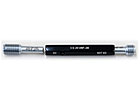
Taperlock style (000 to 1.5 inches diameter sizes only): These gages have a tapered shank behind the threaded portion. They are firmly pressed into an aluminum handle that has a matched tapered hole. New gage members can be inserted into the existing handle. Source: Gage Assembly Co


All objects have some sort of connective facet holding them together. In the case of vehicles, machinery, medical devices or industrial valves, that connective element often consists of various nuts, bolts and component parts that must be assembled.

What makes these items function the way they are supposed to is their “thread.” Design engineers pick specific types of threads that will best suit the function of the finished product. Specific threads are chosen to pull, push, regulate, fasten, mount or permanently hold. A thread is a superior form of fastening that offers a much stronger hold when stressed near limits.
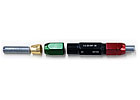


style (000 to 0.75 inch sizes only): These gages are a completely threaded pin and are held in an aluminum handle with a collet and a brass bushing. After one end of the gage is worn, the member can be reversed and the unused portion is now a new gage. Source: Gage Assembly Co.

Thread Gage Basics

In uses where each nut, bolt or part component has to support equal stress or weight, it is particularly important that the load be borne over the entire object. The time to figure out whether that will happen is before the object is tested, and this action is best accomplished by standardized sizes and strengths for all connecting hardware that can be verified.

Most threads have dimensions that correspond to a specific standard. Industry adheres to the standards by American National Standards Institute (ANSI), Japanese Institute of Standards (JIS), British Standards Institute (BS) and the German Institute of Standardization (DIN).

What happens if one cannot verify those attributes? The worst-case scenario is non-assembly or scrap. Part failure and breakage also could occur.


Trilock style (starting 7⁄8 up to 8 inches): Any thread plug gage over 1.5 nominal size is normally supplied in this style. These gages, like reversible style, can be reversed and re-installed on the handle “locking” it in place with a bolt and the three protruding nibs on the handle. Source: Gage Assembly Co.

Consider a car. Exactly how confident would you be driving a vehicle that was held together with a variety of nonconforming nuts, screws and bolts? Thread gages, in short, allow mass-produced threaded components to be gaged for uniform tolerance, which means strength, reliability and overall durability.

Depending on the item to be measured, there are several fixed limit gages that assist in the measurement process. Gages must be used to measure both the internal and external threads in order to comply with the class of fit as specified on the component drawing.

Fixed limit thread gages are the most popular measuring device on the market due to their reliability, cost effectiveness and ease-of-use. Machine operators and inspectors use them throughout assembly and at final inspection for quality assurance.


Thread ring gages (#0 to 15 inches): Adjustable style threaded rings are called “AGD” style in the U.S. Their blank lengths and finished dimensions are standardized by ANSI. All no-go rings are designated by a recessed band around the knurled portion. Source: Gage Assembly Co.

Working and Master Gages

Working gages allow an operator to check and verify the correct size and pitch diameter of the external and internal thread. These gages are intended to be accurate to millionths of an inch, essential for such sensitive uses on aircraft, spaceships and equipment that take on big stress loads, and they must be manufactured to gagemakers’ tolerances that are published by ANSI.

Thread plug gages, which are manufactured to ANSI standards for length and dimensions, include:

  • Go Thread Plug. Common to all classes of thread, checks pitch, lead and angles, but not the minor diameter. Identified by nominal size, threads per inch, series and go pitch diameter, for example; 250-20 (¼-20)UNC GO P.D. 0.2175, a thread plug gage should enter the full threaded length of the product internal thread completely and should never be forced with a wrench.

  • No-go Thread Plug. Sometimes called HI and is made to the maximum pitch diameter of the internal thread. The major diameter of a no-go is flattened or truncated, allowing the flanks of the gage to check the maximum geometric pitch diameter.

    The no-go should never enter the product thread or be forced. Some inspectors will allow the no-go to enter the part for three threads and then stop. It also is important to know that the no-go working thread plug is shorter in length than the go.
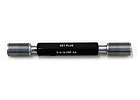


  • Master setting plug. Source: Gage Assembly Co.

    Thread Ring Gages

    Thread ring gages need to be calibrated with another measuring gage called a master plug or setting plug that checks and re-checks the calibration of the original gage.

    Go thread rings check all elements of the external thread, except the major diameter and should be set to its corresponding master setting plug set at “W” tolerance. The no-go thread ring checks the part at the minimum material pitch diameter. The part should not enter the no-go ring and should not be forced. Some inspectors use the rule that the no-go ring can go on the part for three threads and then stop. If doubts about the part’s low limit acceptability occur, then gaging by variables and/or direct measurement of the part should be considered.

    Master gages are often referred to as setting plugs, master or reference gages and wear check plugs. They are made to closer tolerances than working gages. Truncated setting plugs are used to set or calibrate adjustable style rings.

    Master gage blocks, master or setting discs and setting rings are types of master gages used to calibrate or set micrometers, comparators or other gaging systems.
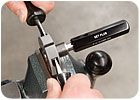


    How to set an adjustable thread ring. Source: Gage Assembly Co.

    Common Terms

  • Pitch Diameter. The pitch diameter on a straight thread is the diameter of the pitch cylinder. In a theoretically perfect thread, the pitch line, parallel to the part axis, is located where the widths of the thread ridge and the thread groove are equal. Pitch diameters marked on thread gages represent the maximum and minimum pitch diameters of the product external or internal threads.

  • Go and No-Go. These terms describe gages that are used to determine whether a part is usable or unusable. A “go” gage would correctly determine whether a part can be used, and a “no-go” would successfully determine a defective part.

  • Class X Tolerance. All working gages are made to these gagemakers’ tolerances. Example: ¼ -20 UNC -2B Go pitch diameter 0.2275+0.0003 (+0.0003 is the class X tolerance). A high limit for this gage is 0.2278.

  • Class W Tolerance. All setting plugs are made to these gagemakers’ tolerances. Example: ¼-20 UNC -2A Go pitch diameter 0.2164 - 0.0001.


    Gages are always identified to their corresponding nominal major diameter and threads per inch:


    Examples - Series
    5/16-18 UNC - Unified National Coarse
    5/16-24 UNF - Unified National Fine
    5/16-32 UNEF - Unified National Extra Fine
    5/16-20 UN - Unified National
    5/16-36 UNS - Unified National Special


    In order to increase life cycle of a thread gage, make sure to always use the correct class of fit and tolerance disposition. Also clean the gage after each use by applying oil or another suitable form of anti-rust formula to prevent damage to the external diameter.

  • Share This Story

    Looking for a reprint of this article?
    From high-res PDFs to custom plaques, order your copy today!

    Dan Plodzeen is president of Gage Assembly Co. (Lincolnwood, IL). For more information, e-mail [email protected] or visit www.gageassembly.com.

    Recommended Content

    JOIN TODAY
    to unlock your recommendations.

    Already have an account? Sign In

    • 2024 Quality Rookie of the Year Justin Wise 1440x750px banner with "Quality Rookie of the Year" logo inset

      Meet the 2024 Quality Rookie of the Year: Justin Wise

      Justin Wise is an exceptional individual who has been...
      Aerospace
      By: Michelle Bangert
    • Man with umbrella and coat stands outside while it rains at night looking at a building.

      Nondestructive Testing: Is there an ethics problem?

      I was a whistleblower who exposed fraudulent activities...
      NDT
      By: Dale Norwood
    • Unraveling Deflategate: Football stadium with closeup of football on field

      Unraveling the Tom Brady Deflategate

      The Deflategate scandal erupted following the 2014 AFC...
      Measurement
      By: Greg Cenker and Henry Zumbrun
    Manage My Account
    • eMagazine Subscriptions
    • Newsletters
    • Online Registration
    • Subscription Customer Service
    • Manage My Preferences

    More Videos

    Sponsored Content

    Sponsored Content is a special paid section where industry companies provide high quality, objective, non-commercial content around topics of interest to the Quality audience. All Sponsored Content is supplied by the advertising company and any opinions expressed in this article are those of the author and not necessarily reflect the views of Quality or its parent company, BNP Media. Interested in participating in our Sponsored Content section? Contact your local rep!

    close
    • Key Takeaways for Quality Leaders
      Sponsored byComplianceQuest

      Key Takeaways for Quality Leaders from the 2026 Gartner Magic Quadrant™ for QMS

    • This image shows a person seated next to a Bobcat T66 compact track loader.
      Sponsored byPolyWorks by InnovMetric

      Supercharging Digital Gauging at Bobcat North America

    • Dorsey Calibration Lab photo by Tom LaBarbera Picture this Studios
      Sponsored byDorsey Metrology International

      Ensuring Product Quality in a Competitive Manufacturing Landscape

    Popular Stories

    This image shows a person seated next to a Bobcat T66 compact track loader.

    Supercharging Digital Gauging at Bobcat North America

    Dorsey Calibration Lab photo by Tom LaBarbera Picture this Studios

    Ensuring Product Quality in a Competitive Manufacturing Landscape

    a professional in the aviation field performing maintenance, repair, and overhaul (MRO) work

    Manufacturing Retention: Strategies for Improving Company Culture, Engagement and Skill Development

    2026 Quality Professional of the Year!

    Events

    June 22, 2026

    Automate 2026

    Automate is North America's largest robotics and automation event — and the best place to take your ideas from insight to impact.
     
    Our show floor features the world’s leading automation solutions, from AI and robotics to motion control, vision systems, and more. Plus, our educational conference is second to none, led by the brightest minds in automation today.
     
    Ready to transform the way you work? Take the next step at Automate.
    July 14, 2026

    Quality Leaders Forum: Better Communication, Better Quality Data

    The Quality Leaders Forum is a quarterly, editor-moderated fireside chat series hosted by Quality Magazine, featuring candid conversations with senior manufacturing and operations executives shaping enterprise-level quality.

    View All Submit An Event

    Products

    Lean Manufacturing and Service Fundamentals, Applications, and Case Studies

    Lean Manufacturing and Service Fundamentals, Applications, and Case Studies

    See More Products
    Quality Podcast Channel Custom Content

    Related Articles

    • Other Dimensions: Thread Gages or Thread Comparators?

      See More
    • Thread Gages

      See More
    • Gage Assembly

      Gage Assembly thread gages

      See More

    Related Directories

    • Thread Check Inc.

      Thread Check Inc. is a full-service gage company offering a complete line of precision thread plug and ring gages, plain plug and ring gages, custom gauges, 3-wire thread measuring systems, API pipe gages, thread comparators, thread engineering software, gear measuring wires, measuring instruments, cutting tools, and calibration services.
    ×

    Stay in the know with Quality’s comprehensive coverage of
    the manufacturing and metrology industries.

    Newsletters | Website | eMagazine

    JOIN TODAY!
    • RESOURCES
      • Advertise
      • Contact Us
      • Directories
      • Manufacturing Division
      • Store
      • Want More
    • SIGN UP TODAY
      • Create Account
      • eMagazine
      • Newsletters
      • Customer Service
      • Manage Preferences
    • SERVICES
      • Marketing Services
      • Market Research
      • Reprints
      • List Rental
      • Survey/Respondent Access
    • STAY CONNECTED
      • LinkedIn
      • Facebook
      • YouTube
      • X (Twitter)
    • PRIVACY
      • PRIVACY POLICY
      • TERMS & CONDITIONS
      • DO NOT SELL MY PERSONAL INFORMATION
      • PRIVACY REQUEST
      • ACCESSIBILITY

    Copyright ©2026. All Rights Reserved BNP Media, Inc. and BNP Media II, LLC.

    Design, CMS, Hosting & Web Development :: ePublishing