Quality Magazine logo
search
cart
facebook twitter linkedin youtube
  • Sign In
  • Create Account
  • Sign Out
  • My Account
Quality Magazine logo
  • NEWS
  • PRODUCTS
    • FEATURED PRODUCTS
    • SUBMIT YOUR PRODUCT
  • CHANNELS
    • AUTOMATION
    • MANAGEMENT
    • MEASUREMENT
    • NDT
    • QUALITY 101
    • SOFTWARE
    • TEST & INSPECTION
    • VISION & SENSORS
  • MARKETS
    • AEROSPACE
    • AUTOMOTIVE
    • ENERGY
    • GREEN MANUFACTURING
    • MEDICAL
  • MEDIA
    • A WORD ON QUALITY PUZZLE
    • EBOOK
    • PODCASTS
    • VIDEOS
    • WEBINARS
  • EVENTS
    • EVENT CALENDAR
    • IMTS
  • DIRECTORIES
    • BUYERS GUIDE >
      • Supplier Insights
    • NDT SOURCEBOOK
    • VISION & SENSORS
    • TAKE A TOUR
  • INFOCENTERS
    • Digital Quality Management Systems
    • NEXT GENERATION SPC & QUALITY ANALYTICS
  • AWARDS
    • ROOKIE OF THE YEAR
    • PLANT OF THE YEAR
    • PROFESSIONAL OF THE YEAR
  • MORE
    • Expert Columns
    • NEWSLETTERS
    • QUALITY STORE
    • INDUSTRY LINKS
    • SPONSOR INSIGHTS
  • EMAG
    • eMAGAZINE
    • ARCHIVES
    • CONTACT
    • ADVERTISE
  • SIGN UP!

50 Years of Quality: The Pros and Cons of Optical Comparators
By Bill Fetter, Gary Hobart
January 1, 2011
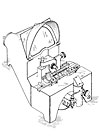
This is a picture of the venerable optical comparator from patent number 1,903,933, filed May 21, 1925. The fact that a modern comparator appears little different from one patented 85 years ago might raise several questions about their relevance. Source: Hexagon Metrology


The illustration pictured here should appear familiar to anyone who has spent any time in a quality control lab or on a factory floor. This is a picture of the venerable optical comparator from patent number 1,903,933, filed May 21, 1925. The fact that a modern comparator appears little different from one patented 85 years ago might raise several questions about its relevance.

The reason comparators have not changed much in 85 years is that the fundamental technology behind an optical comparator is elegantly simple, and it simply works. Since the physics behind optics have not changed, the only possible improvements in comparator technology will revolve around the quality of the optics themselves and the features added to the comparator to make taking measurements easier for the operator.

A good analogy for the principle behind an optical comparator is that it is somewhat similar to the old-school overhead projector. In fact, one can make a rudimentary comparator device with an actual overhead projector.

First, place any two-dimensional part on the stage of any overhead projector and project the image onto a large piece of paper taped to a wall. The resulting shadow projected on the paper can be outlined with a pen.

This pen outline becomes the reference to compare to any subsequent objects placed on the stage. If the parts do not match the drawing, they are not the same.


This optical comparator was manufactured by Jones & Lamson, (J&L, Springfield, VT). Optical comparators were developed by James Hartness, president of J&L, and Russell Porter, architect, engineer and astronomer who worked closely with Hartness. Source: American Precision Museum

Projection Basics

As a practical matter, we cannot really use an overhead projector to check parts. For one thing, if a projector is sitting on a cart, as most are, what happens if the cart is bumped or moved? The projection distance changes slightly, and as a result, the size of reference image on the wall is no longer accurate.

The basic concept of an optical comparator for quality control use is to take that idea of the overhead projector and package it all up inside a box so that the optical distance between the part and the screen is fixed, known and can be calibrated. A part is affixed to a stage, a light source shines on it, and the resulting shadow image of the part is magnified with lenses and bounced by mirrors, to be projected on the back of a screen for magnified viewing, pretty much just like the overhead projector example.

Based on the known magnification of the lenses, measurements of the part can be made directly off the screen, traditionally using a screen overlay or crosshairs as the reference point for projected points or edges. The operator centers a feature of interest on the crosshairs, records a point, then moves the image and records another point.

It is a process of taking multiple points that allows features such as circles, slots, radii and edges to be constructed mathematically. Typically this is done via a microprocessor-based digital display.

The size and magnification of the projected image on a comparator is dependent on the optics and screen size of the comparator itself-typical screen sizes range from 12 inches to 36 inches but ones up to 60 inches have been built.

However, the larger the screen size, the larger the enclosure becomes because a greater distance is required to throw the image. A comparator with an enormous screen is basically a giant, mostly empty box used to inspect small parts, as explained in the sidebar, “Pay No Attention to the Man Inside the Comparator.”


The advantage of a comparator is that it is straightforward to use for simple operations with relatively little training. Source: Hexagon Metrology

Straightforward, Easy-to-Use

The advantage of a comparator is that it is straightforward to use for simple operations with relatively little training. On the simplest comparator, an operator merely has to affix a part and move it with hand controls and observe the onscreen image. Advances in technology, such as computer displays that do the math automatically and remember all measured points, automatic triggering technologies and improvements in stage movement all have contributed to the venerable comparator continuing to serve a useful function in a quality lab.

If one reason for the continuing popularity of comparators is their basic simplicity, this also is their downfall.

As production parts become ever more complex, with more features to inspect to greater tolerances, with higher sampling rates or even 100% inspection, the advantages of the traditional comparator diminish significantly. The rise of vision-based inspection systems makes manual comparator technology, even equipped with modern capabilities, seem quaint in comparison.

This is particularly the case when the requirement is to inspect large quantities of parts at once, where the automation capabilities of a vision system make it the winner in speed and flexibility. Automatic moving stages, computer-aided design (CAD) programming capability, the ability to use multiple lighting techniques and 3-D inspection capabilities greatly surpass the limitations of traditional comparator technology.

So why would anyone still choose a comparator? For many simple, nonrepetitive tasks on two-dimensional parts with clearly defined edges, the optical comparator is still a great tool to have in the toolbox. As with any applied technology, knowing the correct tool to use and when to use it is essential.


Pay No Attention to the Man Inside the Comparator

Gary Hobart recalls an encounter from many years ago when he was servicing a monster 60-inch screen comparator. To adjust the optics inside a comparator, one had to open up the enclosure and work on the mechanism inside. With a comparator this large, one had to physically climb inside the enclosure to work on it. An unsuspecting quality inspector switched on the comparator to use it while Hobart was inside. The blinding light made Hobart scream and stand up, hitting his head on the roof of the enclosure, while the stunned inspector screamed a the sight of a shadowy figure of a man on the comparator screen.

Share This Story

Looking for a reprint of this article?
From high-res PDFs to custom plaques, order your copy today!

Bill Fetter is the director of marketing for Hexagon Metrology Inc. (North Kingstown, RI) and Gary Hobart is a sales manager for Vision products. For more information, call (847) 214-5234, e-mail [email protected] or visit www.hexagonmetrology.us.
Gary Hobart is global vision product manager at the Hexagon Metrology Precision Center (Elgin, IL). For more information, call (847) 931-0100, e-mail [email protected] or visit www.hexagonmetrology.us.

Recommended Content

JOIN TODAY
to unlock your recommendations.

Already have an account? Sign In

  • 2024 Quality Rookie of the Year Justin Wise 1440x750px banner with "Quality Rookie of the Year" logo inset

    Meet the 2024 Quality Rookie of the Year: Justin Wise

    Justin Wise is an exceptional individual who has been...
    Aerospace
    By: Michelle Bangert
  • Man with umbrella and coat stands outside while it rains at night looking at a building.

    Nondestructive Testing: Is there an ethics problem?

    I was a whistleblower who exposed fraudulent activities...
    NDT
    By: Dale Norwood
  • Unraveling Deflategate: Football stadium with closeup of football on field

    Unraveling the Tom Brady Deflategate

    The Deflategate scandal erupted following the 2014 AFC...
    Measurement
    By: Greg Cenker and Henry Zumbrun
Manage My Account
  • eMagazine Subscriptions
  • Newsletters
  • Online Registration
  • Subscription Customer Service
  • Manage My Preferences

More Videos

Sponsored Content

Sponsored Content is a special paid section where industry companies provide high quality, objective, non-commercial content around topics of interest to the Quality audience. All Sponsored Content is supplied by the advertising company and any opinions expressed in this article are those of the author and not necessarily reflect the views of Quality or its parent company, BNP Media. Interested in participating in our Sponsored Content section? Contact your local rep!

close
  • Key Takeaways for Quality Leaders
    Sponsored byComplianceQuest

    Key Takeaways for Quality Leaders from the 2026 Gartner Magic Quadrant™ for QMS

  • This image shows a person seated next to a Bobcat T66 compact track loader.
    Sponsored byPolyWorks by InnovMetric

    Supercharging Digital Gauging at Bobcat North America

  • Dorsey Calibration Lab photo by Tom LaBarbera Picture this Studios
    Sponsored byDorsey Metrology International

    Ensuring Product Quality in a Competitive Manufacturing Landscape

Popular Stories

This image shows a person seated next to a Bobcat T66 compact track loader.

Supercharging Digital Gauging at Bobcat North America

a professional in the aviation field performing maintenance, repair, and overhaul (MRO) work

Manufacturing Retention: Strategies for Improving Company Culture, Engagement and Skill Development

Dorsey Calibration Lab photo by Tom LaBarbera Picture this Studios

Ensuring Product Quality in a Competitive Manufacturing Landscape

2026 Quality Professional of the Year!

Events

June 22, 2026

Automate 2026

Automate is North America's largest robotics and automation event — and the best place to take your ideas from insight to impact.
 
Our show floor features the world’s leading automation solutions, from AI and robotics to motion control, vision systems, and more. Plus, our educational conference is second to none, led by the brightest minds in automation today.
 
Ready to transform the way you work? Take the next step at Automate.
July 14, 2026

Quality Leaders Forum: Better Communication, Better Quality Data

The Quality Leaders Forum is a quarterly, editor-moderated fireside chat series hosted by Quality Magazine, featuring candid conversations with senior manufacturing and operations executives shaping enterprise-level quality.

View All Submit An Event

Products

Lean Manufacturing and Service Fundamentals, Applications, and Case Studies

Lean Manufacturing and Service Fundamentals, Applications, and Case Studies

See More Products
Quality Podcast Channel Custom Content

Related Articles

  • 50 Years of Quality: Optical Comparators Go Digital

    See More
  • 50 Years of Quality: Handheld Gages-The Industry's Workhorse

    See More
  • 50 Years of Quality: A Superficial History of Surface Finish

    See More

Related Products

See More Products
  • certified.jpg

    The Certified Manager of Quality / Organizational Excellence Handbook, 4th Edition

  • principles of quality costs.jpg

    Principles of Quality Costs, Fourth Edition

See More Products

Events

View AllSubmit An Event
  • November 11, 2025

    Cutting the Cost of Quality With Industrial CT

    On Demand This webinar explores how industrial CT scanning transforms quality management by revealing internal flaws, reducing downtime, and eliminating costly scrap and rework.
View AllSubmit An Event

Related Directories

  • Suburban Tool Inc.

    Suburban Tool Inc. has 50+ years of experience in manufacturing the highest quality work holding products and inspection equipment. We offer a complete line of workholding & inspection devices including optical comparators, electronic height gages, digital readouts and hand-held measuring instruments. Visit us at www.subtool.com and on YouTube.com/SuburbanToolInc
  • Keyence Corp. of America

    KEYENCE is a distinguished worldwide developer and producer of factory automation equipment that includes sensors, vision systems, digital microscopes, and measurement systems. Our quality and metrology systems include the IM Series automated optical comparator, LM Series multisensor measurement system, XM Series portable, shop floor CMM, and WM Series wide-area CMM & handheld 3D scanner.
×

Stay in the know with Quality’s comprehensive coverage of
the manufacturing and metrology industries.

Newsletters | Website | eMagazine

JOIN TODAY!
  • RESOURCES
    • Advertise
    • Contact Us
    • Directories
    • Manufacturing Division
    • Store
    • Want More
  • SIGN UP TODAY
    • Create Account
    • eMagazine
    • Newsletters
    • Customer Service
    • Manage Preferences
  • SERVICES
    • Marketing Services
    • Market Research
    • Reprints
    • List Rental
    • Survey/Respondent Access
  • STAY CONNECTED
    • LinkedIn
    • Facebook
    • YouTube
    • X (Twitter)
  • PRIVACY
    • PRIVACY POLICY
    • TERMS & CONDITIONS
    • DO NOT SELL MY PERSONAL INFORMATION
    • PRIVACY REQUEST
    • ACCESSIBILITY

Copyright ©2026. All Rights Reserved BNP Media, Inc. and BNP Media II, LLC.

Design, CMS, Hosting & Web Development :: ePublishing