Quality Magazine logo
search
cart
facebook twitter linkedin youtube
  • Sign In
  • Create Account
  • Sign Out
  • My Account
Quality Magazine logo
  • NEWS
  • PRODUCTS
    • FEATURED PRODUCTS
    • SUBMIT YOUR PRODUCT
  • CHANNELS
    • AUTOMATION
    • MANAGEMENT
    • MEASUREMENT
    • NDT
    • QUALITY 101
    • SOFTWARE
    • TEST & INSPECTION
    • VISION & SENSORS
  • MARKETS
    • AEROSPACE
    • AUTOMOTIVE
    • ENERGY
    • GREEN MANUFACTURING
    • MEDICAL
  • MEDIA
    • A WORD ON QUALITY PUZZLE
    • EBOOK
    • PODCASTS
    • VIDEOS
    • WEBINARS
  • EVENTS
    • EVENT CALENDAR
    • IMTS
  • DIRECTORIES
    • BUYERS GUIDE >
      • Supplier Insights
    • NDT SOURCEBOOK
    • VISION & SENSORS
    • TAKE A TOUR
  • INFOCENTERS
    • Digital Quality Management Systems
    • NEXT GENERATION SPC & QUALITY ANALYTICS
  • AWARDS
    • ROOKIE OF THE YEAR
    • PLANT OF THE YEAR
    • PROFESSIONAL OF THE YEAR
  • MORE
    • Expert Columns
    • NEWSLETTERS
    • QUALITY STORE
    • INDUSTRY LINKS
    • SPONSOR INSIGHTS
  • EMAG
    • eMAGAZINE
    • ARCHIVES
    • CONTACT
    • ADVERTISE
  • SIGN UP!
Management

Management: ISO 9001 - Internal Quality System Audits

By Andrew Nichols
October 1, 2012

Internal Quality Audits are a requirement of ISO 9001 that rarely bring value to an organization past simply maintaining compliance to the standard. Despite
ISO 9001
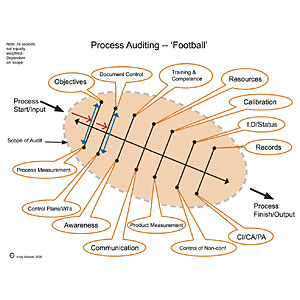
The Football is an example of process auditing applicable to a manufacturing process. Source: Andrew Nichols

their best efforts, even well-trained internal auditors may not be as effective as they could be.

So, how can an internal audit program bring the “Wow” factor and improve the overall performance of the organization, its management and the auditors? By adopting the following two key features focused on business concerns.

AUDIT SCHEDULING
Often in the early phases of implementation of an ISO 9001–based quality management system the focus of the internal audit program is to ensure that no significant issues are found during the Certification Body assessment. However, once found in compliance, the internal audits should be scheduled to ensure that their focus changes to give value to the organization as well as continuing compliance to the ISO standard. To do this, the scheduling of audits must be changed from a ‘push’ system, where audits are scheduled to an annual calendar, to one of a ‘pull’ or demand system, where they are scheduled according to managements’ needs.

The ISO 9001 requirements for internal audits (8.2.2) gives us a clue what might be considered when establishing an audit schedule, also called an audit program. It states, in part, “An audit program shall be established taking into consideration the status and importance of the processes to be audited.” This requirement gives us some opportunities to consider that all processes are not created equally, that some might need to be audited as a priority and possibly more frequently than others. So, how can an audit program meet these requirements and be value-added to an organization?

Let’s consider what’s meant by the status of the processes of the quality management system processes:

Status might include something being new and/or changed, performing below or above expectations. Having something new or changed associated with some function of the organization is frequently associated with causing problems with:

  • customers and requirements
  • suppliers
  • technology
  • regulations
  • process requirements
  • materials and equipment

These are normally considered to be risks to the business.

In fact, how many of us have heard that it’s not a good idea to by a new model car until after it’s been on the market for a year to ‘work the bugs out’? Likewise, a process not performing to expectations, causing scrap, rework, and downtime—in fact, any kind of waste—also is a risk. Got a process that exceeded its goal? Better find out why! Once the reason has been discovered, it could be used to improve other, similar processes.

In some cases, these are planned situations—including the new and changed aspects. Some, like poor performance, are unplanned. What could be done to give a priority to an audit of a new, changed or poorly performing process? This is where the importance of that process must be considered. We have to ask ourselves, is the process important to meeting:

  • customer needs and expectations
  • regulatory compliance
  • costs?

The importance of the process to the customer or other aspects of business can be considered as the impact of that process on the business.

Risk, and the effects of risk on customers, operation performance and regulatory compliance, are what keep management awake at night.

It is common for internal audit programs to be developed on an annual calendar that predicts which aspects of the quality management system are going to be audited. Often the objectives for developing the schedule are to ensure that all of the system is audited in that year, or to ensure all the ISO requirements are covered. However, since there is no requirement to schedule audits in this way, they often miss critical processes when they become a potential risk.
An annualized calendar forces audits of processes that are either not a high priority or before/after any problems transpire, instead of helping to identify what contemporary actions need to be taken to improve things. No wonder then, that in many organizations, the internal audit program is not well supported! Internal audits should be scheduled using current process performance data and feedback from customers to ensure that auditors are focused on what is on managements’ radar screen.

Internal audit management programs, scheduled based on risk and impact, can help usher in a new era synonymous with risk assessment and continual improvements, rather than something done simply for compliance.

AUDITING A PROCESS
Internal audits should be focused on the processes of the quality management system and recurring questions auditors have including:

  • “How do I audit a process?”
  • “Which processes should I start with?”
  • “How will I know if the process is effective?” 

A process can be defined as “activities which transform inputs into outputs.” One might add, “under controlled conditions,” since we usually want to be able to predict a (good) result! From this definition, we know a number of things about any given process, including that they have:

  • Input(s)
  • Output(s)
  • Activities
  • Controls

This is helpful, but heading off to do an internal audit with four topics on our checklist is unlikely to help us reveal if the process is working as intended. As auditors, we have to develop a better understanding of what an effective process requires to deliver a satisfactory outcome for the organization and its customers.

Most business processes have some form of goal or objective assigned to them, so that performance can be determined. This might be focused externally on customers’ needs or internally on the organization. It is common that these goals and objectives have a measurement associated with them. If the process is working effectively, it’s by these performance criteria that an auditor can tell what’s being achieved.

In addition, it’s desirable to produce a consistent result; therefore, the process must be under control. Most of us know the wailing sound (output) made by a loudspeaker when the microphone (input) is placed too close to that speaker—it’s called feedback! You can certainly measure the sound level, but the process is out of control! Our business processes need controls to ensure that things don’t get out of hand.
Process controls for the activities are accomplished in many ways:

  • People—competent, aware and trained
  • Equipment—maintained and calibrated, if necessary for measurement
  • Methods—procedures and work instructions, as necessary, under document control
  • Materials—approved, available, identified


In listing these control criteria, our list of audit topics has grown quickly. We also must consider some other controls that must be in place: documentation controls, non-conformance, records generated from the process, corrective/preventive actions and improvements.

The challenge of preparing for any audit is the sequence in which to place these controls so that we can gather useful information about the process, rather than just a number of facts, since creating a simple list of these topics is not as helpful. There are a number of ‘visual metaphors’ that have been used as tools to assist auditors. One unique approach has proven successful in helping auditors to organize these topics in an appropriate sequence—the Football©.

The use of this tool to ‘visualize’ the path an internal auditor should take when auditing a process has a number of advantages.

One such advantage is comprehensive planning, so that all relevant controls are considered, in their correct sequence (the Football is an example applicable to a manufacturing process). Another is the structure added to audit checklists or questions, they follow the appropriate process flow allowing information to be gathered and used later to verify performance.

It also can assist management with ensuring the assigned auditor(s) does the relevant research of those requirements and controls and develop better understanding of them before the audit interviews. The auditor has a ‘bigger picture’ to audit and is, therefore, more likely to see systematic issues and evaluate the risks that are of concern to management. Where risks are encountered, any audit reports requiring action are likely to get the fullest support and lead to the required improvements being made. 
 

Andrew Nichols is with NQA. 

KEYWORDS: auditing internal quality system ISO 9001 requirements

Share This Story

Looking for a reprint of this article?
From high-res PDFs to custom plaques, order your copy today!

Andy Nichols is managing partner of Quality-Nation Inc. and has more than 40 years’ experience in quality. He has been involved in the implementation of quality management systems since 1985 with experience in N.A.T.O “AQAP 1”, as well as the popular Quality standards ISO 9001, AS 9100 and IATF 16949.

Andy has 25 years of quality management consulting & training, including 16 years as senior consultant with Excel Partnership Inc. and seven years with the Michigan Manufacturing Technology Center, where he specialized in assisting small – medium sized manufacturers.

Clients served include Fortune 500 companies such as Ford, General Motors, Chrysler (now Stellantis), General Electric, Hewlett Packard, Hyundai Motor Manufacturing, GKN, Arvin Meritor, Magna Corporation. He has a number of successes with the unique needs of smaller manufacturers as well.

To ensure access to the most current information on quality management systems, Andy is an active member of the ISO Technical Committee, TC 176, which is responsible for authoring the ISO 9000 standards – the basis of both AS 9100 and IATF 16949. In addition, is a Fellow of the UK’s Chartered Quality Institute (CQP FCQI) and an “IRCA” Principal Auditor. He also holds a certification as an Exemplar Global “Certified Lead Trainer” and is a member of the ASQ. Andy has authored three books on quality management systems and auditing, published by ITG Publications and is a regular content creator for professional publications and LinkedIn. https://www.linkedin.com/in/andy-nichols-cqp-fcqi

Recommended Content

JOIN TODAY
to unlock your recommendations.

Already have an account? Sign In

  • 2024 Quality Rookie of the Year Justin Wise 1440x750px banner with "Quality Rookie of the Year" logo inset

    Meet the 2024 Quality Rookie of the Year: Justin Wise

    Justin Wise is an exceptional individual who has been...
    Aerospace
    By: Michelle Bangert
  • Man with umbrella and coat stands outside while it rains at night looking at a building.

    Nondestructive Testing: Is there an ethics problem?

    I was a whistleblower who exposed fraudulent activities...
    NDT
    By: Dale Norwood
  • Unraveling Deflategate: Football stadium with closeup of football on field

    Unraveling the Tom Brady Deflategate

    The Deflategate scandal erupted following the 2014 AFC...
    Measurement
    By: Greg Cenker and Henry Zumbrun
Manage My Account
  • eMagazine Subscriptions
  • Newsletters
  • Online Registration
  • Subscription Customer Service
  • Manage My Preferences

More Videos

Sponsored Content

Sponsored Content is a special paid section where industry companies provide high quality, objective, non-commercial content around topics of interest to the Quality audience. All Sponsored Content is supplied by the advertising company and any opinions expressed in this article are those of the author and not necessarily reflect the views of Quality or its parent company, BNP Media. Interested in participating in our Sponsored Content section? Contact your local rep!

close
  • Key Takeaways for Quality Leaders
    Sponsored byComplianceQuest

    Key Takeaways for Quality Leaders from the 2026 Gartner Magic Quadrant™ for QMS

  • This image shows a person seated next to a Bobcat T66 compact track loader.
    Sponsored byPolyWorks by InnovMetric

    Supercharging Digital Gauging at Bobcat North America

  • Dorsey Calibration Lab photo by Tom LaBarbera Picture this Studios
    Sponsored byDorsey Metrology International

    Ensuring Product Quality in a Competitive Manufacturing Landscape

Popular Stories

This image shows a person seated next to a Bobcat T66 compact track loader.

Supercharging Digital Gauging at Bobcat North America

Dorsey Calibration Lab photo by Tom LaBarbera Picture this Studios

Ensuring Product Quality in a Competitive Manufacturing Landscape

a professional in the aviation field performing maintenance, repair, and overhaul (MRO) work

Manufacturing Retention: Strategies for Improving Company Culture, Engagement and Skill Development

2026 Quality Professional of the Year!

Events

June 22, 2026

Automate 2026

Automate is North America's largest robotics and automation event — and the best place to take your ideas from insight to impact.
 
Our show floor features the world’s leading automation solutions, from AI and robotics to motion control, vision systems, and more. Plus, our educational conference is second to none, led by the brightest minds in automation today.
 
Ready to transform the way you work? Take the next step at Automate.
July 14, 2026

Quality Leaders Forum: Better Communication, Better Quality Data

The Quality Leaders Forum is a quarterly, editor-moderated fireside chat series hosted by Quality Magazine, featuring candid conversations with senior manufacturing and operations executives shaping enterprise-level quality.

View All Submit An Event

Products

Lean Manufacturing and Service Fundamentals, Applications, and Case Studies

Lean Manufacturing and Service Fundamentals, Applications, and Case Studies

See More Products
Quality Podcast Channel Custom Content

Related Articles

  • Female engineer and a male technician investigate the problem of the operation of the robot arm in the factory.

    Will the Next ISO 9001 Change Require More Training?

    See More
  • an industrial engineer in a manufacturing facility

    Through a Glass Darkly: A Sneak Peek at ISO/DIS 9001:2025

    See More
  • man at a computer

    Remote Quality Management System Audits: An ISO 9001 Auditor’s Perspective and Lessons Learned

    See More

Related Products

See More Products
  • 118122.jpg

    ISO 9001:2015 Internal Audits Made Easy, Fourth Edition

  • louis hannigan.jpg

    The Non-Idiot's Guide to ISO 9001:2015: Understanding and Using the Quality Management System Standard to your benefit

  • H1517.jpg

    A Practical Field Guide For ISO 9001:2015

See More Products

Events

View AllSubmit An Event
  • January 15, 2026

    Navigating QMSR, ISO 9001 Updates, and AI Integration

    On Demand This session guides you through preparing your organization for these changes, incorporating AI-driven solutions to ensure your quality management system remains future-ready and resilient.
View AllSubmit An Event

Related Directories

  • Quality System Consultants

    We have experience developing and maintaining quality systems and have a commitment to the relentless improvement of the regulatory systems of our clients. Whether you are a startup or an established firm, Quality System Consultants can help you implement a range of quality management systems. We have: • Built inspection procedures and testing methods to improve efficiency • Achieved ISO 13485 certifications for clients ahead of schedule • Managed compliance for Class I through Class III medical devices • Averaged a 10-1 return on investment on projects we're involved with • Been voted 7th by Quality Magazine for continuous improvement to quality systems and contribution to bottom-line profitability. Unlike some of the competition, we aren't interested in stacking up billable hours at the expense of your project. We succeed when you succeed, and we're committed to solving the problems you bring to us. If you want an experienced, dedicated firm to work with you through an otherwise intimidating regulatory environment, you want to call Quality System Consultants.
×

Stay in the know with Quality’s comprehensive coverage of
the manufacturing and metrology industries.

Newsletters | Website | eMagazine

JOIN TODAY!
  • RESOURCES
    • Advertise
    • Contact Us
    • Directories
    • Manufacturing Division
    • Store
    • Want More
  • SIGN UP TODAY
    • Create Account
    • eMagazine
    • Newsletters
    • Customer Service
    • Manage Preferences
  • SERVICES
    • Marketing Services
    • Market Research
    • Reprints
    • List Rental
    • Survey/Respondent Access
  • STAY CONNECTED
    • LinkedIn
    • Facebook
    • YouTube
    • X (Twitter)
  • PRIVACY
    • PRIVACY POLICY
    • TERMS & CONDITIONS
    • DO NOT SELL MY PERSONAL INFORMATION
    • PRIVACY REQUEST
    • ACCESSIBILITY

Copyright ©2026. All Rights Reserved BNP Media, Inc. and BNP Media II, LLC.

Design, CMS, Hosting & Web Development :: ePublishing